Brainwave Entrainment: Hacking Neural Oscillations
The Brain's Rhythmic Symphony
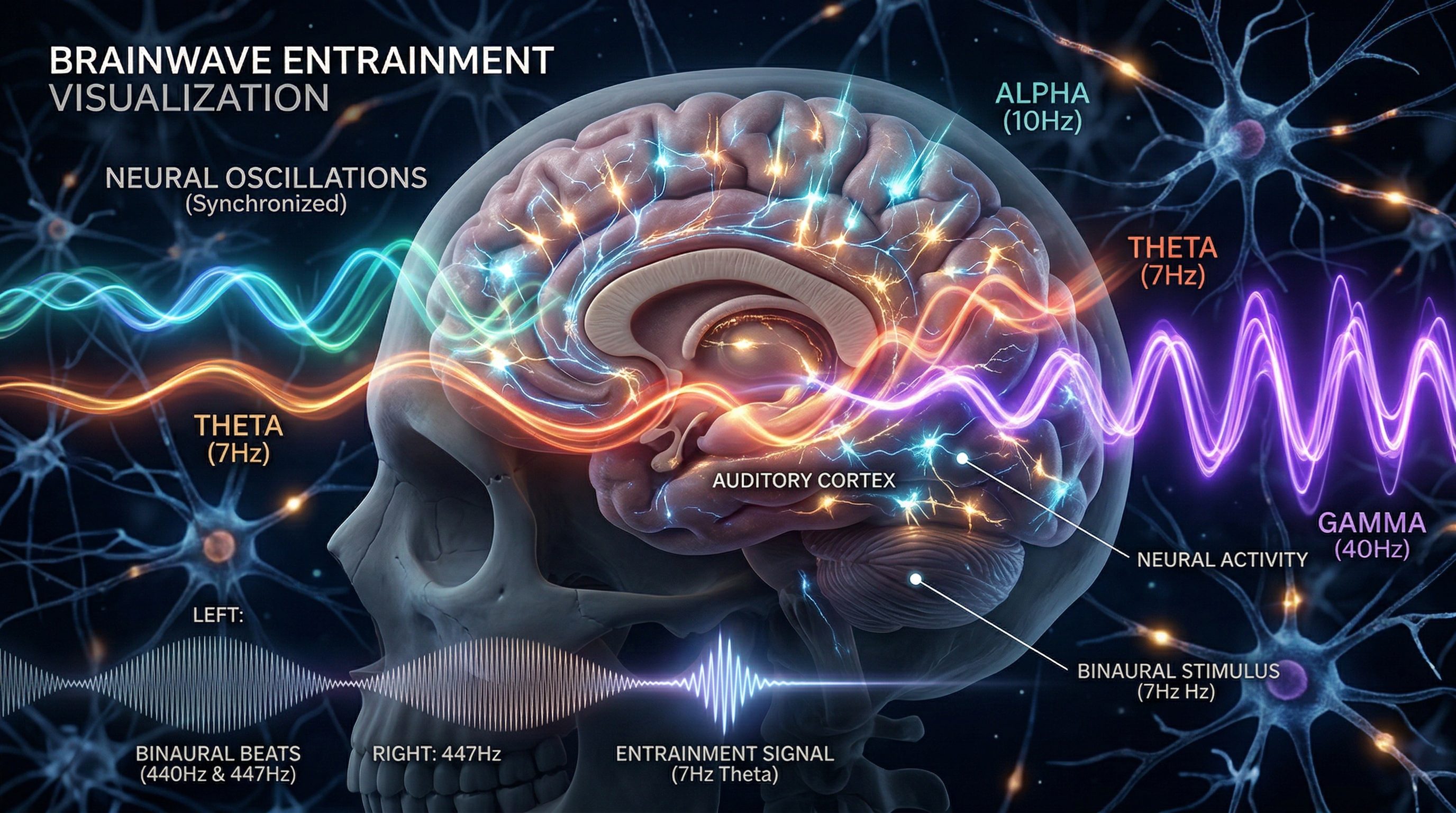
Your brain is not a static organ—it's a dynamic orchestra of electrical activity. Neurons fire in coordinated patterns called brainwaves, rhythmic oscillations that shape consciousness, cognition, and consciousness itself. These brainwaves aren't just neurological noise; they're the very fabric of your mental experience.
From the frenetic energy of high-frequency gamma waves (30-100 Hz) associated with peak cognition and binding, to the slow, dreamy delta waves (0.5-4 Hz) of deep sleep, your brain cycles through distinct frequency bands that correlate with specific mental states. The science of brainwave entrainment leverages this natural property by introducing external rhythmic stimuli that can guide your brain toward target states—like tuning a radio to a specific frequency.
But does it actually work? The answer is more nuanced than marketing claims suggest. Let's dive into the neuroscience, the evidence, and practical protocols you can use today.
Understanding Brainwave Frequency Bands
Before we can hack brainwaves, we need to understand what we're hacking:
The Five Primary Brainwave States
- Delta (0.5-4 Hz) — Deep, dreamless sleep, healing, access to unconscious material
- Theta (4-8 Hz) — Deep relaxation, meditation, creativity, hypnagogic states, memory consolidation
- Alpha (8-12 Hz) — Relaxed wakefulness, flow states, stress reduction, mind-body integration
- Beta (12-30 Hz) — Active thinking, focus, problem-solving, alertness (divided into low/band/beta and high beta)
- Gamma (30-100 Hz) — Peak cognition, insight, binding of sensory information, heightened awareness
Healthy brains flexibly transition between these states. Modern life, however, often traps us in maladaptive patterns—chronic low-grade beta stress or difficulty falling into theta during meditation. Entrainment offers a pathway to reset these patterns.
The Mechanism: How Entrainment Works
Neural entrainment (or the frequency following response) occurs when your brain's electrical activity synchronizes with an external rhythmic stimulus. This isn't magic—it's biophysics. Neural populations have resonant frequencies, and when exposed to sufficiently strong rhythmic input, they tend to oscillate in phase with that input.
The mechanism works through multiple pathways:
- Auditory pathway: Sound frequencies stimulate the auditory cortex and brainstem nuclei, which project to thalamic pacemakers that coordinate cortical oscillations.
- Visual pathway: Flickering light activates the retina, then travels via the geniculostriate pathway to the visual cortex and beyond.
- Thalamic gating: The thalamus acts as a rhythm generator, coordinating large-scale brain networks through synchronized bursts.
Method 1: Binaural Beats
Binaural beats are the most accessible form of brainwave entrainment. Here's how they work:
The Science of Binaural Beats
When you hear a tone of frequency X in your left ear and a tone of frequency Y in your right ear (with X ≠ Y), your brainstem creates a third, phantom tone at the difference frequency (|X - Y|). This illusion only occurs when the two tones are kept separate—hence the need for stereo headphones.
For example: Left ear = 300 Hz, Right ear = 310 Hz = Perceived binaural beat at 10 Hz (alpha range).
Clinical Evidence:- Relaxation & Anxiety: Multiple meta-analyses confirm alpha-range binaural beats (8-12 Hz) reduce subjective anxiety and stress markers. A 2024 randomized controlled trial found 30-minute daily sessions over one month significantly increased theta power and improved mood scales.
- Sleep: Theta and delta-range binaural beats shown to reduce sleep onset latency and improve sleep quality in randomized trials with insomniac patients.
- Memory & Cognition: Mixed evidence. A massive 2023 study (n=920) found no cognitive benefit during learning tasks—performance was identical to pink noise or silence. However, theta entrainment post-learning may enhance memory consolidation.
- Creativity: A 2024 pilot study found theta binaural beats improved divergent thinking tasks and psychological well-being among university students.
Caution: Theta-range binaural beats may impair performance on high-alert tasks. Using them during complex problem-solving or driving could be counterproductive. Match the frequency to your intended state.
Method 2: Isochronic Tones
Isochronic tones differ from binaural beats in a crucial way: they're pulsed single tones rather than bichromatic stimuli. Rather than presenting two tones simultaneously, you hear a single tone that turns on and off at a specific frequency.
Advantages of Isochronic Tones:- No headphones required (can be played through speakers)
- Stronger entrainment effect (sharper onsets create more distinct neural response)
- No special binaural processing needed in the brainstem
Isochronic tones tend to produce more robust entrainment than binaural beats because the amplitude modulation is more pronounced. Research suggests they can shift brainwave patterns more quickly and reliably, particularly in the gamma range.
Method 3: Photic Stimulation (Flickering Light)
Photic driving or visual entrainment uses rhythmic light flicker to synchronize visual cortex oscillations, which then spread to other brain networks. This is the oldest form of brainwave entrainment, with roots in ancient trance practices and modern therapeutic applications.
Applications:- Gamma entrainment: Recent research (2023-2024) has shown 40 Hz light flicker can reduce amyloid plaques in Alzheimer's models and improve cognitive function in preclinical studies.
- Migraine prophylaxis: Specific flicker frequencies can reduce migraine frequency, though certain frequencies may trigger attacks in photosensitive individuals.
- Epilepsy considerations: People with photosensitive epilepsy must use extreme caution—flicker can trigger seizures at certain frequencies (typically 15-20 Hz).
Safety Note: Never use photic stimulation while driving, operating machinery, or in any situation requiring stable visual focus. Always sit or lie down during light stimulation sessions.
Practical Protocols for Different Goals
Protocol 1: Focus & Deep Work (Beta Entrainment)
- Frequency: 14-20 Hz (low-to-mid beta)
- Duration: 20-45 minutes
- Best time: Morning or early afternoon (before 4 PM to avoid sleep disruption)
- Method: Isochronic tones preferred; can use binaural beats with headphones
- Protocol:
- Set up a distraction-free workspace
- Begin with 5 minutes of unstructured focus (get into the zone)
- Start entrainment stimulus (volume at comfortable level, not distracting)
- Begin your deep work task
- Taper off 5 minutes before session end
Protocol 2: Sleep & Relaxation (Theta/Delta Entrainment)
- Frequency: 4-6 Hz for Theta (relaxation), 1-3 Hz for Delta (deep sleep)
- Duration: 30-60 minutes
- Best time: 1-2 hours before bedtime or during naps
- Method: Binaural beats or isochronic tones; very low volume
- Protocol:
- Begin routine 30 minutes before desired sleep time
- Dim lights and eliminate blue light exposure
- Start with a brief meditation or breathing exercise
- Begin entrainment and lie comfortably
- Set timer to auto-stop or use tracks with sleep ramps
- Don't fight sleep—the point is to let go
Protocol 3: Meditation & Inner Work (Theta Entrainment)
- Frequency: 6-8 Hz (theta borderland)
- Duration: 20-40 minutes
- Best time: Morning or during dedicated practice sessions
- Method: Either binaural beats or isochronic tones
- Protocol:
- Set up a comfortable meditation position
- Begin with 3 minutes of breath awareness to settle the body
- Start the theta entrainment stimulus
- Engage in your meditation practice (mindfulness, visualization, loving-kindness, etc.)
- The entrainment makes theta state more accessible; don't force it
- Close with 2 minutes of unstimulated awareness
Protocol 4: Creativity & Flow (Theta-Alpha Border)
- Frequency: 8-10 Hz (alpha to theta transition)
- Duration: 30-60 minutes
- Best time: When engaging in creative tasks
- Method: Isochronic tones often work best for this application
- Protocol:
- Begin with divergent thinking warm-ups (brainstorming, free writing)
- Start alpha/theta entrainment
- Engage in creative work that benefits from reduced inner criticism
- Use entrainment to access "flow state" more reliably
- Journal insights post-session
Protocol 5: Cognitive Enhancement (Alpha-Gamma Entrainment)
- Frequency: Alpha (8-12 Hz) for baseline enhancement; Gamma (40 Hz) for attention/insight
- Duration: Alpha sessions 20-30 min; Gamma 10-20 min
- Best time: Pre-study or pre-cognitive work
- Caveat: Evidence is mixed; use as adjunct to proven cognitive strategies
Clinical Research: What the Evidence Shows
The body of research on brainwave entrainment continues to grow, but it remains a controversial field. Here's an evidence-based summary:
| Outcome | Quality of Evidence | Consensus |
| Relaxation/Anxiety Reduction | Strong (multiple RCTs) | Effective for most people |
| Sleep Onset & Quality | Moderate | Consistently helpful for sleep |
| Attention & Focus (acute) | Mixed | May help or hinder depending on task |
| Memory Consolidation | Emerging | Promising but not conclusive |
| Creativity/Insight | Limited | Anecdotal strong, scientific limited |
| Therapeutic Applications | Emerging | Promising for depression, PTSD |
The Placebo Question: A 2023 large-scale study questioned whether binaural beats work beyond placebo for cognitive enhancement. The answer likely depends on the outcome: subjective effects (relaxation, mood) may be partially placebo-driven, but objective measures (EEG theta power increases) suggest genuine neural entrainment occurs.
Safety, Contraindications, and Best Practices
Who Should Avoid Entrainment:
- People with photosensitive epilepsy (for photic stimulation)
- Those with severe psychiatric conditions without medical supervision
- Anyone operating vehicles or heavy machinery during sessions
- People with certain cardiac conditions (discuss with physician)
Best Practices:
- Start slow: Begin with 10-15 minute sessions to assess response
- Hydration: Entrainment is metabolically active; drink water afterward
- Integration: Use entrainment as a tool, not a crutch; pair with lifestyle factors
- Individual variation: Some people are non-responders; others are hypersensitive
- Volume matters: Keep at comfortable, non-distracting levels
- Consistency: Effects are often cumulative; daily practice > occasional sessions
The Future of Neural Oscillation Science
Brainwave entrainment sits at the intersection of neuroscience, psychology, and consciousness studies. Emerging research avenues include:
- 40 Hz gamma entrainment for Alzheimer's: Recent trials show promise for reducing amyloid and tau pathology
- Personalized frequency matching: Using EEG to determine optimal individual frequencies rather than one-size-fits-all protocols
- Combined modalities: Pairing auditory and visual entrainment for synergistic effects
- Neurofeedback integration: Real-time entrainment adjustments based on ongoing brain state monitoring
Bottom Line
Brainwave entrainment is not magic, but neither is it mere hype. The science is nuanced: robust evidence for relaxation and sleep, mixed findings for cognitive enhancement, and emerging research for therapeutic applications.
The most effective use of entrainment is as a tool for state modulation—a way to more reliably access the brainstates you need for different tasks. Use it strategically: theta for meditation and sleep, alpha for relaxation and flow, beta for focus, and experiment cautiously with gamma.
Your brain has an extraordinary ability to find rhythm. Learn to listen, and you may discover that the key to optimal mental states is already within reach.
This content is for educational purposes only and is not medical advice. Consult healthcare professionals for medical concerns.