Heart Rate Variability and Coherent States: The Science Behind Heart-Brain Harmony
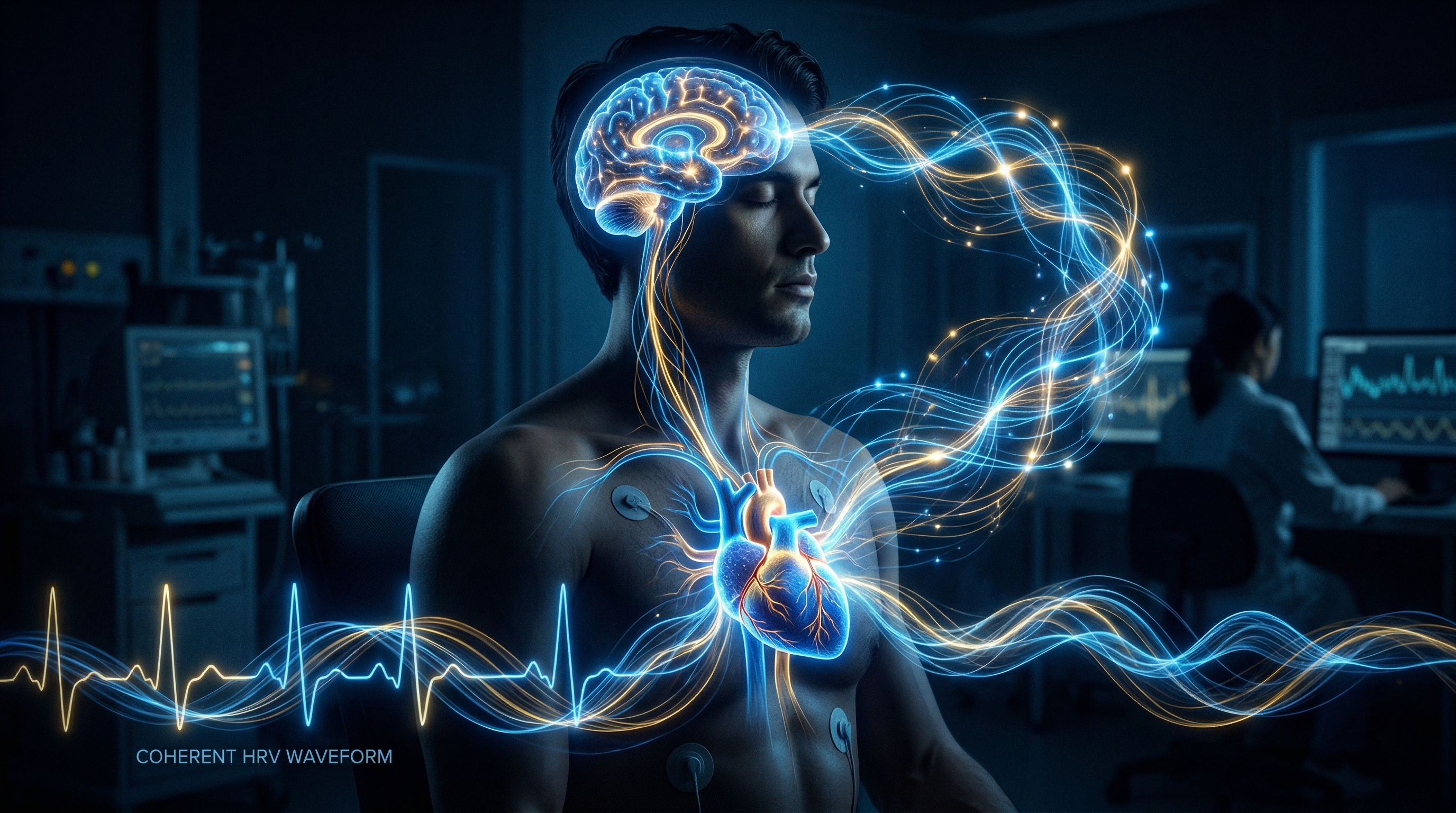
Introduction to Heart Rate Variability
While traditional medicine has long viewed heart rate as a simple measure of cardiovascular health, cutting-edge research reveals that the variation between heartbeats—known as Heart Rate Variability (HRV)—is actually one of the most powerful biomarkers of overall health, resilience, and adaptive capacity. Unlike a consistent beeping metronome, your healthy heart beats with beautiful irregularity, and this irregularity is a sign of vitality, not pathology.
The difference between heartbeats is not noise—it's signal. HRV represents your body's ability to flexibly respond to internal and external stresses.
HRV measures the time variation between consecutive heartbeats, typically expressed in milliseconds (ms). When you see an HRV reading of 50ms, it means the average variation between your heartbeats is 50 milliseconds. Higher HRV generally indicates better autonomic nervous system function, greater stress resilience, and enhanced capacity for recovery and adaptation.
The Autonomic Nervous System: Your Body's Regulatory Balance
Understanding HRV requires understanding the autonomic nervous system (ANS), which operates beneath conscious awareness to regulate heart rate, blood pressure, digestion, and countless other vital functions. The ANS has two primary branches:
- Sympathetic nervous system: The "fight or flight" system that accelerates heart rate, increases blood pressure, and mobilizes energy for action
- Parasympathetic nervous system: The "rest and digest" system that slows heart rate, promotes relaxation, and facilitates restoration and recovery
Optimal health depends on the dynamic interplay between these systems. High HRV indicates a flexible ANS that can rapidly shift between sympathetic activation when needed and parasympathetic dominance during rest. Low HRV suggests autonomic rigidity—either chronic sympathetic dominance (burnout, anxiety, hypertension) or insufficient sympathetic activation (fatigue, depression, cardiovascular risk).
HeartMath Institute: Pioneering Heart-Brain Coherence Research
The HeartMath Institute, founded in 1991 by cardiologistDoc Childre, has conducted groundbreaking research demonstrating that the heart is not merely a pump but an intelligent organ that communicates with and influences the brain. Their research has revealed several counterintuitive findings:
The Heart's Electromagnetic Field
The heart generates the body's largest and most powerful rhythmic electromagnetic field. This field:
- Extends several feet outside the body and can be detected with sensitive magnetometers
- carries information about emotional state through its frequency patterns
- Can influence others within its field—meaning your emotional state physically radiates outward
- Is approximately 100 times greater in amplitude than the brain's electromagnetic field
Coherent vs. Incoherent Heart Rhythms
HeartMath researchers have identified two distinct patterns of heart rhythm:
Incoherent pattern: Occurs during stress, anger, frustration, or anxiety. The heart rhythm becomes jagged and irregular, with chaotic patterns that interfere with efficient blood flow and communication with the brain. During incoherence, cognitive performance declines, decision-making suffers, and the immune system becomes suppressed.
Coherent pattern: Occurs during positive emotional states like appreciation, love, and care. The heart rhythm forms a smooth, sine-wave-like pattern that optimizes cardiovascular efficiency, enhances cognitive function, and reduces stress hormones. This coherence can be consciously cultivated through specific techniques.
Heart-Brain Communication Pathways
The heart communicates with the brain through four primary mechanisms:
- Neural pathways: The heart has an intrinsic nervous system (the "little brain") containing over 40,000 sensory neurons. It sends more signals TO the brain than it receives FROM the brain
- Pressure waves: The heart creates a pressure wave that travels through the circulatory system faster than thought—about 20 feet per second, reaching the brain in approximately 2.5 seconds
- Biochemical signals: The heart releases hormones like atrial natriuretic peptide (ANP) that affect brain function
- Electromagnetic signaling: As mentioned, the heart's electromagnetic field provides real-time information to the brain and surrounding individuals
Breathing Practices for HRV Optimization
One of the most accessible and effective methods for increasing HRV and generating heart coherence is through specific breathing practices. The respiratory system directly influences heart rate through a phenomenon called respiratory sinus arrhythmia (RSA)—the natural increase in heart rate during inhalation and decrease during exhalation.
Coherent Breathing Technique
HeartMath researchers have identified an optimal breathing rate for generating coherence: approximately 5-6 breaths per minute (roughly 5 seconds inhale, 5 seconds exhale, with no pause at the top or bottom). This "coherent breathing" technique:
- Maximizes HRV by synchronizing breathing with the cardiovascular system's natural rhythms
- Activates the parasympathetic nervous system through stretch receptors in the lungs and heart
- Generates high-amplitude oscillations in blood pressure, heart rate, and HRV
- Produces the smooth, sine-wave pattern characteristic of heart coherence
Progressive Implementation
Week 1-2: Practice 10 minutes of coherent breathing twice daily. Focus on smooth, effortless breathing without straining.
Week 3-4: Increase duration to 20 minutes twice daily. Begin practicing during mildly stressful situations to build resilience.
Month 2+: Integrate coherent breathing into daily life. Many practitioners report the ability to achieve coherence within 60-90 seconds, even during challenging circumstances.
Advanced Respiratory Techniques
In addition to coherent breathing, several other respiratory practices enhance HRV:
- Holotropic breathing: Rapid, deep breathing patterns that can induce altered states and profound emotional release
- Wim Hof method: Combines breathing exercises with cold exposure to build stress resilience and immune function
- Nadi Shodhana: Alternate nostril breathing from traditional yoga, which balances left and right brain hemispheres
- Box breathing: 4-count inhalation, 4-count hold, 4-count exhalation, 4-count hold—used by Navy SEALs for stress management
Practical Applications and Health Benefits
Regular HRV optimization and coherence practice delivers measurable benefits across multiple domains:
Cardiovascular Health
Multiple studies demonstrate that coherence practice:
- Reduces blood pressure in pre-hypertensive and hypertensive individuals
- Improves lipid profiles and reduces inflammatory markers
- Decreases risk of cardiovascular events
- Enhances cardiovascular efficiency and reduces strain
Cognitive Performance
Heart coherence optimizes brain function by:
- Increasing alpha wave production in the brain (associated with relaxed alertness)
- Improving decision-making and problem-solving abilities
- Enhancing emotional regulation and impulse control
- Increasing creativity and intuitive insight
Emotional Well-being
Coherence practice directly influences emotional regulation:
- Reduces symptoms of anxiety and depression
- Increases positive emotional states and life satisfaction
- Improves relationships through enhanced emotional communication
- Builds resilience to stress and trauma
Measuring and Tracking HRV
Modern technology has made HRV monitoring accessible to everyone. Several methods are available:
Chest Strap Monitors
Devices like the Polar H10 and Garmin EDR provide the most accurate HRV measurements by detecting the electrical signals between heartbeats. These recommend for serious practitioners who want detailed, actionable data.
Wearable Devices
Apple Watch, Oura Ring, and Whoop use optical sensors to estimate HRV. While slightly less precise than chest straps, they provide excellent trend data and are more convenient for continuous monitoring.
Mobile Applications
HeartMath's InnerBalance, Elite HRV, and other apps work with wearable devices to provide real-time feedback on heart rhythm patterns, helping users learn to generate coherence on demand.
The Neuroscience of Heart Coherence
Recent neuroimaging studies have revealed the profound impact of heart coherence on brain function:
Enhanced Prefrontal Cortex Function
The prefrontal cortex—the brain's executive center responsible for decision-making, emotional regulation, and long-term planning—receives direct input from the heart. During coherence, fMRI studies show increased blood flow and metabolic activity in prefrontal regions, explaining the enhanced cognitive performance observed during coherent states.
Reduced Amygdala Activity
The amygdala, the brain's threat detection center, shows decreased activation during heart coherence. This explains why coherence practice reduces anxiety and improves emotional regulation—the heart literally signals to the brain that the environment is safe.
Improved Functional Connectivity
EEG studies demonstrate that coherence practice increases connectivity between brain hemispheres and between limbic and cortical regions, creating a more integrated and efficient neural network.
Beyond the Individual: Collective Coherence
HeartMath's research extends beyond individual benefits. Their Global Coherence Initiative explores how collective heart coherence might influence global systems:
- During major global events where large numbers of people simultaneously focus on positive intentions, measurable changes in geomagnetic activity and earthquake patterns have been observed
- Group coherence sessions in schools have improved academic performance and reduced behavioral problems
- Workplace coherence interventions have increased productivity, collaboration, and employee well-being
Conclusion: Integrating Heart Wisdom
Heart rate variability represents far more than a number on a fitness tracker—it's a window into your fundamental capacity for resilience, adaptation, and well-being. Through understanding and cultivating heart-brain coherence, you gain access to a powerful tool for transforming your physiology, psychology, and ultimately your experience of reality itself.
The heart has been called the seat of consciousness, the center of intuition, and the bridge between body and spirit. Modern science now confirms these ancient wisdom traditions: the heart is indeed an intelligent organ that, when operated in coherence, creates the optimal conditions for human flourishing.
The future of wellness isn't just about managing stress—it's about consciously generating coherent states that optimize health, enhance performance, and deepen our connection to ourselves and the world around us.
Whether you use coherent breathing for five minutes in the morning, implement workplace interventions on a larger scale, or study the profound implications of collective consciousness, you're participating in one of the most exciting frontiers of human development: understanding how we can consciously engineer our internal states to create the conditions for health, wisdom, and love to flourish.