Microtubules and the Quantum Mind
Microtubules and the Quantum Mind
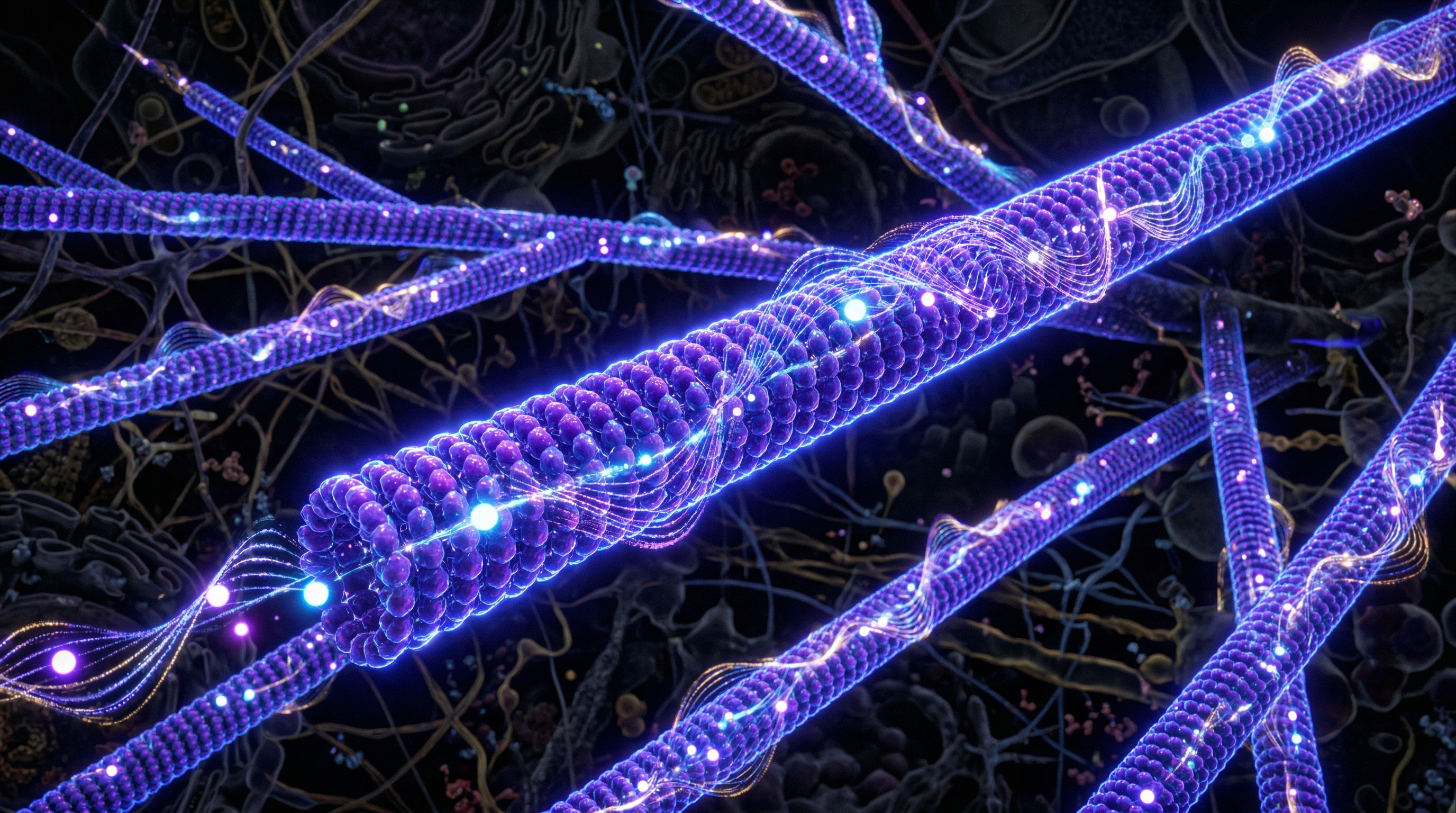
Imagine a structure inside every neuron—a protein lattice so precisely organized that it might support quantum superpositions at room temperature. These are microtubules: cylindrical scaffolds made of tubulin proteins that not only maintain cellular shape but may compute consciousness itself.
For decades, neuroscience has explained thought as electrical signaling between neurons. But this classical model struggles to account for the unity of conscious experience, the binding problem (how separate sensory streams merge into one coherent perception), and the mystery of subjective awareness—the "hard problem" of consciousness.
Enter the quantum mind.
The Penrose-Hameroff Hypothesis
In the 1990s, mathematician Roger Penrose and anesthesiologist Stuart Hameroff proposed the Orchestrated Objective Reduction (Orch-OR) theory—the most scientifically rigorous attempt to ground consciousness in quantum physics.
Penrose's Insight: Non-Algorithmic Consciousness
Penrose observed that human consciousness exhibits non-algorithmic properties. We make intuitive leaps, grasp mathematical truths, and access insights that cannot be fully explained by computable processes. In his book The Emperor's New Mind, he proposed that consciousness must arise from physical processes beyond classical computation.
Penrose identified one candidate: quantum gravity-induced wavefunction collapse, which he called "objective reduction." Unlike standard quantum decoherence (which occurs when a quantum system interacts with its environment), objective reduction is a fundamental, gravity-driven collapse that occurs when quantum superposition reaches a threshold of spacetime separation. This process is non-computable—exactly what consciousness might need.
Hameroff's Contribution: Microtubules as Quantum Processors
Microtubules, proposed by Hameroff as the substrate for quantum processing, are hollow cylinders 25 nanometers in diameter, composed of tubulin protein dimers arranged in a crystalline lattice. Each tubulin molecule can exist in multiple conformational states (dipole configurations), theoretically supporting quantum superposition.
Key mechanism: Tubulin superpositions maintain quantum coherence for milliseconds long enough for objective reduction, orchestrating discrete moments of conscious awareness approximately 40 times per second—the frequency of gamma-band neural synchrony.
Quantum Effects in Warm, Wet Biology
The primary critique of Orch-OR has been decoherence: quantum states should collapse almost instantly in the warm, wet environment of the brain. Maxwell Tegmark's 2000 calculations suggested microtubule superpositions would decohere in 10^-13 seconds—far too fast for consciousness.
But recent research challenges this assumption:
Fröhlich Condensation
Biophysicist Herbert Fröhlich proposed that biological systems can sustain coherent excitations (long-range quantum coherence) through continuous energy input, creating a "Fröhlich condensation." Microtubules may achieve this via ATP-driven oscillations, maintaining coherence times of 10^-6 to 10^-4 seconds.
Debye Shielding and Nuclear Spins
Research in 2024-2025 showed that microtubules achieve extended coherence through:
- Debye shielding: Protein surfaces create electric field configurations that protect quantum states from thermal noise.
- Nuclear spin environments: Phosphorus and other nuclear spins in tubulin create decoherence-free subspaces.
- Aquaporins: Water channels within microtubules facilitate ordered water structures that support quantum coherence.
Superradiance Evidence
Experimental papers from 2024 (Babcock et al.) demonstrated superradiance—coherent collective emission of excitations—from microtubules. This quantum optical phenomenon scales with microtubule size, suggesting biological quantum effects are real and functionally relevant.
Experimental Support for Microtubule Quantum States
Anesthesia Targets Microtubules
The most compelling evidence comes from anesthesia research: general anesthetics don't act through receptor binding alone but target hydrophobic pockets in tubulin itself. A 2024 rat study found that administering epothilone B (a microtubule-stabilizing drug) delayed unconsciousness by 69 seconds during induction (p=0.0016, Cohen's d=1.9).
This suggests anesthetic potency correlates with microtubule quantum state disruption, not just classical neurotransmitter inhibition.
MRI Detection of Entangled Spins
Studies in 2022-2023 used MRI to detect entangled nuclear spins in human brains, observing correlations with consciousness levels and working memory performance (fidelity correlated ~0.83 with memory). While not definitive, these findings support the existence of macroscopic quantum states in the brain.
Gamma Band Synchrony
Neuroscientific research shows that 40 Hz gamma oscillations correlate with conscious perception, attention, and memory binding. Orch-OR predicts this matches microtubule quantum collapse frequency—a remarkably precise alignment.
The Binding Problem and Quantum Coherence
Consciousness isn't fragmented information processing; it's a *unified experience*. When you see a sunset, hear a dog barking, and smell salt air, these aren't separate events—they merge into one coherent perception. This is the "binding problem" that classical neuroscience struggles to explain.
Quantum coherence provides an elegant solution: entanglement literally links separate neural processes into one quantum system. Microtubules in distal neurons could, via quantum entanglement and biophoton communication, participate in a unified consciousness field.
Microtubules and Neural Oscillations
Recent 2025 models (Singh, Perry) show that microtubule resonances can drive membrane oscillations across multiple frequency bands:
- Theta (4-8 Hz): Memory encoding, REM sleep, creative insight.
- Alpha (8-12 Hz): Relaxed wakefulness, sensory gating.
- Gamma (30-100 Hz): Conscious awareness, attention, binding.
This suggests microtubules don't just *respond* to neural signals—they orchestrate them, driving the brain's rhythmic architecture.
Controversy and Skepticism
Orch-OR remains controversial. Critics argue:
- Quantum coherence times may still be too short.
- Alternative explanations exist for anesthesia effects.
- The theory is difficult to falsify (though experiments are being designed).
However, 2024-2025 peer-reviewed publications in Neuroscience of Consciousness and other journals show convergent evidence: quantum effects in microtubules are real, and their disruption alters consciousness.
Implications for Consciousness Engineering
If microtubules process quantum information:
Implication 1: Altered states (meditation, psychedelics, flow states) may represent enhanced or modified quantum coherence states, expanding the bandwidth of conscious processing.
Implication 2: Therapeutic interventions could target microtubule stability and quantum function—new anesthetics, cognitive enhancers, or consciousness-modulating technologies.
Implication 3: Consciousness may persist in forms we don't yet recognize—near-death experiences, quantum-mediated entanglement, or biofield phenomena once quantum processes are better understood.
The Human Microtubule Complement
A single human neuron contains approximately 10^9 tubulin dimers. Multiply this by 86 billion neurons, and you have ~10^17 potential quantum-processing elements. If even a fraction operate coherently, the computational capacity is staggering—far exceeding any classical computer, and perhaps explaining consciousness's seemingly limitless depth.
The Frontier of Microtubule Science
Current research directions include:
- Direct imaging: Using ultrafast spectroscopy to observe quantum coherence in microtubules in vivo.
- Nanoparticle coupling: Attaching quantum dots to microtubules to probe and enhance quantum states.
- Microtubule drugs: Developing microtubule-stabilizing or destabilizing compounds to test consciousness correlations.
- Quantum cognition: Modeling decision-making and perception using quantum probability theory (which explains irrational choices better than classical probability).
Conclusion: The Quantum Inside Us
Microtubules represent one of biology's most radical possibilities: that consciousness isn't just a biological phenomenon but a quantum one. The same laws that govern subatomic particles may also govern awareness, love, creativity, and the deepest mysteries of human experience.
As Stuart Hameroff says: "We are quantum beings who think we're biological. This paradigm shift will revolutionize neuroscience, medicine, and our understanding of reality itself."
The quantum mind is no longer science fiction. It's a testable, empirically grounded hypothesis—and the evidence is mounting.