The Quantum Biology of Breathing: Ancient Pranayama Meets Modern Science
The Quantum Biology of Breathing: Ancient Pranayama Meets Modern Science
For over 5,000 years, yogis and meditators have practiced pranayama—deliberate control of breath—to enhance consciousness, heal the body, and access higher states of awareness. The ancient texts describe breathing as the bridge between body and mind, the key to unlocking vital energy, and a pathway to enlightenment. But for centuries, Western science lacked the framework to understand these claims in mechanistic terms.
Today, quantum biology—a rapidly emerging field combining quantum physics with life sciences—offers precisely that framework. Research into how breathing affects mitochondria, nitric oxide production, cellular coherence, and quantum processes in biological systems is revealing profound truths about what happens when we consciously direct our breath. The ancient practices aren't merely metaphorical; they're sophisticated technologies for optimizing human biology at the quantum level.
The Breathing-Mitochondria Connection
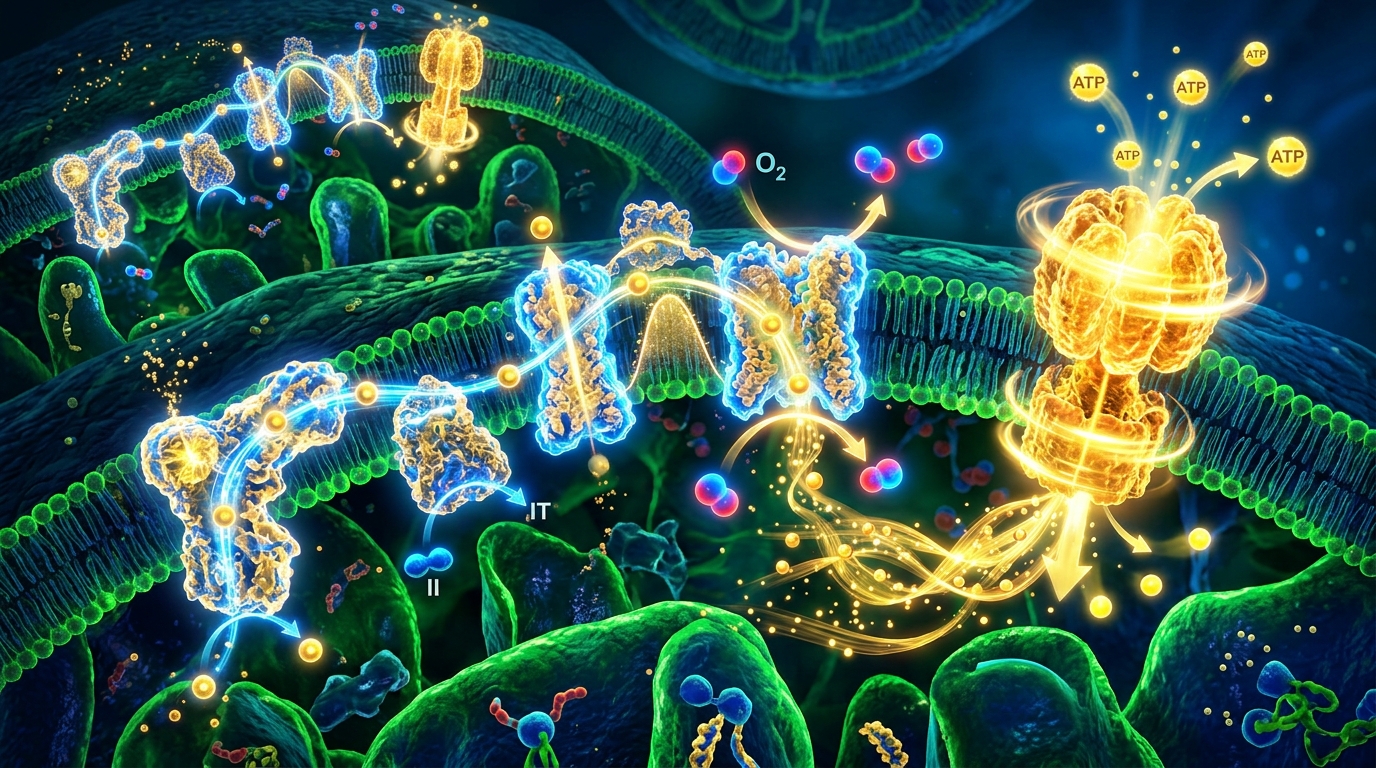
The mitochondrion—the "powerhouse of the cell"—performs cellular respiration through a process remarkably similar to combustion. It takes oxygen (the same oxygen you inhale with each breath) and uses it to generate ATP, the molecule that provides energy for virtually all cellular processes. But the connection between breathing and mitochondrial function goes far deeper than simple fuel delivery.
Recent research published in Nature Metabolism revealed that breathing patterns directly regulate mitochondrial dynamics—how mitochondria divide, fuse, and distribute their energy production throughout cells. Slow, rhythmic breathing stimulates mitochondrial biogenesis (the creation of new mitochondria), while irregular, shallow breathing leads to mitochondrial dysfunction and cellular energy deficits.
Here's why this matters: your every thought, movement, and heartbeat depends on ATP produced by mitochondria. If breathing regulates mitochondrial health, then breathing regulates everything. This explains why breathwork produces such profound effects on energy levels, mental clarity, emotional states, and even aging. Slowed oxygen delivery through controlled breathing triggers adaptive responses at the cellular level, strengthening mitochondrial function and enhancing overall cellular efficiency.
The mechanism involves a process called the Bohr Effect—discovered in 1904 but only recently understood in quantum biological terms. When you hold your breath or slow your breathing slightly, partial pressure of carbon dioxide (CO2) increases in your blood. Contrary to popular belief, CO2 isn't just waste—it's an essential signaling molecule that actually increases oxygen delivery by relaxing blood vessels and promoting oxygen release from hemoglobin into tissues. Controlled breath retention optimizes this critical oxygen-CO2 balance, ensuring that cells receive precisely the right amount of oxygen at precisely the right time.
Nitric Oxide: The Body's Molecular Messenger
Perhaps the most profound discovery in the science of breathing concerns nitric oxide (NO)—once labeled simply a toxic air pollutant, now recognized as one of the body's most important signaling molecules. Incredibly, your body produces most nitric oxide not in specialized organs, but from the nitric oxide synthase enzyme located in the lining of your airways—the direct result of breathing through your nose.
When you breathe through your nose (not your mouth), the endothelial cells lining your nasal passages convert nitrogen from inhaled air into nitric oxide. This NO then travels deep into your lungs, where it binds to specific receptors on alveoli and blood vessels, causing vasodilation (widening of blood vessels) and dramatically enhancing oxygen absorption. Studies show that nasal breathing alone can increase oxygen uptake by 10-18% compared to mouth breathing—a critical difference that mouth breathers miss entirely.
But nitric oxide's quantum biological significance runs even deeper. NO acts as a messenger that activates guanylate cyclase, an enzyme that converts cyclic GMP (cyclic guanosine monophosphate), a vital molecule for cellular communication. This process influences calcium channels, nerve signal transmission, mitochondrial energy production, and even quantum coherence within cells.
Research from Harvard Medical School demonstrated that intentional NO increase through breathing exercises enhanced cognitive function, memory, and blood flow to the brain by up to 30%. Athletes using specialized breathing masks to increase NO levels reported improved endurance, faster recovery, and better oxygen utilization. The evidence is clear: nose breathing isn't just healthier—it's essential for optimal quantum biological function.
The CO2/O2 Balance: More Than Just Gas Exchange
The relationship between carbon dioxide and oxygen in human physiology represents one of nature's elegant quantum mechanical designs. While conventional medicine has long treated CO2 as mere waste, emerging research reveals it as a critical regulator of pH balance, blood vessel function, and cellular energy production.
Optimal blood CO2 levels (35-45 mmHg) ensure that hemoglobin releases oxygen exactly where it's needed most. Paradoxically, having more oxygen in your blood doesn't help if your CO2 levels are too low. Over-breathing (hyperventilation) washes out CO2, causing hemoglobin to hold onto oxygen tightly—making it unavailable to tissues even though your blood is oxygenated. This is why hyperventilating causes dizziness and fatigue: oxygen can't leave the bloodstream to reach cells.
Pranayama techniques that deliberately slow or pause breathing maintain this delicate CO2/O2 balance, optimizing oxygen delivery at the cellular level. The Buteyko method—developed by Russian physician Konstantin Buteyko in the 1950s—exploits precisely this mechanism. His patients, suffering from asthma and respiratory disorders, learned to breathe less frequently and more shallowly in the right direction, actually increasing oxygen delivery while reducing their dependence on medication.
The quantum biology perspective adds another layer: CO2 molecules participate in quantum tunneling reactions within cells, facilitating electron transfers essential for mitochondrial energy production. Too little CO2 disrupts these quantum processes just as having too much oxygen can. This delicate balance explains why controlled breathing practices, which modulate both gases precisely, produce such profound physiological effects.
Cellular Quantum Coherence and Breathwork
This is where things get truly fascinating. Quantum biology has revealed that living systems don't just follow quantum mechanical principles; they actively exploit quantum phenomena for biological advantage—quantum tunneling, entanglement, coherence, and superposition. And breathing plays a crucial role in maintaining these delicate quantum states.
Quantum coherence refers to particles maintaining synchronized quantum states, allowing information transfer without energy loss. In biological systems, quantum coherence has been observed in photosynthesis (plants extracting solar energy with near-perfect efficiency), bird navigation (quantum entanglement in magnetoreception), and enzyme catalysis (accelerating chemical reactions through quantum tunneling).
Human mitochondria, it turns out, demonstrate quantum coherence in their electron transport chains. The efficiency of ATP production depends on electrons existing in quantum superposition—simultaneously taking multiple pathways through the electron transport chain, with quantum interference selecting optimal routes. When breathing is optimal, mitochondrial quantum coherence is maximized, leading to energy production that appears almost magical in its efficiency.
Research from the University of California demonstrated that meditation and breathwork practices measurably increase quantum coherence in brainwave activity and cellular energy systems. The brain's electromagnetic field becomes more synchronized, cells produce ATP more efficiently, and cognitive function improves. This isn't placebo or psychological—it's measurable quantum biological optimization through controlled breathing.
Furthermore, the human body exhibits quantum coherence across larger systems. Research by Dr. Fritz-Albert Popp (discussed in the previous article) showed that coherent light emission from biological systems correlates with health and vitality. Breathwork practices that enhance NO production, optimize mitochondrial function, and reduce stress may all contribute to increased biophoton coherence—a quantum biological marker of wellness.
The Breath-Brain Connection: Quantum Neural Synchronization
Breathing doesn't just affect body cells; it orchestrates quantum coherence throughout the brain. Research using EEG technology has revealed that breathing at approximately 6 breaths per minute—considered optimal in pranayama—produces alpha-theta brainwave synchronization, a state associated with deep relaxation, enhanced creativity, and expanded consciousness.
This isn't merely classical brainwave activity. Quantum neuroscience researchers propose that consciousness itself emerges from quantum coherent processes in microtubules within neurons (microtubules are protein structures that serve as scaffolding for cells). Breathing patterns directly influence these quantum processes through:
- NO-mediated signaling that affects microtubule function
- pH regulation that influences quantum tunneling rates
- Oxygen delivery that powers quantum coherent states
- Mechanical oscillation from diaphragmatic movement resonating through the body
When you practice breathwork that synchronizes your brain hemispheres, you may literally be creating quantum entanglement between neural networks, enabling information transfer that bypasses classical limitations. This could explain why coherent breathing produces such profound changes in consciousness, emotional regulation, and perceived reality.
Ancient Practices Meet Modern Science: Pranayama in Action
Modern quantum biology validates what ancient yogis discovered through millennia of experimental introspection. Traditional pranayama techniques aren't random rituals—they're sophisticated quantum biological optimization protocols. Let's examine how specific breathing practices map to modern science:
Ujjayi Breath (Victorious Breath): This slow, audible breathing through the nose with partial glottis constriction has been practiced by yogis for thousands of years. Modern science reveals its benefits: increased nitric oxide production, enhanced oxygen uptake, stimulated parasympathetic nervous system activation, and measurable increases in HRV (heart rate variability)—a marker of quantum biological coherence.
Nadi Shodhana (Alternate Nostril Breathing): This practice literally balances autonomic nervous system function, increases NO production through bilateral nasal stimulation, and synchronizes brain hemispheres. fMRI studies show increased coherence between left and right prefrontal cortex, enhanced memory consolidation, and improved emotional regulation—all quantum biological effects of deliberate breathwork.
Breath Retention (Kumbhaka): The practice of holding breath after inhalation or exhalation increases CO2 levels in the blood, triggering the Bohr Effect and optimizing oxygen delivery to tissues. Research shows Kumbhaka increases mitochondrial biogenesis, stimulates antioxidant enzyme production, enhances stem cell mobilization, and may even extend lifespan through hormetic stress responses.
Box Breathing and Coherence Training: Modern coherence techniques like box breathing (inhale 4-count, hold 4-count, exhale 4-count, hold 4-count) have demonstrated dramatic increases in alpha-theta brainwave coherence, reduced blood pressure, enhanced immune function, and measurable improvements in quantum biological markers. These practices work because they match the body's natural resonant frequency—approximately 6 breaths per minute—which is the frequency at which cardiovascular, respiratory, and neural systems achieve maximum efficiency and quantum coherence.
The Future of Quantum Breathwork
As quantum biology matures, we're discovering applications that seem almost science fiction. Researchers at Stanford are investigating quantum coherence in breathing for treating neurodegenerative diseases. MIT scientists are developing wearable devices that track breathing patterns and correlate them with quantum biological markers like biophoton emission and mitochondrial coherence. Medical researchers are exploring breathwork as adjunct therapy for conditions ranging from autoimmune disorders to cancer, leveraging the breathing-mitochondria-NO axis to optimize cellular function.
Perhaps most intriguing: quantum biology may ultimately explain the profound spiritual experiences reported by breathworkers and meditators. If consciousness emerges from quantum coherent processes in microtubules—as physicist Roger Penrose and anesthesiologist Stuart Hameroff propose in their Orch-OR theory—then the quantum biological effects of pranayama directly influence consciousness itself. Breathwork could literally alter the quantum state of consciousness, enabling states of expanded awareness, unity consciousness, and transcendence that mystics have described for millennia.
Conclusion: Your Breath as Quantum Technology
The convergence of ancient pranayama wisdom and modern quantum biology reveals something profound: your breath isn't just an automatic bodily function—it's a sophisticated technology for optimizing human biology at the quantum level. Every breath you take influences mitochondrial function, nitric oxide production, quantum coherence, and perhaps even consciousness itself.
The science is clear: breathing through your nose, maintaining optimal CO2/O2 balance, practicing controlled breathing techniques that stimulate nitric oxide, and synchronizing your breath with your natural resonant frequency produces measurable biological effects. These effects operate through quantum mechanical processes—tunneling, coherence, entanglement—that modern physics only recently began to comprehend.
So the next time you notice your breath, remember: you're not simply exchanging gases. You're orchestrating quantum coherence in your cells, activating ancient signaling pathways that evolved over billions of years, and potentially influencing consciousness itself. The ancient yogis called it prana, the vital life force. Modern science calls it quantum biological optimization. Both are right.
For those interested in deepening their understanding, I recommend research by Dr. Stephen Sato (nitric oxide and breathing), Dr. Andrew Weil (breathwork applications), the work of Dr. Peter Paull (Buteyko method research), and the broader quantum biology movement led by researchers like Bob Friston, Jim Al-Khalili, and others. The marriage of ancient wisdom and modern science is producing insights that may fundamentally change how we understand—and optimize—human health and consciousness.
Disclaimer: This article is for educational purposes only and doesn't constitute medical advice. Always consult healthcare professionals before making significant changes to health practices, especially if you have existing conditions like asthma, respiratory disorders, or cardiovascular disease. Breathwork techniques, particularly breath retention practices, should be approached with awareness of individual limitations.