Red Light Therapy vs Ultrasound: Which Actually Works Better?
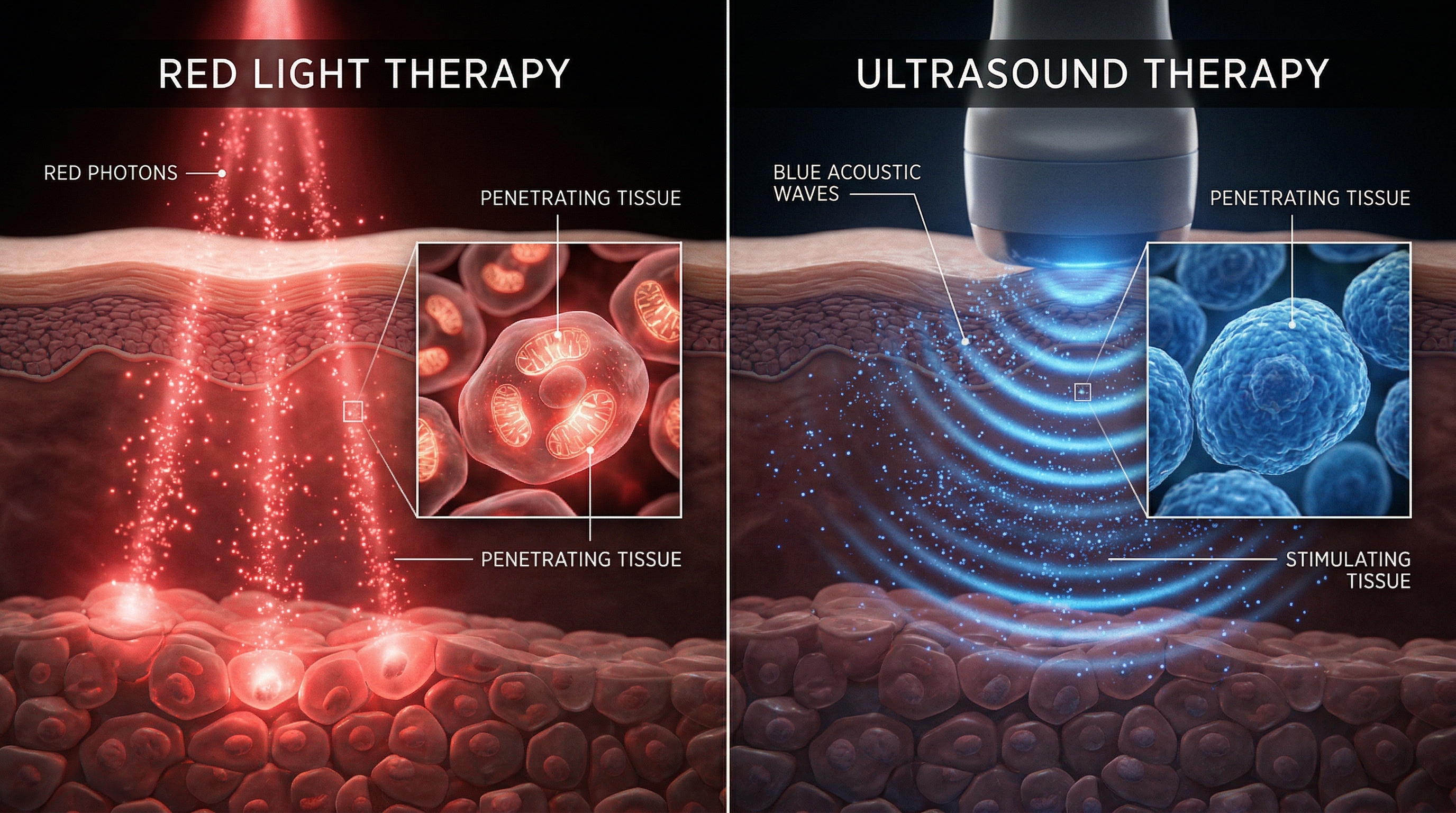
Red Light Therapy vs Ultrasound: Which Actually Works Better?
Walk into any modern wellness clinic or scroll through a biohacking forum, and you'll encounter two therapies that dominate the conversation about non-invasive healing: red light therapy (photobiomodulation) and therapeutic ultrasound. Both claim to reduce pain, accelerate recovery, and improve cellular function. Both have research behind them. And both are marketed with enough enthusiasm that it's hard to know which one actually delivers.
The honest answer — as with most things in biology — is that it depends on what you're trying to achieve. These two modalities work through fundamentally different mechanisms, target different cellular structures, and have different strengths. Understanding those differences is the key to choosing wisely.
How Each One Works
Red Light Therapy (Photobiomodulation)
Red light therapy uses specific wavelengths of visible red light (typically 620–700 nm) and near-infrared light (700–1000 nm) to stimulate cellular function. The primary target is cytochrome c oxidase (Complex IV) of the mitochondrial electron transport chain.
The mechanism, as described by Dr. Michael Hamblin and colleagues in extensive reviews published in Photonics and Journal of Biophotonics, works like this:
- Photons of specific wavelengths are absorbed by cytochrome c oxidase
- This displaces inhibitory nitric oxide (NO) from the enzyme
- Electron transport accelerates, increasing mitochondrial membrane potential
- ATP production increases
- Mild, transient increases in reactive oxygen species (ROS) trigger protective signaling cascades — activating NF-κB, MAPK, and antioxidant defense pathways
Red light therapy is fundamentally a photonic intervention — it uses electromagnetic radiation to directly interact with mitochondrial enzymes. It doesn't generate meaningful heat at therapeutic doses, and its effects are primarily biochemical rather than mechanical.
Therapeutic Ultrasound
Therapeutic ultrasound uses high-frequency sound waves (0.8–3 MHz) to create mechanical and thermal effects in tissue. Its mechanisms are acoustic rather than photonic:
- Thermal: Deep tissue heating (40–45°C) through molecular friction, promoting vasodilation and muscle relaxation
- Cavitation: Microscopic gas bubbles oscillate, altering cell membrane permeability
- Acoustic streaming: Micro-currents along cell membranes enhance nutrient transport
- Mechanotransduction: Physical stress is converted to biochemical signals through integrins and ion channels
Where red light targets the mitochondrial electron transport chain directly, ultrasound targets the mechanical environment around and within cells — their membranes, their fluid surroundings, and the physical forces that translate into biological signals.
Red light speaks to mitochondria through photons. Ultrasound speaks to cells through mechanical force. Both languages produce healing responses, but they're activating different cellular programs through different sensory mechanisms.
Head-to-Head Comparison
| Parameter | Red Light Therapy | Therapeutic Ultrasound |
|---|---|---|
| Energy type | Electromagnetic (photons) | Mechanical (acoustic waves) |
| Primary target | Cytochrome c oxidase (Complex IV) | Cell membranes, integrins, ion channels |
| Penetration depth | 5–10 mm (red), up to 50 mm (NIR) | 20–50 mm (depending on frequency) |
| Thermal effect | Negligible at therapeutic doses | Significant in continuous mode |
| Best for acute injuries | Moderate — reduces inflammation | Strong — pulsed mode excellent for edema |
| Best for chronic pain | Good — systemic anti-inflammatory effects | Good — deep thermal relaxation |
| Bone healing | Some evidence | Strong — FDA-cleared for fractures (LIPUS) |
| Muscle recovery | Strong — reduces DOMS, speeds repair | Moderate — primarily via blood flow |
| Skin/wound healing | Strong — extensive evidence base | Moderate — fibroblast activation |
| Ease of home use | High — many consumer devices available | Moderate — requires proper technique |
| Cost | $50–$3,000+ for home devices | $30–$200+ for home; clinical setups more |
| Session duration | 10–20 minutes typical | 5–10 minutes typical |
Where Red Light Therapy Excels
Mitochondrial Optimization
If your primary goal is to directly enhance mitochondrial function — more ATP, better efficiency, improved cellular energy — red light therapy has the more direct mechanism of action. By specifically targeting cytochrome c oxidase, it addresses the electron transport chain where energy production actually happens.
Research published in Photobiomodulation, Photomedicine, and Laser Surgery demonstrates consistent improvements in mitochondrial membrane potential, ATP synthesis, and cellular metabolism across multiple tissue types. This is why red light therapy has become popular among athletes and biohackers focused on energy and performance.
Skin Health and Collagen Production
The evidence for red light therapy in dermatology is robust. Wavelengths in the 630–660 nm range stimulate fibroblast activity, increase collagen and elastin synthesis, and improve skin texture and wound healing. Multiple randomized controlled trials support its use for skin rejuvenation, acne, and wound recovery.
Systemic Anti-Inflammatory Effects
While ultrasound creates local anti-inflammatory effects through mechanotransduction, red light therapy produces systemic effects through the activation of transcription factors that modulate inflammatory gene expression. Studies show reduced levels of TNF-α, IL-1β, and IL-6 following photobiomodulation — effects that extend beyond the treatment site.
Where Ultrasound Excels
Deep Tissue Access
Ultrasound's mechanical energy penetrates deeper than most red light devices. While near-infrared light can reach 4–5 cm in ideal conditions, ultrasound reliably reaches similar or greater depths with more predictable energy delivery. For conditions affecting deep structures — hip joints, deep muscles, internal ligaments — ultrasound has a practical advantage.
Bone and Fracture Healing
LIPUS (low-intensity pulsed ultrasound) is FDA-approved for accelerating fracture healing, with clinical evidence showing approximately 38% faster bone union. Red light therapy does not have comparable evidence or regulatory clearance for this application. If bone repair is your primary concern, ultrasound is the clear choice.
Thermal Pain Relief
For conditions that benefit from deep tissue heating — chronic muscle spasm, joint stiffness, myofascial pain — continuous-mode ultrasound provides therapeutic heat delivery that red light simply cannot match. The thermal effects relax tight tissue, increase collagen extensibility, and create immediate pain relief through the gate control mechanism.
Precise Tissue Targeting
Ultrasound can be focused with more spatial precision than red light. A therapist can direct energy to a specific tendon, ligament, or joint capsule with millimeter accuracy — something that's harder to achieve with light-based therapies that scatter through tissue.
When to Use Both (Synergy)
The most sophisticated practitioners don't see this as an either/or choice. There's emerging evidence that combining the two modalities can produce synergistic effects:
- Red light first, then ultrasound: Photobiomodulation primes mitochondria for enhanced energy production. Ultrasound then increases blood flow and mechanical stimulation, delivering more resources to those energized cells.
- For injury recovery: Red light during the acute inflammatory phase to modulate immune response and protect mitochondria. Ultrasound during the proliferative and remodeling phases to enhance collagen organization and tissue strength.
- For chronic pain: Red light for systemic anti-inflammatory effects and cellular energy. Ultrasound for localized thermal relaxation and mechanotransduction-based pain modulation.
Use red light therapy when your primary goal is mitochondrial enhancement, skin health, or systemic anti-inflammatory support. Use ultrasound when you need deep tissue access, bone healing, thermal pain relief, or precise targeting. Use both when you want comprehensive cellular and mechanical support for recovery.
The Honest Assessment
Neither modality is a miracle cure. Both have solid but imperfect evidence bases, with variability in study quality, treatment parameters, and patient populations. Red light therapy has broader consumer availability but also more unsubstantiated marketing claims. Ultrasound has longer clinical track records but requires more skill to apply correctly.
The best approach is to match the tool to the task, consult with practitioners who understand both modalities, and maintain realistic expectations. Your mitochondria don't care about marketing — they respond to physics and biology. Choose the physics that fits your biology.
References
- Hamblin MR. "Mechanisms and applications of the anti-inflammatory effects of photobiomodulation." AIMS Biophysics 4(3):337-361.
- de Freitas LF, Hamblin MR. "Proposed mechanisms of photobiomodulation or low-level light therapy." IEEE Journal of Selected Topics in Quantum Electronics 22(3).
- NCBI StatPearls. "Therapeutic Ultrasound in Physical Therapy." NBK547717
- Defined et al. "LIPUS and fracture healing: FDA clearance evidence." PubMed PMID: 30198009.
- Ferraresi et al. "Muscle performance, mitochondria, and photobiomodulation." Photonics.
- Frontiers in Bioengineering (2022). "Therapeutic ultrasound: cellular mechanisms and clinical applications." doi: 10.3389/fbioe.2022.1080430
- AIUM. "Statement on Biological Effects of Therapeutic Ultrasound."
- Salehpour et al. "Transcranial photobiomodulation for mitochondrial enhancement." Journal of Biophotonics.