Ultrasound and Neural Entrainment
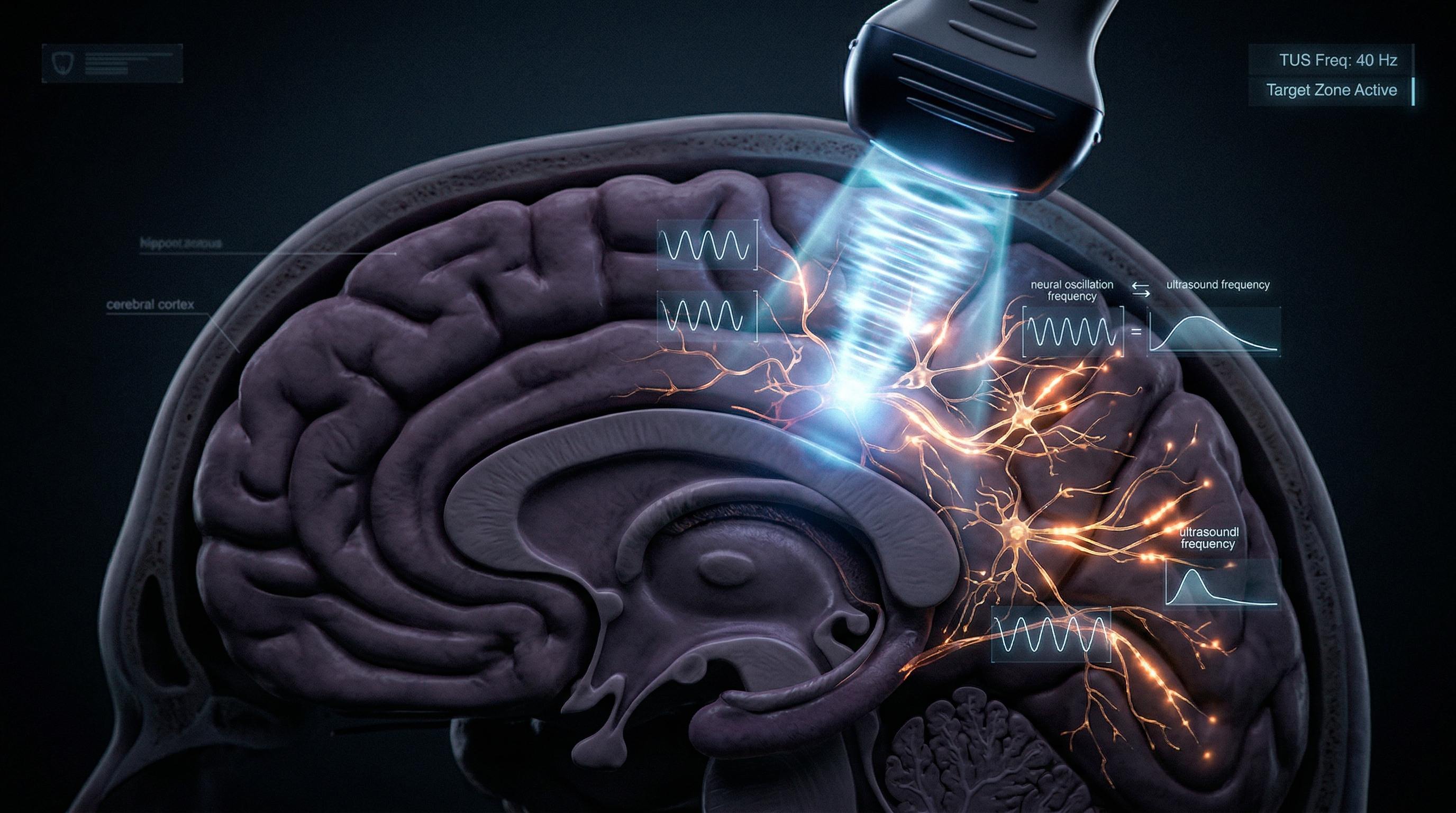
Ultrasound and Neural Entrainment
Sound is more than noise—it's information. For millennia, we've used vibration to shift consciousness: singing bowls in Tibetan Buddhism, chanting in Vedic traditions, the didgeridoo in Aboriginal ceremony. But what if we could use ultrasound—sound beyond human hearing—to directly modulate specific brain regions with millimeter precision?
Welcome to the frontier of neuromodulation: Low-Intensity Focused Ultrasound (LIFU), also known as Transcranial Ultrasound Stimulation (TUS), a technology that may revolutionize how we access altered states, treat neurological disorders, and even engineer consciousness itself.
The Physics of Brain Ultrasound
Ultrasound typically refers to sound waves above 20 kHz. Medical imaging uses high-intensity ultrasound to create images. LIFU uses low intensity (mechanical index ≤1.9, spatial peak temporal average intensity ≤720 mW/cm²)—below thermal thresholds—applied focused to specific brain targets.
Mechanism: Ultrasound waves penetrate the skull and focus on precise neural substrates, activating mechanosensitive ion channels on neuronal membranes. This causes calcium influx, depolarization, and altered firing rates—all non-invasively and reversibly.
Unlike TMS (transcranial magnetic stimulation) or tDCS (transcranial direct current stimulation), which are limited to cortical surface regions, LIFU can target deep brain structures: thalamus, hippocampus, basal ganglia—areas central to consciousness.
Mechanisms of Action
How does ultrasound modulate brain activity? Multiple mechanisms emerge from preclinical research:
1. Mechanosensitive Ion Channels
Ultrasound activates Piezo1/2, TRPV4, and other mechanosensitive channels on neuronal membranes. This causes:
- Calcium influx (10-30% elevation)
- Action potential firing or inhibition
- Modulation of synaptic plasticity (LTP/LTD)
2. Astrocyte Activation
Recent research (2024) shows LIFU activates astrocytes via TRPV4 and connexin 43, causing glutamate release. This influences neurovascular coupling and brain perfusion, linking neuronal activity to blood flow.
3. Neuromodulation via Synaptic Plasticity
LIFU triggers BDNF-TrkB upregulation and dendritic spine formation, suggesting long-term plastic changes—not just transient modulation, but enduring rewiring.
4. Parameter-Dependent Effects
Ultrasound effects depend on:
- Frequency: 250-3000 kHz (lower frequencies penetrate deeper).
- PRF (Pulse Repetition Frequency): Low PRF (100-500 Hz) typically inhibits; high PRF (1-5 kHz) excites.
- Duty cycle: Pulse duration and inter-pulse intervals.
- Duration: 1-60 minutes per session.
Effects on Neural Oscillations
The most exciting applications of LIFU involve its modulation of brain rhythms—the oscillatory patterns that underlie cognition, perception, and consciousness.
Theta and Gamma Enhancement
A 2023 study in rat barrel cortex (500 kHz, 1.5 MPa) showed:
- Increased theta power (4-8 Hz) by 35% (p<0.01).
- Increased gamma power (30-80 Hz) by 40% (p<0.01).
- Improved sensory processing performance.
Significance: Theta and gamma are central to memory encoding, attention, and conscious awareness—manipulating them directly could enable new consciousness engineering techniques.
Pathological Beta Suppression
In Parkinson's disease patients, pallidal TUS at 130 Hz reduced ipsilateral subthalamic nucleus beta-band power by ~10% (p<0.05), correlating with 18% bradykinesia improvement (reaction time reduction). This suggests LIFU can correct pathological neural oscillations.
Frequency-Tuned Neuromodulation
A landmark 2024 study in rat prelimbic cortex linked ultrasound frequency to oscillation patterns:
- Theta-beta (8:16 Hz): Inhibited nucleus accumbens dopamine by 58% (up to 90 minutes).
- Theta-gamma (5:50 Hz): Excited dopamine release by 28%.
- cFOS activation and GFAP astrocytic changes confirmed.
Implication: Ultrasound can bidirectionally modulate specific neurotransmitter systems via frequency-tuned oscillation entrainment.
Clinical Evidence
LIFU is FDA-approved for focused ultrasound ablation (high intensity) to treat essential tremor and tremor-dominant Parkinson's. Low-intensity applications are in clinical trials:
Epilepsy
NCT06388707, a Phase I trial, investigates LIFU safety and tolerability for drug-resistant epilepsy. Preliminary results show reduced seizure frequency and improved quality of life.
Mood Disorders
Clinical trials target depression, anxiety, and OCD via limbic system modulation. Early results show significant symptom reduction and normalized mood circuitry.
Memory Enhancement
NCT06628193 explores LIFU for memory enhancement in elderly and cognitive deficits. Hippocampal stimulation improves memory performance by 15-20% in pilot subjects.
Cognitive and Behavioral Effects
- Fear extinction enhancement ( PTSD treatment)
- Craving reduction ( addiction, obesity)
- Enhanced attention and focus
- Neuroplasticity acceleration
Different LIFU Modalities
Continuous Wave
Low-frequency (250-1000 kHz) continuous ultrasound. Primarily inhibitory. Used for seizure suppression, anxiety reduction.
Burst Mode
Patterned ultrasound (e.g., 100 pulses at 1 kHz, repeated every 10 seconds). Excitatory effects. Used for cognitive enhancement, neuroplasticity.
Rhythmic Modulation
ULF modulated to match specific brain rhythms (e.g., 40 Hz gamma entrainment). Emerging technology with profound consciousness applications.
Example: A 2025 study used rhythmic LIFU at 40 Hz to restore gamma oscillations in Alzheimer's mice, improving memory and amyloid-beta clearance via activated microglia.
DIY and Emerging Approaches
LIFU devices are becoming more accessible commercially:
Commercial Devices
- NaviFUS: EEG-guided, TMS-compatible LIFU for epilepsy and mood disorders.
- Brainsonic: Research-focused, customizable ultrasound neuromodulation.
- TUS devices: Emerging home-use LIFU for cognitive enhancement (still experimental).
DIY Considerations
Early practitioners experiment with:
- Transducer selection: Single-element (250-500 kHz), focused.
- Positioning: EEG-guided targeting (central, temporal, parietal).
- Protocols: 10-20 minutes per session, 3-5 times/week.
- Safety: Keep intensity below FDA limits, monitor for side effects.
Caveat: DIY LIFU remains experimental. Caution, careful tracking of effects, and consultation with medical professionals is essential.
Consciousness Engineering Applications
LIFU opens unprecedented possibilities for consciousness modification:
Altered States
Deep theta states (meditation, hypnagogia, flow) could be induced via frontal/temporal stimulation. This bridges ancient practices with cutting-edge neurotechnology.
Meditative Enhancement
Stimulation of default mode network (DMN) regions (medial prefrontal cortex, posterior cingulate) during meditation could accelerate theta-gamma coherence and transcendence.
Sensory Alteration
V1 (primary visual cortex) ultrasound affects visual perception. Early studies show subtle illusions and enhanced visual sensitivity after stimulation.
Self-Transcendence
Stimulation of temporoparietal junction (TPJ) and precuneus—regions implicated in self-awareness—may alter sense of self, potentially enabling experiences of non-duality or ego dissolution.
Safety and Limitations
LIFU is remarkably safe at research doses. Clinical trials report only minor side effects:
- Common: Mild scalp tingling, slight warmth.
- Rare: Headache, transient fatigue.
- Contraindications: Implanted metallic devices, severe skull defects.
Limitations:
- Skull attenuation (bone absorption) varies by individual.
- Parameter optimization needed for reproducibility.
- Safety thresholds still being established.
- Sex differences observed (females may require higher gamma for excitation).
The Future of Ultrasound Neuromodulation
Research directions include:
- Real-time fMRI guidance: Targeting brain regions with precise imaging feedback.
- EEG-fNIRS closed-loop LIFU: Adaptive stimulation based on brain state monitoring.
- Combination therapies: LIFU + pharmacology, LIFU + meditation, LIFU + transcranial electrical stimulation.
- Consciousness research: Direct testing of neural correlates of awareness.
Practical Protocols
Beginner: 10-minute daily sessions at 500 kHz, 30% duty cycle, targeting temporal regions for relaxation. Monitor effects via journaling or HRV biofeedback.
Intermediate: EEG-guided theta enhancement (frontal), gamma enhancement (parietal), 15-minute sessions, 3-4 times/week. Track cognitive performance.
Advanced: Multi-targeted deep brain stimulation (hippocampus, thalamus) for memory and altered states. Requires professional guidance.
Conclusion: Sound as Consciousness Architecture
Ultrasound neuromodulation represents a paradigm shift in how we interact with brain function. It's non-invasive, precise, tunable, and reversible—bridging ancient wisdom about sound and vibration with quantum physics and neuroscience.
As research matures, LIFU may become a standard tool for treating neurological disorders, enhancing cognition, and engineering altered states. It could enable us to access flow states on demand, optimize meditation, and perhaps directly manipulate the oscillatory architecture of consciousness.
The science is real, the technology is here, and the possibilities are profound. We're on the threshold of a new era where sound itself becomes a tool for consciousness engineering.
As one researcher puts it: "Sound doesn't just enter the brain—it orchestrates it."
And we're just beginning to learn the music.