Vagus Nerve: The Consciousness Highway
Vagus Nerve: The Consciousness Highway
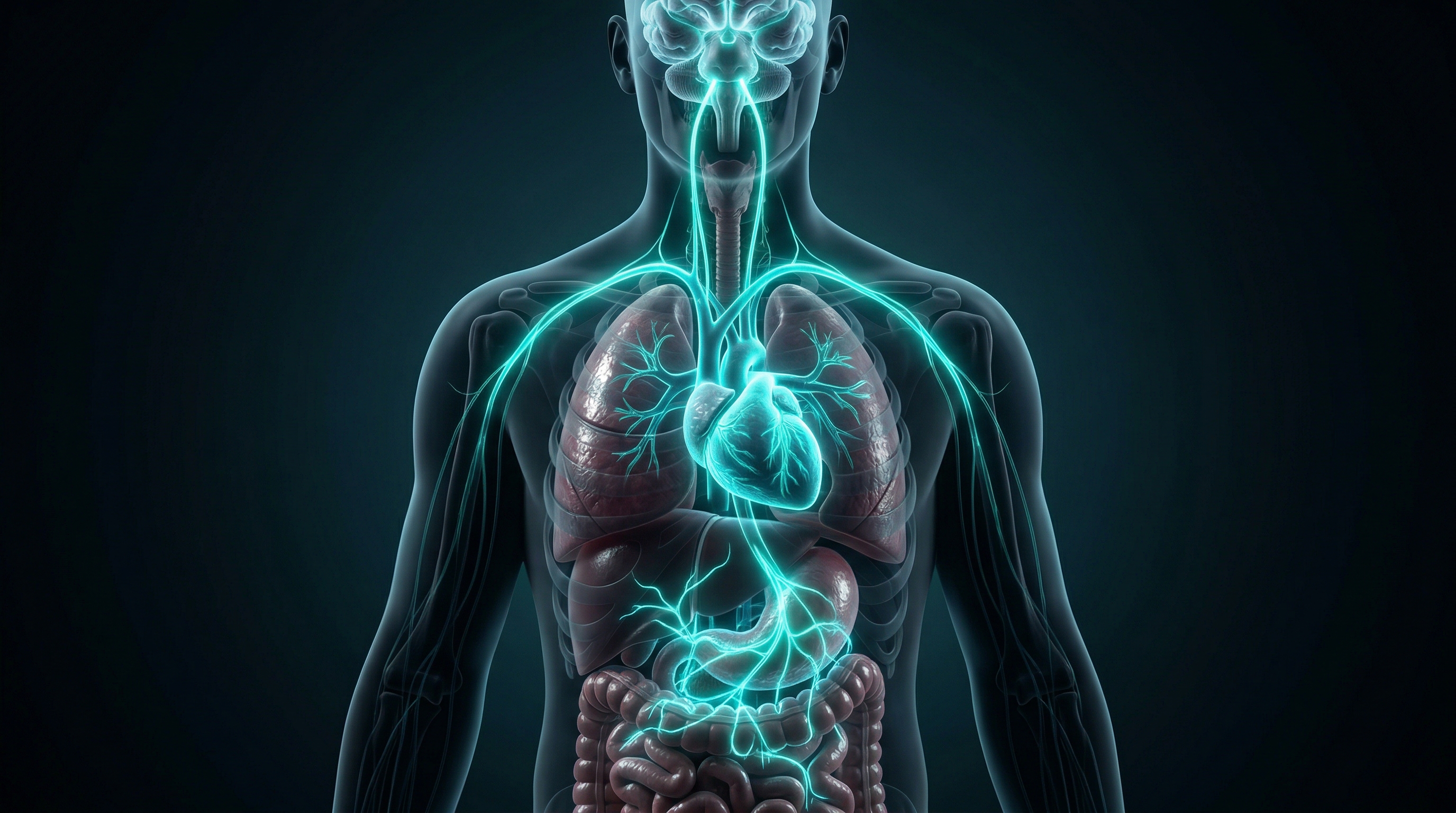
Nestled within your neck, whispering through your chest, winding through your abdomen like a cosmic cable: the vagus nerve. It's the longest cranial nerve in your body, comprising approximately 80% afferent fibers that carry information from your organs to your brain. It's your biological superhighway, and it may be the key to understanding how consciousness emerges from the body.
Anatomy of the Wanderer
The vagus nerve (cranial nerve X) originates in the brainstem and branches to the heart, lungs, digestive tract, liver, kidneys, and more. Latin for "wandering," it truly is—its pathways touch nearly every major organ system.
Key fact: 80% of vagal fibers are sensory—afferent. This means the vagus doesn't just send signals to the body; it constantly informs the brain about the internal state of organs, creating a continuous dialogue between physiology and consciousness.
Modern neuroscience maps the vagus nerve as a core component of the "polyvagal theory" (Stephen Porges), which proposes:
- Ventral vagal branch: Social engagement, parasympathetic calm, connection.
- Dorsal vagal branch: Freeze, shutdown, dissociation (evolutionary survival response).
- Sympathetic nervous system: Fight-or-flight activation.
Mechanisms of Vagal Action
The vagus nerve regulates consciousness through multiple pathways:
1. Inflammation Control (Cholinergic Anti-Inflammatory Pathway)
Research in the late 1990s revealed the "vagus reflex": electrical stimulation of the vagus nerve suppresses systemic inflammation by inhibiting NF-κB, the master inflammation transcription factor. The mechanism:
- Vagal activation releases acetylcholine (ACh).
- ACh binds to alpha-7 nicotinic receptors on macrophages.
- NF-κB is blocked, reducing pro-inflammatory cytokines (TNF-α, IL-1β, IL-6).
Implication: Chronic inflammation ("inflammaging") degrades cognitive function, mood, and consciousness. Optimizing vagal tone = reducing inflammation = optimizing brain function.
2. Gut-Brain Axis Communication
The gut hosts approximately 100 million neurons (the enteric nervous system) and trillions of microbes. The vagus nerve is its primary data cable to the brain.
Research shows:
- Gut bacteria produce neuroactive compounds (serotonin, GABA, dopamine precursors) that signal via the vagus.
- Inflammation from dysbiosis triggers vagal afferents, affecting mood and cognition.
- Probiotics (psychobiotics) can improve depression and anxiety via vagal pathways.
- Vagotomy (cutting the vagus) blocks many probiotic benefits.
Key insight: The vagus nerve is the "gut feeling" mechanism—your intuition literally travels along this nerve between intestines and brain.
3. Emotional Regulation
Vagal tone correlates with emotional regulation capacity. High-toned vagal function (measured via heart rate variability) predicts:
- Resilience to stress
- Ability to return to baseline after emotional arousal
- Empathy and social connection
- Social engagement behaviors
Polyvagal theory posits that vagal inhibition occurs during stress, leading to sympathetic dominance (fight/flight). Vagal re-engagement (ventral branch) restores calm and connection.
Vagus Nerve Stimulation (VNS): Clinical Evidence
VNS is FDA-approved for:
- Refractory epilepsy: Reduces seizures by 50%+ in many patients.
- Major depressive disorder: VNS implanted devices show significant antidepressant effects in medication-resistant cases.
- OCD and migraine: Emerging evidence.
Mechanisms of VNS therapeutic effects:
- Modulation of neuroinflammation
- Increase in BDNF (brain-derived neurotrophic factor)
- Changes in amygdala and prefrontal cortex activity
- Increased heart rate variability and coherence
Vagal Stimulation Techniques
You don't need surgical implantation to vagally stimulate yourself. Multiple proven techniques exist:
1. Slow Breathwork (0.1 Hz Breathing)
Respiratory sinus arrhythmia (RSA) naturally modulates vagal tone. Breathing at ~6 breaths/minute (5s inhale, 5s exhale) achieves "HRV coherence," maximizing vagal activity.
Protocol: 10-15 minutes daily of slow, deep nasal breathing. Use a biofeedback app (e.g., Inner Balance, HeartMate) for real-time feedback.
2. Cold Water Immersion
Face immersion in cold water (Mammalian Dive Reflex) triggers immediate vagal activation, lowering heart rate and inducing calm. Research shows this reduces anxiety and stress.
Protocol: 30-second cold face splashes or brief whole-body cold exposure (Wim Hof method, cold showers).
3. Humming and Chanting
Vagus nerve branches the larynx and pharynx. Humming, chanting (e.g., "OM"), or singing stimulates vagal fibers directly. Studies show reduced sympathetic tone and increased parasympathetic activity.
Protocol: 5 minutes of deep, resonant humming; 5 rounds of OM mantra.
4. Yoga and Posture
Certain yoga poses compress the neck, stimulating vagal pathways: shoulder stand, fish pose, forward folds. Neck massage and self-massage of the throat region also activate vagal receptors.
5. Acupressure
GV26 (philtrum), LR3 (foot), and ST9 (neck) are acupoints that modulate vagal tone. Research supports their use for anxiety and autonomic regulation.
6. Ear Stimulation (Tragus Stimulation)
The auricular branch of the vagus nerve innervates the outer ear. Transcutaneous VNS (taVNS) via clips on the tragus is gaining traction as a non-invasive alternative to surgical VNS.
Protocol: 20-30 minutes daily of auricular stimulation (commercial devices like gammaCore, or DIY tVNS).
7. Social Connection and Laughter
Positive social engagement, eye contact, and genuine laughter directly activate the ventral vagal branch. This is not metaphorical—neuroimaging shows reduced amygdala activity and increased vagal tone during prosocial interactions.
Protocol: Daily practices of genuine connection, laughter, and eye contact.
Vagus and Altered States
Many altered states of consciousness correlate with vagal modulation:
Flow and Transcendence
Flow states (complete absorption, effortless action) and transcendent experiences (meditation, mysticism) both show increased vagal tone and HRV coherence. Research suggests this is not merely correlate but causal: optimal vagal function creates the physiological conditions for expanded awareness.
Dissociation and Trauma
Conversely, trauma often "traps" the nervous system in dorsal vagal shutdown (freeze, dissociation). Somatic therapies (Bodynami, Somatic Experiencing) aim to release dorsal vagal constriction and restore ventral vagal tone.
Breathwork-Induced States
Intensive breathwork (Holotropic, Satyananda) can trigger ecstatic, mystical, or traumatic release states. These correlate with rapid shifts in vagal tone and autonomic dysregulation followed by reorganization.
The Vagus-Consciousness Connection
If consciousness is information integration (Integrated Information Theory), the vagus nerve is literally an information superhighway: carrying massive data streams from the body to the brain, influencing perception, emotion, and awareness.
Thesis: Vagal coherence may be a neurophysiological substrate for self-transcendence, optimal health, and conscious awareness itself.
Emerging research tracks:
- Vagal tone predicts meditation depth.
- VNS improves attention and cognitive control.
- Vagal modulation alters subjective time perception.
- High vagal tone correlates with greater psychological well-being.
Clinical Applications
Vagal interventions are being explored for:
- Depression and anxiety: taVNS as adjunctive therapy.
- Epilepsy: VNS to reduce seizure frequency.
- Autoimmune diseases: VNS to suppress inflammatory pathways.
- Neurodegenerative disease: BD NF upregulation, inflammation reduction.
- Addiction: VNS to reduce cravings and withdrawal symptoms.
Protocol: Daily Vagal Optimization
Morning (5-10 min): Slow breathing + cold splash face Midday (5 min): Humming or chanting Evening (10-15 min): Yoga pose sequence + gratitude practice Weekly: Social connection practices, laughter, eye contact
The Frontier of Vagal Science
Current research directions include:
- Vagal biomarkers: Using vagal tone as a clinical indicator of health.
- VNS implants for Alzheimer's: Emerging trials show cognitive improvements.
- Gut microbiome-vagus crosstalk: Manipulating microbiota to modulate vagal signals.
- Consciousness research: Is vagal coherence necessary for self-awareness?
Conclusion: The Nervous System as Bridge
The vagus nerve is more than a physiological structure—it's the embodiment of our body-mind-spirit integration. By consciously stimulating the vagus, we can access deeper states of relaxation, reduce inflammation that clouds consciousness, regulate emotion, and potentially enhance our awareness itself.
As research continues to map the vagus-consciousness connection, one thing is clear: this wandering nerve, this consciousness highway, deserves our attention. It may be the bridge to the deepest mysteries of human awareness—and the key to unlocking optimal health and well-being.
Stimulate your vagus. Your consciousness will thank you.