Cold Exposure and Mitochondria: What the Science Actually Shows
Cold Exposure and Mitochondria: What the Science Actually Shows
Cold plunges have become one of the most talked-about wellness practices of the decade. Scroll through any health podcast or social media feed, and you'll find claims about cold exposure boosting metabolism, building brown fat, reversing aging, and supercharging mitochondria. Some of this is grounded in real science. Some of it is considerably more enthusiastic than the evidence supports.
So what does the research actually tell us about cold exposure and mitochondrial biology? The answer is more nuanced — and more interesting — than a simple "cold is good."
Brown Fat: Your Body's Built-In Furnace
To understand how cold affects mitochondria, you first need to understand brown adipose tissue (BAT) — a type of fat that's fundamentally different from the white fat that makes up most of your body's fat stores.
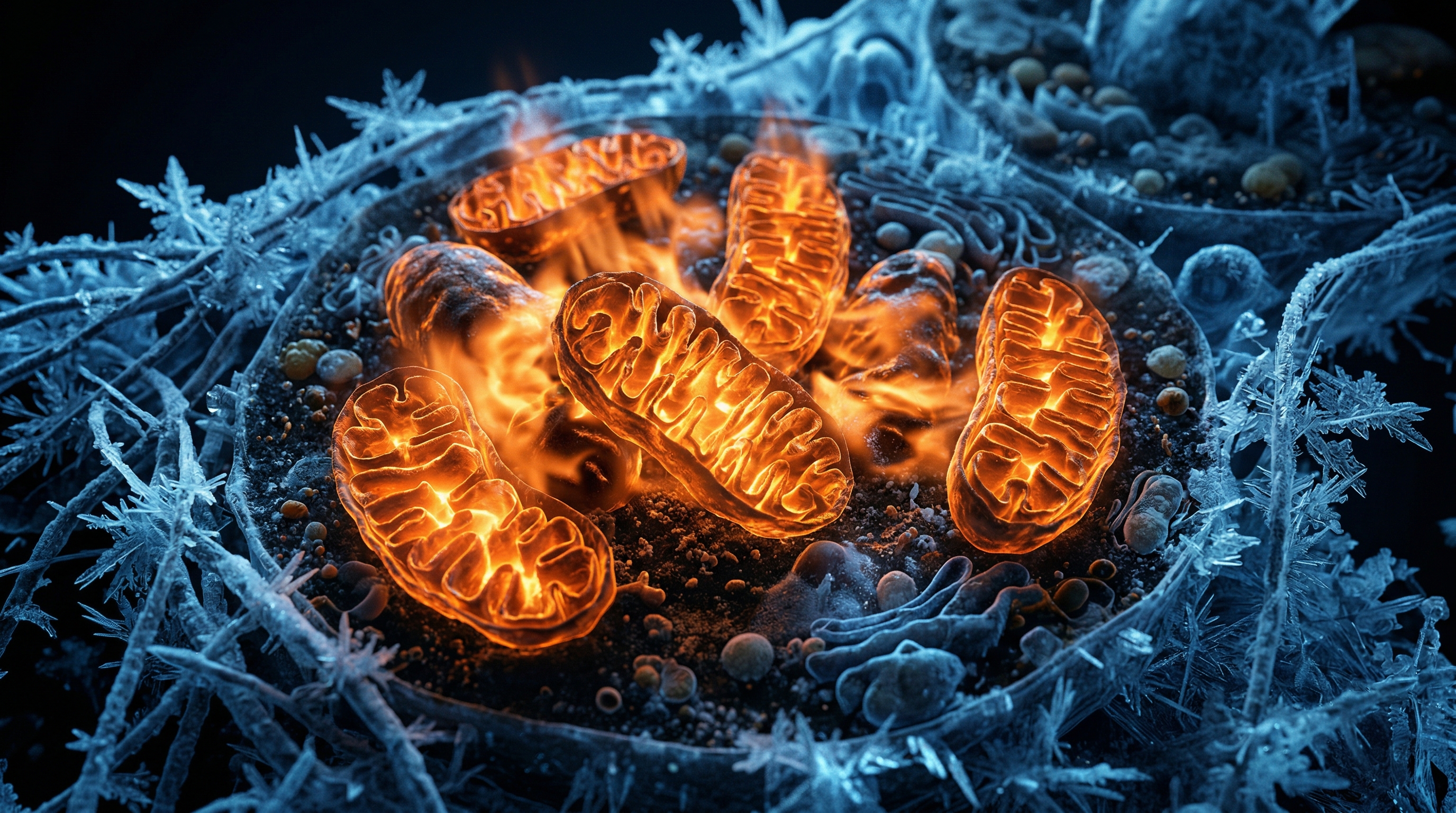
Brown fat is brown because it's packed with mitochondria. Thousands of them per cell, densely arranged with extensive cristae (inner membrane folds). These mitochondria contain a special protein called uncoupling protein 1 (UCP1), which creates a "short circuit" in the electron transport chain. Instead of using the proton gradient to generate ATP, UCP1 allows protons to flow back across the membrane, releasing energy as heat.
In other words, brown fat mitochondria are designed to burn fuel and produce warmth — not to store energy. This is non-shivering thermogenesis, and it's your body's first line of defense against cold before shivering kicks in.
Humans are born with substantial brown fat deposits (it keeps babies warm), but brown fat was long thought to disappear in adulthood. Research over the past two decades has overturned this view. PET-CT imaging studies have confirmed that metabolically active brown fat persists in adults, primarily in the supraclavicular region, neck, and along the spine. And cold exposure is the most potent natural activator of this tissue.
How Cold Triggers Mitochondrial Biogenesis in Brown Fat
When your body detects cold — through skin thermoreceptors and the hypothalamus — it activates the sympathetic nervous system, releasing norepinephrine. This neurotransmitter binds to β-adrenergic receptors on brown fat cells, initiating a cascade that fundamentally remodels their mitochondria.
The key player in this remodeling is PGC-1α (peroxisome proliferator-activated receptor gamma coactivator 1-alpha), the master transcriptional regulator of mitochondrial biogenesis. Cold exposure robustly upregulates PGC-1α, which in turn drives the expression of nuclear and mitochondrial genes needed to build new mitochondria.
The results are dramatic:
- Increased mitochondrial number: Electron microscopy studies show that chronic cold exposure (4–6°C for weeks in rodent models) substantially increases mitochondrial density in brown fat cells.
- Enhanced cristae formation: The inner membrane folds become more elaborate, increasing the surface area available for the electron transport chain and UCP1.
- UCP1 upregulation: Expression of the uncoupling protein increases several-fold, boosting thermogenic capacity.
- Cytochrome c oxidase activity: Cold acclimation increases Complex IV activity approximately 2.5-fold in BAT within two weeks, mediated by transcription factors NRF-2 and ERRα.
A 2023 study published in Nature Communications identified FAM210A as a crucial protein for cold-induced mitochondrial remodeling in BAT. During sustained cold exposure (6°C for 5 days in mice), FAM210A prevents excessive fission and supports the structural integrity of newly synthesized mitochondria, highlighting how finely regulated this process is.
What About White Fat? The Browning Effect
Cold exposure doesn't just activate existing brown fat — it can also induce "browning" of white adipose tissue. This process converts some white fat cells into "beige" or "brite" (brown-in-white) cells that express UCP1 and contain more mitochondria than typical white fat cells.
A 2024 study in Cell Reports confirmed that cold exposure upregulates UCP1, PGC-1α, and mitochondrial biogenesis genes in subcutaneous white adipose tissue. However, the browning effect is less potent than true brown fat activation — beige cells have fewer mitochondria and lower UCP1 expression than dedicated brown adipocytes.
Still, the metabolic implications are significant. More mitochondria in fat tissue means more calories burned as heat, improved insulin sensitivity, and better lipid metabolism. A 2014 study in PLoS ONE found that intermittent cold exposure (15–16°C for 31 days) activated BAT, roughly doubled metabolic rate, and improved insulin sensitivity in human subjects.
Beyond Fat: Cold Effects on Muscle Mitochondria
The effects of cold extend beyond adipose tissue. A study in rats found that cold exposure combined with exercise upregulated mitochondrial biogenesis genes (PGC-1α, NRF1, TFAM) in skeletal muscle, with additive effects greater than either stimulus alone. This suggests cold and exercise may work through complementary pathways — exercise through calcium/AMPK signaling, cold through sympathetic/β-adrenergic activation.
A 2023 study in Cell Reports also found that cold increases serum levels of nicotinamide and 1-methylnicotinamide — NAD⁺ metabolites — that correlate with BAT activation and mitochondrial function. This links cold exposure to the broader NAD⁺/sirtuin axis that governs mitochondrial health and aging.
Autophagy and Mitochondrial Quality Control
Beyond building new mitochondria, cold exposure also improves mitochondrial quality. Prolonged cold induces autophagy in brown adipose tissue — the cellular recycling process that breaks down damaged organelles and proteins. Specifically, cold-activated mitophagy (selective autophagy of mitochondria) removes old, inefficient mitochondria and replaces them with fresh, high-capacity ones.
This dual action — building new mitochondria while clearing damaged ones — means cold exposure may improve mitochondrial quality, not just quantity. It's a remodeling process, not just an expansion.
The Human Evidence: What We Know and Don't Know
Here's where the picture becomes more complicated. Most of the detailed mechanistic studies on cold and mitochondrial biogenesis come from rodent models, where researchers can control temperature precisely, use invasive tissue sampling, and employ genetic tools that aren't available in human studies.
The human evidence, while growing, is more limited:
- BAT activation is confirmed: Multiple human studies show that cold exposure (typically 15–16°C for hours to weeks) activates BAT and increases metabolic rate.
- Cold acclimation works: Ten days at 15°C recruits BAT and elevates non-shivering thermogenesis through mitochondrial uncoupling (Lee et al., 2014, Journal of Clinical Investigation).
- Mitochondrial biogenesis in humans is inferred, not directly measured: We don't yet have biopsy studies in humans showing the same mitochondrial density changes seen in mice. The metabolic and thermogenic improvements are consistent with biogenesis, but direct evidence is still emerging.
- Optimal protocols are unclear: How cold? How long? How often? The research doesn't yet support precise recommendations. Rodent studies often use 4–6°C for weeks; human studies typically use 15–16°C for shorter periods.
Practical Implications: What to Make of the Evidence
The science supports several conclusions about cold exposure and mitochondria:
- Cold is a genuine mitochondrial stimulus. The biological mechanism — sympathetic activation → PGC-1α upregulation → mitochondrial biogenesis in BAT — is well-established in animal models and supported by human metabolic data.
- Brown fat activation is real. Humans do have active BAT, and cold exposure activates it. This is not controversial in the scientific literature.
- Claims about anti-aging and disease prevention are premature. While improved mitochondrial function is theoretically beneficial for aging and metabolic disease, long-term human outcome data from cold exposure protocols is limited.
- Cold is one tool, not a magic bullet. Exercise remains the most potent and best-studied stimulus for mitochondrial biogenesis across all tissues. Cold is a complementary strategy, not a replacement.
The bottom line: Cold exposure does activate brown fat, does stimulate mitochondrial biogenesis, and does increase metabolic rate — these are real, measurable effects supported by rigorous science. But the magnitude of these effects in humans, and their long-term health implications, are still being worked out. Enjoy your cold plunge, but don't expect it to single-handedly reverse aging. Your mitochondria are listening to many signals — cold is one of them, and a legitimate one at that.
References
- Cannon B, Nedergaard J. "Brown Adipose Tissue: Function and Physiological Significance." Physiological Reviews, 2004;84(1):277-359.
- Fenzl A, Kiefer FW. "Brown Adipose Tissue and Thermogenesis." Hormone Molecular Biology and Clinical Investigation, 2014;19(1):25-37.
- Li Y et al. "FAM210A Regulates Mitochondrial Remodeling in Brown Adipose Tissue During Cold Exposure." Nature Communications, 2023;14:6169.
- Wu J et al. "Beige Adipocytes: A Novel Therapeutic Target for Obesity?" Cell Reports, 2024;43(2):113752.
- Lee P et al. "Cold-Activated Brown Fat and Nonshivering Thermogenesis in Humans." Journal of Clinical Investigation, 2014;124(5):2157-2165.
- Yoneshiro T et al. "Recruited Brown Adipose Tissue as an Antiobesity Agent in Humans." Journal of Clinical Investigation, 2013;123(8):3404-3408.
- Shabalina IG et al. "UCP1 in Brite/Beige Adipose Tissue Mitochondria Is Functionally Thermogenic." Cell Reports, 2013;5(5):1196-1203.
- Wang X et al. "Cold Exposure and NAD+ Metabolites." Cell Reports, 2023;42(12):113507.
- Alcalá M et al. "Autophagy and Mitophagy in BAT During Cold Exposure." iScience, 2021;24(4):102328.