Panic Attacks as Autonomic Storms: A Practitioner's Decoding Guide
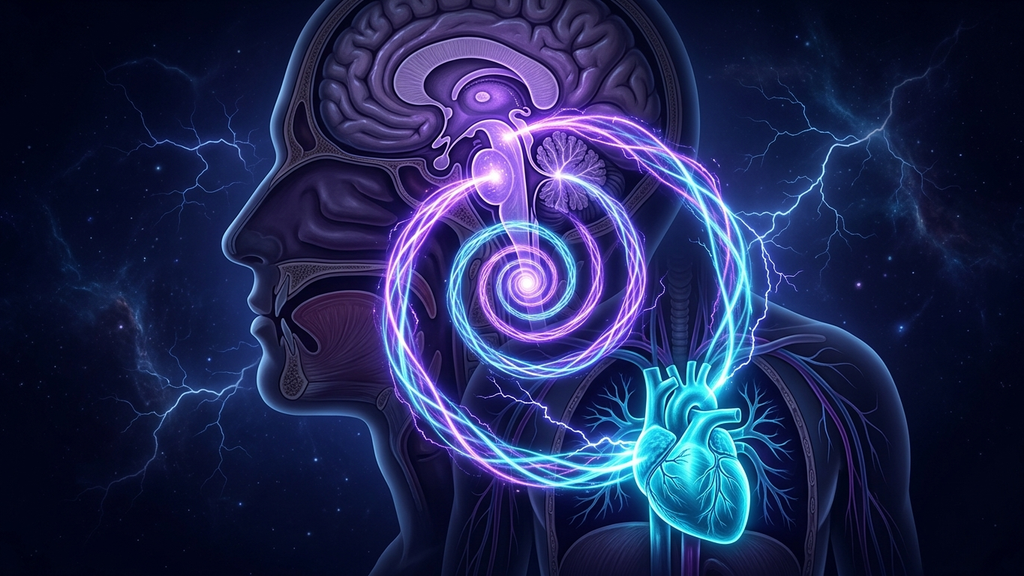
Clients who experience panic attacks almost universally believe two things: that the attack came "out of nowhere," and that something is medically wrong with their heart. Both beliefs are wrong in instructive ways, and correcting them is a large part of the treatment. A panic attack is best understood not as an emotion but as an autonomic feedback storm — a loop between interoceptive signals and the brainstem's threat machinery that briefly runs away with itself.
Anatomy of the Loop
The sequence is remarkably stereotyped once you know what to look for:
- A small physiological perturbation occurs — a skipped beat, a shift in CO2 from a sigh, a blood-sugar dip, a postural blood-pressure change.
- Interoceptive afferents carry that signal up, largely through the vagus and spinal pathways, to the insula and amygdala.
- The brain, primed by prior experience, misreads the signal as a threat and triggers a sympathetic surge.
- The surge produces exactly the sensations the client fears — pounding heart, breathlessness, dizziness, tingling.
- Those sensations become fresh interoceptive "evidence" of danger, which drives the next surge. The loop closes and amplifies.
This is why panic feels like it escalates on its own. It is a positive feedback loop, and the terror is not the cause — it is a rung on the ladder.
The Hyperventilation Engine
One mechanism deserves special attention because it is so often missed. Subtle over-breathing during panic blows off CO2, producing respiratory alkalosis. Alkalosis causes cerebral vasoconstriction (the dizziness and unreality), reduced calcium availability (the tingling and tetany), and a further sense of air hunger that drives even more breathing. Many "unexplained" panic symptoms are simply the signature of low CO2, and this is directly interruptible.
Where to Break the Loop
Because it is a loop, you can intervene at any point — but some points are far more effective than others.
- The exhale. Slow, extended exhalation raises CO2 back toward normal and directly stimulates vagal afferents, applying the parasympathetic brake at the exact site the storm is spinning. This is the single highest-yield in-the-moment tool.
- Interoceptive reappraisal. Training clients, when calm, to relabel the sensations ("this is a surge of adrenaline, it peaks and passes in minutes") weakens the misread at step 3. The physiology is identical; the interpretation is what feeds or starves the loop.
- Peripheral cooling. Cold on the face or a cold drink recruits the diving reflex, a hardwired parasympathetic response that can abort an early storm.
- Between-episode vagal conditioning. Raising baseline vagal tone — through breath practice, and for resistant cases non-invasive vagus nerve stimulation or focused ultrasound neuromodulation — raises the threshold at which the loop can ignite at all.
The Medical Reassurance That Actually Helps
Telling a panic client "your heart is fine" rarely lands, because it contradicts what their body is screaming. What lands is mechanism: explaining that the palpitations are a normal adrenergic response, that the loop is self-limiting because adrenaline clears in minutes, and that the very sensations they fear are proof the alarm system works, not that the machine is broken. Understanding turns a catastrophe into a process with an end.
Clinical takeaway: Treat panic as a feedback storm, not an emotion. The exhale is your fastest intervention — it corrects CO2 and applies the vagal brake simultaneously. Long-term, raise baseline vagal tone so the loop can't reach ignition.
References
- Meuret AE et al. "Feedback of end-tidal pCO2 as a therapeutic approach for panic disorder." Journal of Psychiatric Research, 2008;42(7):560-568.
- Paulus MP, Stein MB. "Interoception in anxiety and depression." Brain Structure and Function, 2010;214(5-6):451-463.
- Domschke K et al. "Interoceptive sensitivity in anxiety and anxiety disorders." Clinical Psychology Review, 2010;30(1):1-11.
- Clark DM. "A cognitive approach to panic." Behaviour Research and Therapy, 1986;24(4):461-470.