Sensory Overwhelm: When the Nervous System's Volume Knob Breaks
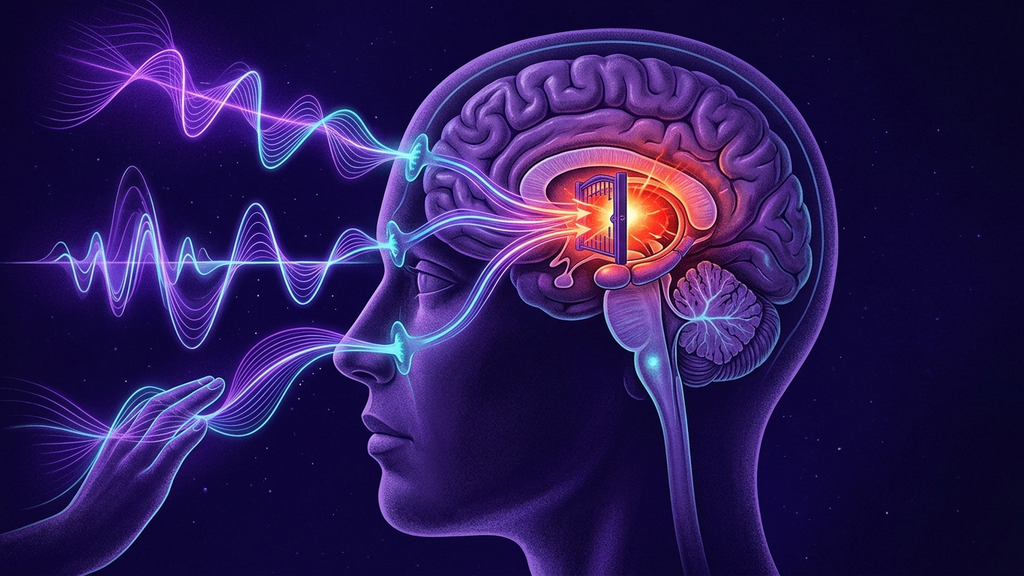
Sensory hypersensitivity — being overwhelmed by bright light, loud sound, busy environments, or physical touch — is a real and underserved complaint in the intake data, and it cuts across conditions from long COVID to chronic pain to trauma to POTS. Clients often can't name it precisely; they say the world feels "too much." For the practitioner, the useful model is that sensory gating is not fixed. It is set by autonomic state, and a nervous system on high alert turns the volume up on everything.
The Gate That Filters the World
At every moment the nervous system is flooded with far more sensory input than consciousness can use. Healthy function depends on filtering — sensory gating — that suppresses the irrelevant and lets through the important. The thalamus and brainstem perform much of this filtering, and crucially, the threshold is dynamic. It adjusts based on the body's assessment of threat. A safe, regulated nervous system filters generously. A threatened one lowers the threshold and lets more through, because in a dangerous world, missing a signal could be fatal.
Why Overwhelm Follows Dysregulation
Here is the mechanism that explains so many clients. When the autonomic nervous system is stuck in a sympathetic, hypervigilant state, the sensory gate is held wide open. Every input is treated as potentially important, so nothing gets filtered out. The client experiences light as too bright, sound as too loud, and crowds as unbearable — not because their eyes or ears changed, but because the filtering threshold dropped. The volume knob is stuck high because the system believes it is in danger.
This is why sensory overwhelm reliably worsens with fatigue, illness, poor sleep, and stress — all states that push the nervous system toward threat mode — and why it improves when the client feels safe and rested.
The Interoceptive Layer
Sensory sensitivity is not limited to the outside world. Many of these clients are also hypersensitive to internal signals — a normal heartbeat felt as pounding, normal digestion felt as pain, minor sensations amplified into alarms. This is the same gating failure applied to interoception, and it links sensory processing directly to anxiety, panic, and the amplified symptom perception seen across functional conditions.
Recalibrating the Gate
- Validate the mechanism. Clients told they are "too sensitive" internalize it as a character flaw. Explaining that their gate is set for threat — and can be reset — is both accurate and therapeutic.
- Lower the baseline threat signal. Vagal-tone work, exhale-biased breathing, and sleep restoration move the system out of the state that holds the gate open.
- Titrate exposure, don't force it. Gentle, graded reintroduction of stimulation in a regulated state teaches the gate it is safe to filter again; overwhelming exposure reinforces the threat setting.
- Consider direct neuromodulation. Non-invasive vagus nerve stimulation and focused ultrasound are being explored for their capacity to shift the autonomic set-point that governs gating.
Clinical takeaway: Sensory overwhelm is a gating problem, not oversensitivity of the sense organs. The filtering threshold is set by autonomic state — restore a sense of safety and vagal tone, titrate exposure gently, and the volume knob comes back down.
References
- McFadyen J et al. "The influence of subcortical shortcuts on disordered sensory and cognitive processing." Nature Reviews Neuroscience, 2020;21(5):264-276.
- Cheung PP, Siu AM. "A comparison of patterns of sensory processing in children with and without developmental disabilities." Research in Developmental Disabilities, 2009;30(6):1468-1480.
- Craig AD. "How do you feel — now? The anterior insula and human awareness." Nature Reviews Neuroscience, 2009;10(1):59-70.
- Harrison LA et al. "Interoception of breathing and its relationship with anxiety." Neuron, 2021;109(24):4080-4093.