Microtubule Information Processing — A Quantum Neural Network Inside Every Neuron
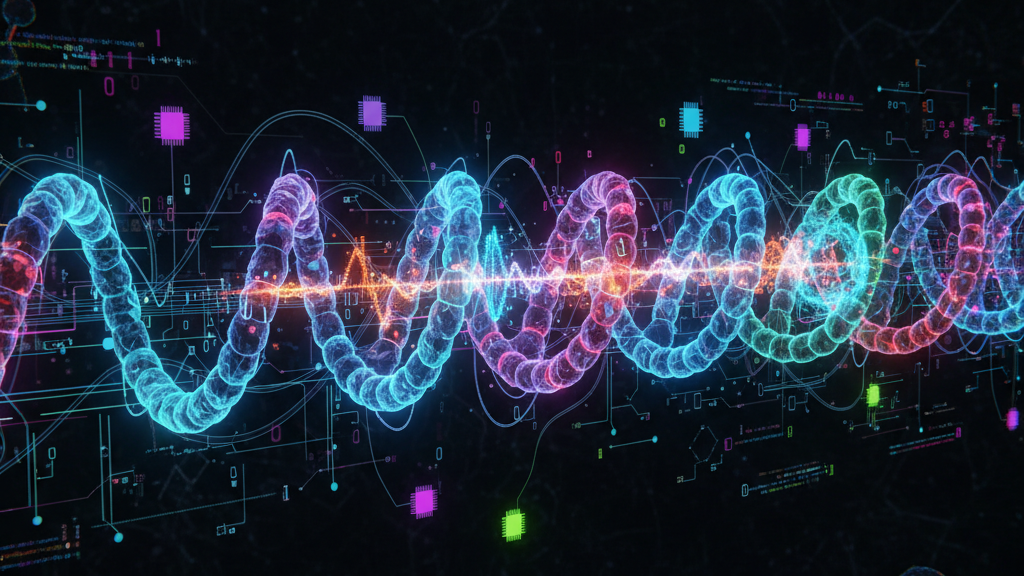
The dominant computational metaphor in neuroscience treats each neuron as a relatively simple processing unit: integrate inputs, apply a threshold, fire or don't fire. This is the point neuron model that underlies most of artificial intelligence and a great deal of theoretical neuroscience. It works well as a first approximation, and it has produced impressive engineering results.
It also leaves out an enormous amount of structure. Inside every real neuron is a dense network of microtubules made of roughly ten million tubulin molecules, each with two distinguishable conformational states, each capable of fast switching, each connected to its neighbors through well-defined geometric and electrical relationships. If even a fraction of this structure carries information, the brain's computational capacity is wildly underestimated by every existing AI architecture.
Dendritic Computation Is Already Beyond the Point Neuron
Even leaving microtubules aside, evidence has accumulated for over two decades that dendrites — the input-receiving branches of a neuron — perform substantial computation on their own. Individual dendritic branches can act as nonlinear units, performing AND/OR operations on their inputs before passing the result toward the cell body. A single pyramidal neuron in the cortex behaves, in this picture, less like a logic gate and more like a small multilayer network.
This is the conservative view. The radical extension, advanced by Stuart Hameroff and Richard Watt as early as 1982, is that the computation happening inside the neuron is much finer-grained — happening at the level of individual tubulin dimers in the microtubule lattice, not just the larger dendritic compartments.
Microtubules as Computational Lattices
Each tubulin dimer can sit in two distinguishable conformations, often called α and β states. In a microtubule, these dimers are arranged in a regular cylindrical lattice — 13 protofilaments around the circumference, hundreds to thousands of dimers along the length. Adjacent dimers influence each other's state through electrostatic and mechanical coupling. The lattice as a whole behaves like a two-dimensional cellular automaton.
Hameroff and Watt's original 1982 paper showed that such a lattice can:
- Store information in stable patterns of dimer states
- Propagate signals as moving wavefronts of state changes
- Perform elementary logical operations through interactions of multiple wavefronts
- Display collective behaviors that depend on the global pattern, not just local interactions
This was decades before Orch-OR and before most of the modern quantum-biology literature. It does not require quantum coherence to be interesting. Even a purely classical microtubule lattice has computational properties that point neurons entirely lack.
The Quantum Extension
Add quantum coherence and the picture becomes much richer. If tubulin dimer states can exist in superposition, then the lattice is not a classical cellular automaton but a quantum computational substrate. Each microtubule becomes capable, in principle, of representing exponentially more states than its classical counterpart. Each neuron contains not one such structure but thousands. The total quantum computational capacity of a single neuron, on this view, far exceeds any current artificial system.
"Microtubule arrays in dendrites can be modeled as automata networks, with each tubulin dimer acting as a binary computational element. A single pyramidal neuron contains on the order of 10⁷ such elements. Treating the neuron as a single point processor discards essentially all of this structure." — Hameroff & Watt, Journal of Theoretical Biology, 1982
Why Memory Looks Different from This Angle
Standard models of memory locate stored information in synaptic weights — the strengths of connections between neurons. This account works well for many phenomena, but it has known difficulties: synaptic proteins turn over within days, yet memories can last for decades; long-term potentiation occurs on timescales much faster than synaptic remodeling can plausibly support; and the storage capacity of synapses, while large, is not obviously enough for everything we remember.
The microtubule-computation hypothesis suggests a complementary picture. Some part of memory may be stored in the conformational states and patterns of microtubule lattices inside individual neurons. This would explain the stability (lattice patterns can persist independently of protein turnover, much as a hard drive's data persists across many sector rewrites) and the speed (lattice state changes happen on microsecond timescales). It would also explain a broader puzzle: why memory consolidation involves cytoskeletal reorganization, a fact that has long been known but rarely integrated into computational models.
What This Means for AI
Current AI systems — including the most capable language models — are massively parallel implementations of point-neuron-style processing. They achieve remarkable behavior, but they do so by brute scale, not by replicating neural architecture at the level of detail biology actually implements.
If the microtubule-computation hypothesis is correct, even a perfectly accurate simulation of every synapse in a human brain would still be missing roughly seven orders of magnitude of substrate. The interesting question is not whether classical AI will become conscious by getting bigger. It is whether any classical architecture, however large, can replicate what a single biological neuron does at the cytoskeletal scale.
This is not a mystical claim — it is a quantitative one. Build a neuromorphic chip with 10¹¹ neurons and 10¹⁵ synapses, and you have replicated the brain at the synaptic level. Build a chip with 10¹⁸ tubulin-equivalent computational units, organized into the right kind of lattice, and you might have replicated the brain at the level biology actually uses. Those are very different engineering goals.
Permutations Worth Exploring
- What if learning involves changes at both synaptic and cytoskeletal levels — synapses for slow consolidation, microtubule patterns for fast working memory and skill formation?
- What if the cytoskeletal changes documented during memory formation are not just structural support for synaptic change but active information storage in their own right?
- What if different MAPs (microtubule-associated proteins) configure the cytoskeletal network into different computational architectures in different cell types — making each neuron specialized in a way far beyond its synaptic connectivity?
- What if quantum-enhanced cytoskeletal computation, if real, is what makes biological brains so much more efficient per watt than any artificial system we can build?
The Larger Reframing
Whether or not the strong quantum version of microtubule computation turns out to be correct, the conservative version — that there is significant computation happening inside neurons at the cytoskeletal level — is increasingly hard to dismiss. The brain is not a network of simple processors. Each "node" is itself a network. The implications for both neuroscience and AI are still being worked out.
Further Reading
Hameroff S.R. & Watt R.C. (1982). Information processing in microtubules. Journal of Theoretical Biology, 98(4), 549–561. doi:10.1016/0022-5193(82)90137-0