Microtubules and Consciousness: The Structural Basis of Awareness
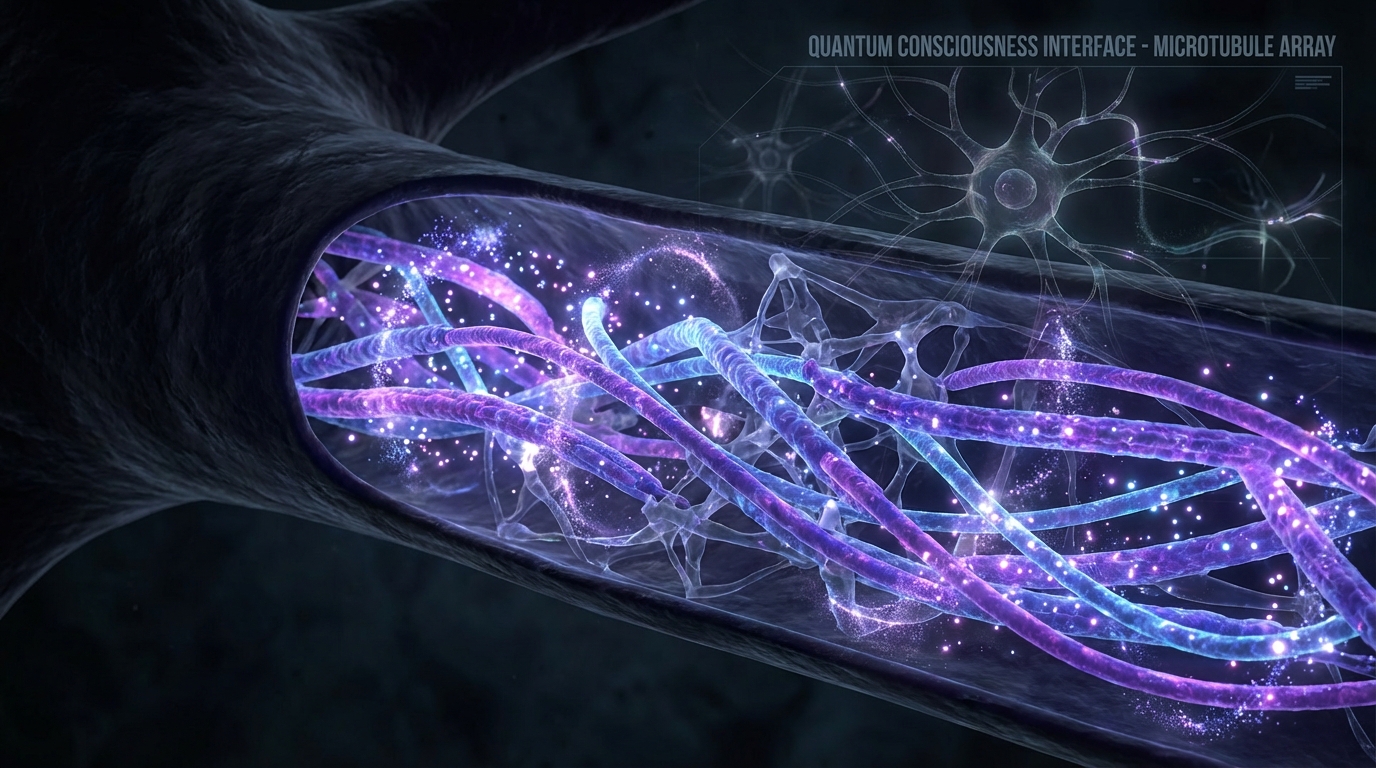
Deep inside your neurons, a lattice of protein structures called microtubules does far more than maintain cell shape. According to a growing body of theoretical work — most notably the Orchestrated Objective Reduction (Orch-OR) theory proposed by physicist Roger Penrose and anesthesiologist Stuart Hameroff — these structures may be the physical substrate of consciousness itself.
What Are Microtubules?
Microtubules are cylindrical polymers made of tubulin protein dimers. They form the structural backbone of the cytoskeleton in every eukaryotic cell, but in neurons they take on a special role. Neuronal microtubules are extraordinarily stable, lasting hours to days rather than the minutes seen in other cell types. They organize synaptic connections, transport neurotransmitter vesicles, and maintain the elaborate dendritic architecture that allows a single neuron to receive up to 10,000 synaptic inputs.
The Quantum Brain Hypothesis
The Orch-OR theory proposes that quantum superposition and entanglement can occur within the tubulin proteins of microtubules. Each tubulin molecule can exist in two conformational states, and the theory suggests these states can exist in quantum superposition — much like Schrödinger's cat — until a threshold is reached and the superposition collapses ("objective reduction").
"Consciousness is not computation. It is a quantum gravitational phenomenon occurring in the brain's microtubules." — Roger Penrose
Evidence Supporting Quantum Effects in Microtubules
- Quantum coherence in tryptophan: Tryptophan residues in tubulin exhibit quantum fluorescence effects that could support quantum computation
- Anesthetic mechanism: General anesthetics bind specifically to microtubules and disrupt quantum coherence — which would explain why they abolish consciousness
- Warm quantum effects: Experiments have shown quantum coherence lasting microseconds in warm biological systems, challenging the assumption that quantum effects are destroyed by thermal noise
- Gamma synchrony: The 40 Hz gamma oscillations associated with consciousness may be driven by microtubule resonance
Microtubules and Neurodegeneration
When microtubules destabilize, the consequences are catastrophic. In Alzheimer's disease, the tau protein that normally stabilizes microtubules becomes hyperphosphorylated and detaches, forming neurofibrillary tangles. The resulting microtubule collapse leads to impaired axonal transport, synaptic dysfunction, and neuronal death.
This connection between microtubule integrity and cognitive function adds another dimension to the consciousness hypothesis: if microtubules are indeed involved in generating conscious experience, their degradation in neurodegeneration would directly erode consciousness itself.
Implications for Understanding Awareness
If Orch-OR is correct, consciousness is not an emergent property of complex computation — it is a fundamental feature of the universe, connected to quantum gravity at the Planck scale. This would mean that even simple organisms with microtubules possess some form of proto-consciousness, and that the subjective experience of being alive is woven into the fabric of physical reality.
Whether or not Orch-OR proves to be the complete picture, the study of microtubules has opened a new frontier at the intersection of quantum physics, neuroscience, and philosophy of mind. The structural basis of awareness may be hiding in plain sight — in the protein lattice that holds your neurons together.