The Bottom-Up Anxiety Nobody Treats: Why Your Vagus Nerve Writes the Fear Before Your Mind Explains It
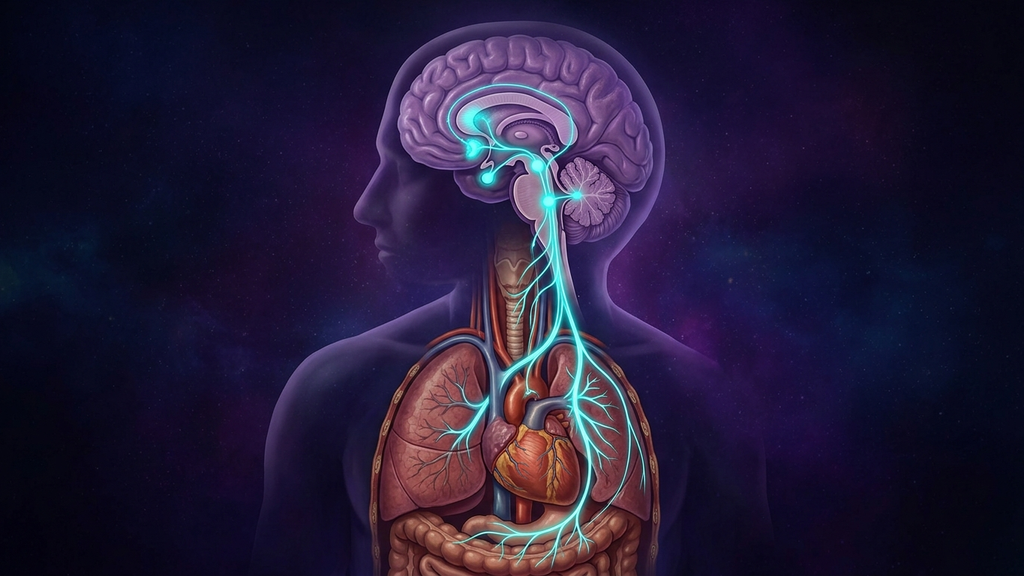
We treat anxiety as though it originates in thought. The reasoning goes: the mind misjudges a situation, catastrophizes, and the body follows. So we hand people cognitive worksheets and ask them to argue with their own fear. For a meaningful subset of patients this works. For a larger subset — the ones with palpitations, air hunger, a gut that never settles, and a resting heart rate variability in the basement — it fails completely, and they conclude something is broken in them. What is actually broken is the direction of the arrow. Roughly eighty percent of the fibers in the vagus nerve are afferent: they run from body to brain, not brain to body. In these patients, anxiety is not a bad thought. It is an accurate report of an alarmed body.
The Vagus Is Mostly a Sensory Nerve
The vagus is usually described as the body's great parasympathetic brake — the nerve you stimulate to calm down. That description is true but backwards in emphasis. Anatomically, the vagus is dominated by afferent traffic. Its sensory fibers wrap the heart, the lungs, the stomach, the intestines, the liver, and the chemoreceptors that sample your blood. Moment to moment, they report cardiac rhythm, respiratory stretch, gastric distension, gut inflammation, and blood chemistry upward into the brainstem. This is the raw data stream of interoception — the sense of the internal state of the body.
That stream does not arrive in the thinking brain first. It lands in the nucleus tractus solitarius (NTS) in the medulla, the first-order relay for nearly all visceral sensation. From the NTS it projects to the parabrachial nucleus, then upward to the insular cortex — the brain's map of the body — and, critically, to the amygdala and the anterior cingulate before the prefrontal cortex ever gets a vote. In other words, the body's status report reaches the brain's threat-detection hardware before it reaches the machinery of reason. By the time you have a thought about being anxious, the interoceptive verdict has already been rendered.
The Brain Is a Prediction Engine, Not a Camera
Modern neuroscience no longer treats the brain as a passive receiver of sensation. Under the predictive processing framework advanced by Lisa Feldman Barrett and others, the brain is constantly generating predictions about the state of the body and comparing them against the incoming afferent signal. Emotion, in this model, is the brain's best guess about what a given pattern of bodily sensation means. A pounding heart, shallow breath, and a churning gut are physiologically nonspecific — they accompany excitement, exertion, infection, and fear alike. The brain must assign a meaning. When the interoceptive signal is loud and disordered and the context is ambiguous, the most metabolically conservative guess the brain can make is threat.
This is the mechanism behind the anxious narrative. The body sends up a barrage of alarm-shaped signals — an erratic heartbeat, a glucose crash, a bloated and inflamed gut, a breath held high in the chest. The brain, doing its job, constructs a story that would justify feeling this way: something is wrong, I am in danger, this meeting/relationship/symptom is the threat. The narrative feels like the cause. It is the caption. This is precisely why "just think differently" so often fails. You cannot reason your way out of a conclusion the body keeps re-supplying with fresh evidence every few seconds.
HRV: Reading the Afferent Traffic
If anxiety is frequently bottom-up, we need a way to measure the bottom. Heart rate variability — the beat-to-beat variation in cardiac timing — is the most accessible window we have. High-frequency HRV is largely a readout of vagal (parasympathetic) influence on the sinoatrial node. Julian Thayer's neurovisceral integration model ties this directly to emotion regulation: a well-functioning prefrontal cortex exerts inhibitory control over the amygdala and brainstem via the vagus, and the visible signature of that control is a flexible, high HRV. When that circuit degrades — through chronic stress, illness, long COVID, dysautonomia, or POTS — HRV tends to fall, and the top-down brake weakens exactly as the bottom-up alarm grows louder.
A meta-analysis of HRV and neuroimaging studies mapped the anatomy: individual differences in vagal tone track with activity in the very cortical regions — medial prefrontal, anterior cingulate, insula — that gate the threat response. Low HRV is not merely correlated with anxiety. In this framing it is a biomarker of a nervous system in which the afferent alarm is winning and the regulatory circuit that should quiet it has lost flexibility.
GABA, Glutamate, and the Gut's Vote
Two more mechanisms make this loop self-reinforcing. The first is neurochemical. The balance between GABA (the brain's primary inhibitory transmitter) and glutamate (its primary excitatory one) sets the excitability of the threat circuits. A nervous system with robust vagal tone tends to sit on the inhibitory side of that ledger, with the prefrontal-limbic circuitry able to dampen the amygdala; when vagal regulation collapses, the system tilts toward excitation and the amygdala becomes easier to trip.
The second is the gut, and here the vagus is the wire. The microbiome is a genuine participant in this chemistry, and it signals the brain through the vagus. In a now-classic experiment, Bravo and colleagues showed that feeding mice a specific Lactobacillus strain altered central GABA-receptor expression and reduced anxiety-like behavior — and that the effect disappeared when the vagus was cut. The gut was not producing the behavioral change through the bloodstream in that case; it was signaling up the vagal cable. This is the mechanistic heart of the gut-brain axis for anxiety: an inflamed, dysbiotic, or dysmotile gut is an afferent generator, and its output is routed straight into the emotional brainstem.
How to Recognize Bottom-Up Anxiety
This phenotype has a recognizable clinical signature, distinct from the ruminative, cognition-first presentation:
- The physical sensations come first — the pounding heart or air hunger precedes the worried thought, rather than following it.
- Anxiety and panic that arrive "out of nowhere," including nocturnal panic that wakes the person from sleep, when there is no thought to have triggered it.
- Prominent palpitations, chest tightness, air hunger, and a gut that is bloated, inflamed, or erratic.
- Low resting HRV and a resting heart rate that is high or unstable, often with orthostatic symptoms.
- Symptoms that worsen with poor sleep, glucose swings, alcohol, and gut flares — physiological perturbations — more than with life circumstances.
- A history of "doing all the therapy right" with limited relief, because the intervention was aimed at the caption, not the signal.
None of this makes cognitive and trauma-focused therapy wrong; for many people the top-down and bottom-up contributions coexist. The point is that when the body is the louder driver, a body-level intervention has to come first, or the talk therapy is working against a signal that keeps regenerating.
Where Neuromodulation and Ultrasound Fit
If the problem is an overloud afferent stream feeding an under-braked brain, then the fastest anxiolytic is often physiological — an intervention applied to the vagal-afferent pathway itself.
1. Slow, extended-exhale breathing
Breathing is the one autonomic function under direct voluntary control, and the exhale is the vagal half of the cycle. Breathing at roughly six breaths per minute with a longer exhale than inhale loads the pulmonary stretch receptors and baroreceptors in a rhythm that maximizes vagal afferent firing and drives high-amplitude HRV. This is not relaxation theater; it is a direct edit to the afferent signal the brain is reading. Systematic reviews of slow breathing document consistent shifts toward parasympathetic dominance and reduced self-reported anxiety.
2. taVNS — stimulating the afferent vagus directly
The auricular branch of the vagus surfaces on the skin of the outer ear, which makes it non-invasively accessible. Transcutaneous auricular vagus nerve stimulation (taVNS) delivers a mild electrical current there and recruits the same NTS-to-limbic afferent pathway. Early controlled trials in major depression and anxiety are encouraging, and the proposed mechanism is exactly the one described here: driving orderly afferent input to quiet an overreactive limbic system. This is emerging technology — the trials are still small and often nonrandomized — but the direction of the data has been consistent, and larger trials are underway.
3. Low-intensity focused ultrasound
Focused low-intensity ultrasound aimed at the cervical vagus or at deep autonomic hubs is being studied as a way to neuromodulate this circuit with more spatial precision than surface electrodes allow. The work is early and belongs firmly in the "being studied" column, but over the coming years we expect focused ultrasound to become a serious tool for tuning vagal-afferent tone non-invasively. For now it is a research modality, not a home practice.
4. Humming, gargling, singing, and the dive reflex
Humming and singing recruit the vagally innervated muscles of the larynx and extend the exhale simultaneously. Cold-water face immersion triggers the diving reflex — a hardwired vagal response that slows the heart within seconds — and is one of the fastest ways to interrupt an escalating panic loop. These cost nothing, and they act on the same afferent machinery as the technology. (People with known cardiac arrhythmia should approach hard cold exposure cautiously and with clinician input, since the same reflex that slows the heart can, rarely, provoke rhythm problems.)
Note where this meets the body's energy story. A vagal fiber, a cardiac pacemaker cell, and a gut smooth-muscle cell all run on mitochondrial ATP. When cellular energy is depleted — as is often described in ME/CFS, long COVID, and perimenopause — the tissues generating the afferent signal misfire, and the vagus itself may signal less cleanly. Anxiety of this kind sits at the intersection of afferent signaling and cellular energy: you are calming the alarm and, in parallel, helping rebuild the capacity of the tissues that sound it.
When to Get Evaluated
Reframing anxiety as bottom-up does not mean assuming every alarming sensation is benign. Palpitations with chest pain, syncope or near-syncope, breathlessness at rest, a genuinely irregular pulse, or any new cardiac symptom must be evaluated medically before being attributed to the nervous system. Panic and a heart attack can feel alike, and a first panic-like episode in an older adult or anyone with cardiac risk factors deserves a workup rather than reassurance. The body's alarm is sometimes reporting real, treatable disease. Rule that out first, then treat the loop. And none of the above is a reason to start or stop a prescribed medication on your own — any change to psychiatric or cardiac medication is a decision to make with the clinician who prescribed it.
Clinical takeaway: When anxiety resists cognitive work, stop treating the caption and treat the signal. In this phenotype the fear is a downstream read of a dysregulated body flooding the brainstem with interoceptive threat. Measure HRV, address the gut, and intervene on the vagal afferent pathway directly — extended-exhale breathing first, then taVNS and, as the evidence matures, focused ultrasound. You are not talking a patient out of a belief. You are changing the data the brain is forced to explain.
References
- Craig AD. "How do you feel? Interoception: the sense of the physiological condition of the body." Nature Reviews Neuroscience, 2002;3(8):655-666.
- Barrett LF, Simmons WK. "Interoceptive predictions in the brain." Nature Reviews Neuroscience, 2015;16(7):419-429.
- Thayer JF, Ahs F, Fredrikson M, Sollers JJ, Wager TD. "A meta-analysis of heart rate variability and neuroimaging studies: implications for heart rate variability as a marker of stress and health." Neuroscience & Biobehavioral Reviews, 2012;36(2):747-756.
- Berthoud HR, Neuhuber WL. "Functional and chemical anatomy of the afferent vagal system." Autonomic Neuroscience, 2000;85(1-3):1-17.
- Bravo JA, Forsythe P, Chew MV, et al. "Ingestion of Lactobacillus strain regulates emotional behavior and central GABA receptor expression in a mouse via the vagus nerve." Proceedings of the National Academy of Sciences, 2011;108(38):16050-16055.
- Zaccaro A, Piarulli A, Laurino M, et al. "How breath-control can change your life: a systematic review on psycho-physiological correlates of slow breathing." Frontiers in Human Neuroscience, 2018;12:353.
- Rong P, Liu J, Wang L, et al. "Effect of transcutaneous auricular vagus nerve stimulation on major depressive disorder: a nonrandomized controlled pilot study." Journal of Affective Disorders, 2016;195:172-179.