The Gut-Brain Axis: Mitochondria at the Crossroads
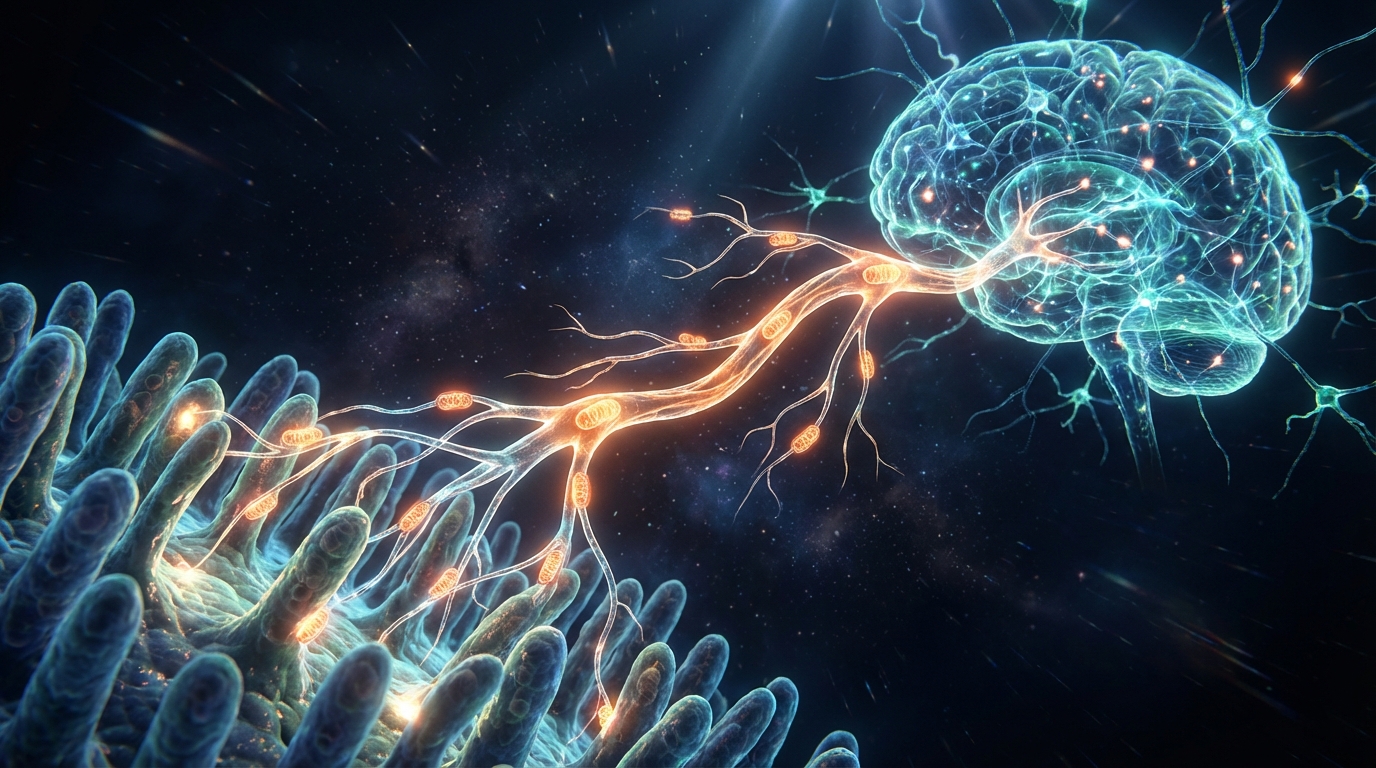
The gut-brain axis is one of the most fascinating communication networks in human biology. Your gastrointestinal tract sends signals to your brain via the vagus nerve, immune mediators, and microbial metabolites — and your brain sends signals back, influencing gut motility, secretion, and the microbiome itself. At the center of this two-way conversation sit mitochondria, powering both sides of the dialogue.
The Vagus Nerve: A Mitochondrial Highway
The vagus nerve is the longest cranial nerve, running from the brainstem to the gut and touching nearly every organ along the way. It transmits signals at speeds of up to 120 meters per second — and each of those signals requires ATP. The vagus nerve is richly supplied with mitochondria, particularly at the synaptic junctions where parasympathetic signals are transmitted to target organs.
When vagal tone is high (strong vagus nerve function), the gut receives clear parasympathetic signals promoting digestion, anti-inflammatory responses, and microbiome balance. When vagal tone drops — often due to chronic stress, poor mitochondrial function, or autonomic dysfunction — the gut-brain axis degrades.
"The vagus nerve is not just a communication cable — it's a living tissue whose function depends on the health of its mitochondria. Damaged mitochondria in vagal neurons literally degrade the gut-brain connection." — Frontiers in Neuroscience, 2025
Serotonin: The Gut's Energy-Dependent Neurotransmitter
Approximately 95% of your body's serotonin is produced in the gut by enterochromaffin cells. Serotonin synthesis requires the enzyme tryptophan hydroxylase (TPH1), which uses molecular oxygen and the cofactor tetrahydrobiopterin (BH4) — both of whose availability is influenced by mitochondrial function:
- Oxygen: Mitochondria consume oxygen for oxidative phosphorylation; local oxygen levels affect TPH1 activity
- BH4 recycling: The regeneration of BH4 requires NADH, produced by mitochondrial complex I
- Tryptophan availability: Mitochondrial dysfunction increases kynurenine pathway metabolism, diverting tryptophan away from serotonin synthesis
The Microbiome-Mitochondria Connection
Your gut microbiome and your mitochondria share an ancient evolutionary relationship. Mitochondria are descendants of alpha-proteobacteria that were engulfed by ancestral eukaryotic cells — meaning your mitochondria are, in a sense, domesticated bacteria. This shared heritage creates remarkable biochemical crosstalk:
- Short-chain fatty acids (SCFAs): Bacterial fermentation produces butyrate, propionate, and acetate that serve as mitochondrial fuel in colonocytes
- Mitochondria-like bacterial metabolism: Gut bacteria use electron transport chains similar to mitochondrial ETC, and some can directly influence host mitochondrial function
- Molecular mimicry: Bacterial peptides can activate or inhibit mitochondrial pathways through shared evolutionary motifs
- Immune calibration: Microbiome signals train the innate immune system, which regulates mitochondrial biogenesis through inflammatory cytokines
Leaky Gut, Leaky Mitochondria
Intestinal permeability ("leaky gut") and mitochondrial dysfunction often appear together, and the relationship is bidirectional:
- Gut → Mitochondria: When the intestinal barrier fails, bacterial lipopolysaccharide (LPS) enters the bloodstream and damages mitochondria by triggering excessive ROS production
- Mitochondria → Gut: When colonocyte mitochondria fail, the tight junctions that seal the intestinal barrier lose their energy supply and weaken
This creates a vicious cycle: mitochondrial damage causes leaky gut, which causes more mitochondrial damage. Breaking the cycle requires addressing both sides simultaneously.
Practical Protocol: Supporting Both Ends
A gut-brain axis optimization protocol should address mitochondrial health on both sides:
- Prebiotics and fiber: Feed the microbiome to produce SCFAs that fuel colonocyte mitochondria
- Vagus nerve stimulation: Cold exposure, humming, and deep breathing improve vagal tone and parasympathetic signaling to the gut
- Mitochondrial nutrients: CoQ10, PQQ, magnesium, and B vitamins support the electron transport chain
- Polyphenols: Compounds like resveratrol and curcumin activate mitochondrial biogenesis (SIRT1/PGC-1α pathway) while supporting gut barrier integrity
- Circadian alignment: Both the gut microbiome and mitochondrial function follow circadian rhythms — disrupted sleep damages both
The gut-brain axis is not an abstract concept — it is a physical, electrical, and chemical network powered by mitochondria at every junction. To optimize this axis, you must optimize the cellular engines that drive it.