Autoimmunity and the Nervous System: The Case for Treating the Regulator, Not Just the Immune System
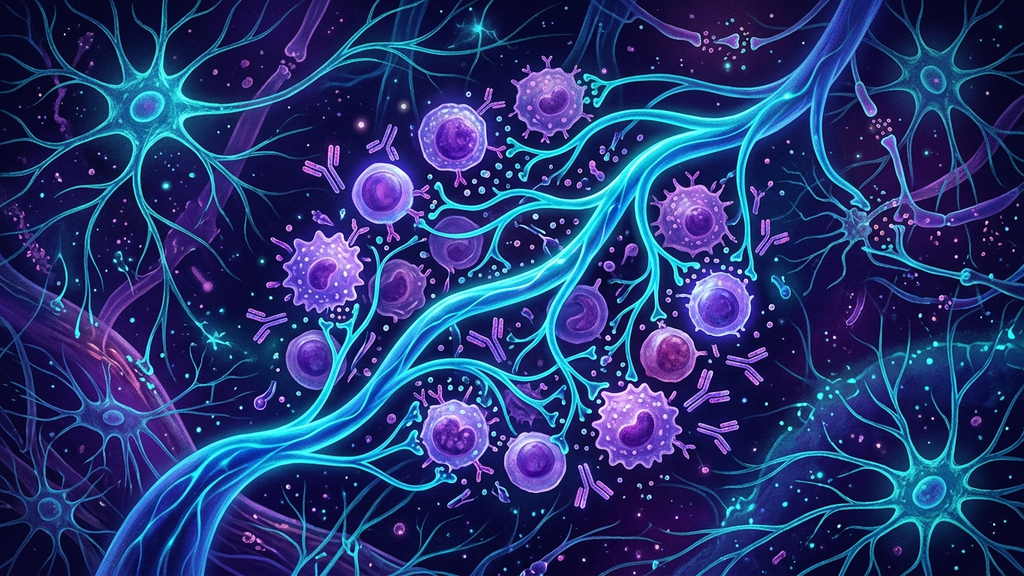
A recurring theme in intake reads something like: "my autoimmune condition is coming from my trauma and dysregulation." Clients sense a connection that conventional care often dismisses. They are onto something real. The nervous system exerts direct, mechanistic control over immune activation, and for practitioners working with autoimmune clients, the regulator itself is an underused treatment target.
The Inflammatory Reflex
The core insight comes from neuroimmunology: the vagus nerve forms a reflex arc that senses and controls inflammation. Afferent fibers detect inflammatory cytokines and report to the brainstem. Efferent fibers, through the cholinergic anti-inflammatory pathway, release acetylcholine that acts on immune cells — particularly in the spleen — to suppress the production of pro-inflammatory cytokines like TNF. In plain terms: a well-functioning vagus applies a continuous brake to immune over-activation.
When vagal tone is low — from chronic stress, trauma, poor sleep, or illness — that brake weakens. The immune system loses a layer of top-down regulation. This does not cause autoimmunity by itself, but it removes a governor from a system that, in autoimmune disease, is already prone to over-firing.
Why Flares Track With Stress
Clients consistently report that flares follow periods of stress, poor sleep, and emotional load. This is not coincidence or psychosomatic hand-waving. Sympathetic dominance and HPA-axis dysregulation shift immune signaling toward a pro-inflammatory profile, while simultaneously the withdrawn vagal brake fails to counter it. The felt experience of "my body attacks itself when I'm dysregulated" has a clean mechanistic explanation.
The Evidence for Neuromodulation
This is not merely theoretical. Vagus nerve stimulation has moved into clinical trials for rheumatoid arthritis, inflammatory bowel disease, and other autoimmune conditions, with measurable reductions in disease activity and inflammatory markers in early studies. The mechanism is precisely the cholinergic anti-inflammatory pathway. Non-invasive approaches — transcutaneous auricular stimulation and emerging focused ultrasound neuromodulation — aim to deliver the same effect without surgery.
What This Means for Practice
- Position autonomic regulation as adjunctive, not alternative. This complements disease-modifying medical care; it does not replace it. Clients should never stop prescribed immunotherapy in favor of vagal work.
- Raise baseline vagal tone deliberately — breath practice, HRV biofeedback, sleep protection, and where appropriate non-invasive vagus nerve stimulation or focused ultrasound.
- Treat the nervous system state as a modifiable flare variable. Helping a client shift out of chronic sympathetic overdrive is a legitimate way to reduce flare frequency and intensity.
- Address the bioenergetic and gut layers — mitochondrial support and gut barrier integrity, both of which feed the inflammatory load the vagus then has to counter.
Clinical takeaway: Autoimmune clients who feel their condition tracks with dysregulation are describing the inflammatory reflex. The vagus is a real, trainable brake on immune over-activation. Treat autonomic state as a modifiable flare variable alongside — never instead of — disease-modifying care.
References
- Tracey KJ. "Reflex control of immunity." Nature Reviews Immunology, 2009;9(6):418-428.
- Koopman FA et al. "Vagus nerve stimulation inhibits cytokine production and attenuates disease severity in rheumatoid arthritis." PNAS, 2016;113(29):8284-8289.
- Bonaz B et al. "Vagus nerve stimulation: a new promising therapeutic tool in inflammatory bowel disease." Journal of Internal Medicine, 2017;282(1):46-63.
- Pavlov VA, Tracey KJ. "Neural regulation of immunity: molecular mechanisms and clinical translation." Nature Neuroscience, 2017;20(2):156-166.