How to Actually Rebuild Vagal Tone: A Coaching Protocol for the Autonomic Nervous System
Most coaches treat the nervous system as a mood to be managed — a state you talk someone down from, breathe someone out of, one session at a time. That framing quietly fails the people who need it most: the dysautonomia, POTS, long-COVID, and ME/CFS clients whose baseline never resets no matter how calm the room is. The reframe that changes everything is this: vagal tone is not a mood. It is a physiological capacity, and it is trainable — like aerobic base or grip strength. It has a mechanism, a dose-response curve, and a measurable output you can program against. This article is the methodology that ties the whole library together: what a coach actually does with everything else you have read here.
Why the Vagus Is the Trainable Variable
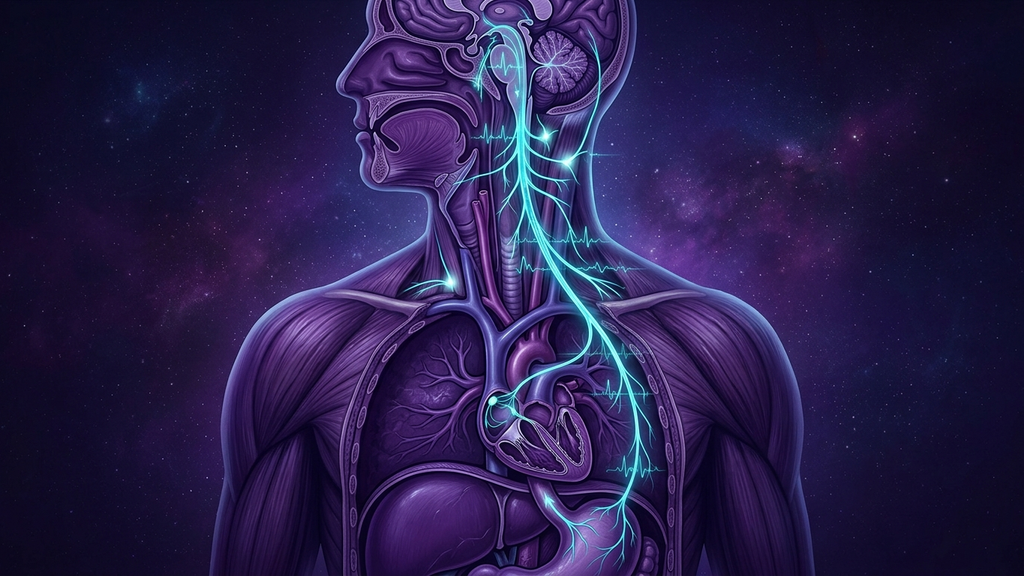
The vagus nerve is the primary parasympathetic pathway between the brainstem and the viscera — heart, lungs, gut, spleen. Roughly 80% of its fibers are afferent, carrying information up from the body to the nucleus tractus solitarius in the brainstem. That detail is the entire reason this is coachable: the vagus is not just a brake you apply to the heart, it is a sensing-and-signaling loop. "Vagal tone" is shorthand for how much parasympathetic influence that loop exerts on the sinoatrial node beat to beat.
You can see it in the timing of the heartbeat. When cardiac vagal drive is high, the interval between beats stretches and compresses with the breath — inhale tends to speed the heart, exhale to slow it. That is respiratory sinus arrhythmia, and its magnitude is a widely used readout of cardiac vagal control. This is why heart rate variability (HRV) is the coach's key performance indicator. It is not merely a wellness-gadget metric. It is among the closest non-invasive proxies we have for the integrity of the neurovisceral loop Thayer and Lane described — the system that lets the brain flexibly match physiology to demand. Low HRV is a signature shared across nearly every population you serve: chronic stress, systemic inflammation, depression, POTS, long COVID. That shared signature is not a coincidence. It is the training target.
Phase One: Measure Before You Intervene
You cannot program against a number you have not established. Before any protocol, spend one to two weeks building a baseline across three streams:
- Resting HRV, measured the same way every day. First thing on waking, supine or seated, before caffeine or phone. Consistency of measurement matters more than the specific device. A single reading is noise — HRV swings with sleep, hydration, hormones, illness, and last night's alcohol. What you are building is a trend line. A seven-day rolling average is the unit of analysis; any single morning is close to meaningless on its own.
- Orthostatic response. Heart rate lying down, then standing for one to three minutes. The size of the jump, and whether it settles, tells you how the autonomic system handles a gravitational challenge — the ordinary daily stressor that flattens POTS and dysautonomia clients.
- Symptom breadth, not just severity. Have the client track how many distinct symptoms show up each day (brain fog, palpitations, gut, sleep, temperature dysregulation, mood). In autonomic dysfunction, recovery often shows up first as the list getting shorter, before any single symptom fully resolves.
Trend beats any single reading, always. Teach the client this on day one, or they will ride every daily fluctuation like a verdict.
Phase Two: The Intervention Hierarchy
Order matters. Interventions are stacked from foundational to advanced, and you do not add a tier until the one beneath it is stable. Skipping to cold plunges and ultrasound while someone sleeps four hours and feels unsafe is how coaches trigger crashes.
1. Breath — the highest-leverage daily practice
Slow breathing at approximately six breaths per minute, with exhales longer than inhales, is one of the most reliable and best-evidenced vagal interventions available, and it costs nothing. The mechanism is fairly precise: at roughly 0.1 Hz, breathing resonates with the baroreflex, and the resulting blood-pressure oscillations maximally recruit vagal outflow to the heart. The extended exhale is where parasympathetic activation concentrates. This is not simply "relaxation" — it is rhythmic mechanical loading of the vagal reflex arc, and done daily it tends to raise resting HRV over weeks. Ten minutes, twice a day, is the anchor of the entire protocol. Everything else is built on top of it.
2. Safety and co-regulation — the coaching relationship as intervention
Here is the piece coaches underweight. A nervous system will not reliably downshift into a parasympathetic state while it perceives threat. Porges' polyvagal framing makes the point clinically useful: the ventral vagal, social-engagement state is gated by cues of safety — a calm voice, a regulated presence, predictability. This means the coaching relationship itself functions as a physiological intervention. Your regulated nervous system helps co-regulate theirs. For trauma-loaded and chronically-ill clients who have spent years being disbelieved, felt safety is not a preamble to the work; it is the work that makes every downstream technique available.
3. Sleep and circadian anchoring
Autonomic recovery is consolidated during sleep, and parasympathetic (vagal) dominance rises during deep, slow-wave sleep. A wandering sleep schedule keeps HRV suppressed no matter how good the breathwork is. Anchor wake time first, get morning light, protect the last hour before bed. This tier is unglamorous and non-negotiable.
4. Voice work
The vagus innervates the larynx and pharynx through its laryngeal and pharyngeal branches. Humming, gargling, chanting, and singing mechanically and reflexively engage those muscles and structures, and are a genuine, if gentler, form of vagal exercise — often well tolerated by sensitive clients who cannot yet handle cold or exertion. A few minutes of humming on the exhale layers neatly onto the breath practice.
5. Movement and gentle reconditioning
Deconditioning worsens orthostatic intolerance and tends to lower HRV; appropriate movement rebuilds both. But in the POTS and ME/CFS populations, start recumbent or supported — rowing, recumbent cycling, floor-based work — and progress by tolerance, never by ambition.
6. Cold exposure — dosed
Cold-water facial immersion recruits the diving reflex, a hardwired vagally mediated response that slows the heart. Brief, controlled cold — a cold splash to the face, later short cool showers — can acutely raise vagal tone. But cold is a stressor, and in fragile nervous systems it is the tier most likely to backfire. Introduce it late, small, and monitored, and skip it entirely in clients with cardiac history until cleared.
7. The emerging-tech tier
Covered in its own section below.
Phase Three: Dosing and Progression
Consistency beats intensity, nearly every time. Vagal tone appears to respond to frequent, sub-threshold stimulation the way an aerobic base responds to easy volume, not to heroic single efforts. Find the minimum effective dose and repeat it daily.
The trap that ruins protocols in ME/CFS and long COVID is post-exertional malaise — a delayed, disproportionate crash 12 to 48 hours after over-doing it, physically or autonomically. This is why the intervention hierarchy is titrated. Pacing is not caution for its own sake; it is respecting a system with an impaired recovery loop. Stay under the client's energy envelope. When in doubt, do less and hold it longer. A protocol that produces a crash has not been progressed too slowly — it has been progressed too fast.
Where Ultrasound and Neuromodulation Fit
Once the foundational tiers are stable, technology can add targeted vagal drive. Transcutaneous auricular vagus nerve stimulation (taVNS) delivers mild electrical stimulation to the auricular branch of the vagus at the outer ear — one of the few sites where a vagal afferent has a cutaneous representation accessible from the skin surface. Early data suggest it can shift autonomic balance and raise some vagal indices non-invasively, and it is being actively studied across inflammatory and dysautonomic conditions. The evidence is still maturing, and effects vary by protocol and population.
The emerging frontier — and Sterling Cooley's domain — is low-intensity focused ultrasound aimed at the cervical vagus or associated ganglia. It is genuinely preliminary: the appeal is precision, the possibility of targeting deep neural structures non-invasively that surface electrodes cannot reach. We expect the evidence base here to mature considerably over the coming years, and coaches should say so plainly to clients. For now, treat these tools as accelerants layered onto a working foundation, framed honestly as emerging — not as the thing that replaces breath, safety, and sleep.
How to Know It's Working — and When to Refer Out
Three signals, in roughly their order of appearance: the HRV trend lifts and, importantly, becomes more stable day to day; symptom breadth shrinks — the daily list gets shorter before it gets milder; and recovery accelerates — the same stressor knocks them down less far and for less long. That widening window between provocation and recovery is autonomic flexibility returning.
Red flags — refer to a physician, do not coach through these: new or worsening chest pain, syncope (actual fainting, not just lightheadedness), a resting heart rate persistently over 120, a very wide orthostatic jump that has not previously been worked up, unexplained weight loss, new neurological deficits, or any sudden change in symptom pattern. Autonomic symptoms can mask cardiac, endocrine, and neurological disease. Note too that beta-blockers and several other prescribed agents blunt heart rate and HRV readings — so a low or flat number may reflect medication, not deterioration. Any decision to start, stop, or change a medication belongs to the client and their clinician, never to you. Your scope is training a capacity in a medically-cleared client and knowing where that scope ends.
Clinical takeaway: Stop treating the nervous system as a state to manage and start treating vagal tone as a capacity to train. Measure HRV as a trend, build from breath and felt safety upward, dose for consistency over intensity, respect the post-exertional ceiling, and layer neuromodulation only onto a working foundation. This is what a coach does with everything else in this library.
References
- Thayer JF, Lane RD. "A model of neurovisceral integration in emotion regulation and dysregulation." Journal of Affective Disorders, 2000;61(3):201-216.
- Porges SW. "The polyvagal theory: phylogenetic substrates of a social nervous system." International Journal of Psychophysiology, 2001;42(2):123-146.
- Shaffer F, Ginsberg JP. "An overview of heart rate variability metrics and norms." Frontiers in Public Health, 2017;5:258.
- Laborde S, Mosley E, Thayer JF. "Heart rate variability and cardiac vagal tone in psychophysiological research — recommendations for experiment planning, data analysis, and data reporting." Frontiers in Psychology, 2017;8:213.
- Zaccaro A, Piarulli A, Laurino M, et al. "How breath-control can change your life: a systematic review on psycho-physiological correlates of slow breathing." Frontiers in Human Neuroscience, 2018;12:353.
- Lehrer PM, Gevirtz R. "Heart rate variability biofeedback: how and why does it work?" Frontiers in Psychology, 2014;5:756.
- Badran BW, Dowdle LT, Mithoefer OJ, et al. "Neurophysiologic effects of transcutaneous auricular vagus nerve stimulation (taVNS) via electrical stimulation of the tragus." Brain Stimulation, 2018;11(3):492-500.