Blood Pressure Instability and the Baroreflex: Why the Vagus Nerve Is Half of Your Cardiovascular Thermostat
We treat high blood pressure and low blood pressure as if they were opposite diseases requiring opposite drugs. One patient gets an antihypertensive; another gets salt and a mineralocorticoid. But the longer I work with people whose pressure will not hold still — who spike to 160 in the morning, crater to 85 when they stand, feel their heart pound at rest, and grey out reaching for a top shelf — the clearer it becomes that the highs and lows are usually the same lesion wearing two masks. The problem is not the pressure. It is the regulation of pressure. And the reflex that regulates it, beat to beat, runs half its circuit through the vagus nerve.
Blood Pressure Is Not a Number, It Is a Servo Loop
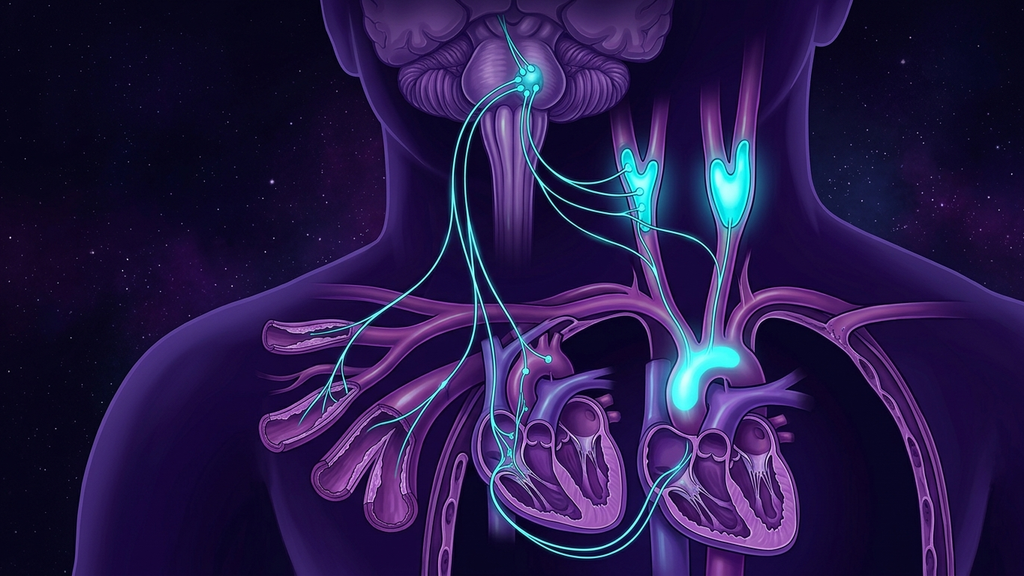
The body does not defend a blood-pressure reading. It defends perfusion of the brain, and it does so with one of the fastest negative-feedback loops in human physiology: the arterial baroreflex. Stretch-sensitive nerve endings in the carotid sinus and the aortic arch fire in proportion to how hard the vessel wall is being pushed. When pressure rises, they fire faster; when it falls, they go quiet. This is a continuous, moment-to-moment pressure gauge reporting to the brainstem several times per second.
Those afferent signals travel to a single relay station in the medulla — the nucleus tractus solitarius (NTS). The fibers from the carotid sinus run in the glossopharyngeal nerve; those from the aortic arch run in the vagus. The NTS is the integrating hub, the place where the raw pressure signal becomes a decision. From there, the correction goes out along two efferent arms, and this is the part clinicians tend to under-teach.
- The vagal arm. From the NTS, projections drive the nucleus ambiguus, the source of the parasympathetic cardiac fibers. This is the vagal brake on the heart. When pressure climbs, the NTS increases vagal outflow and the heart slows within a single beat — the vagus is fast because acetylcholine acts on the sinoatrial node almost instantly.
- The sympathetic arm. The NTS also feeds an inhibitory relay (the caudal ventrolateral medulla) that restrains the sympatho-excitatory neurons of the rostral ventrolateral medulla. When pressure falls, that restraint is lifted, sympathetic outflow rises, vessels constrict, and the heart speeds up.
So the baroreflex has a slow lever (sympathetic vascular tone, seconds to minutes) and a fast lever (the vagal brake, one heartbeat). A healthy system uses the vagal brake constantly, making tiny corrections you never feel. When that brake weakens, the body is forced to lean on the cruder, slower sympathetic lever — and crude correction is exactly what produces overshoot, undershoot, and swing.
The Vagus Is Half the Loop — and the Half We Can Measure
Here is the fact that reorganizes the whole clinical picture: baroreflex sensitivity — how many milliseconds the heart's interval lengthens for each millimeter of mercury that pressure rises — is one of the most validated non-invasive markers of cardiac vagal function we have. It is not a proxy invented for convenience. The reflex arc it measures physically runs through the vagus. When cardiologists use baroreflex sensitivity to risk-stratify after a heart attack, they are, in effect, measuring how intact the vagal brake is; in the landmark ATRAMI study, a depressed baroreflex predicted cardiac mortality independently of how well the heart was pumping.
This is why heart rate variability and baroreflex sensitivity tend to move together, and why both are blunted in the same populations: chronic stress, long COVID, ME/CFS, diabetes, aging, and dysautonomia. A person with a chronically low HRV usually has a blunted baroreflex too, because the two are reporting on the same wiring from different angles. When a coach sees a persistently low resting HRV, they should think, before anything else, this person's pressure-regulation buffer is thin.
Why a Blunted Baroreflex Produces Both Highs and Lows
The intuition most people carry — weak reflex means low pressure — is only half right. A poorly functioning thermostat does not make a room cold. It makes the room swing hot and cold, because it corrects late and then overcorrects. The baroreflex is a thermostat for pressure, and a blunted one fails in both directions.
Orthostatic hypotension. Stand up, and roughly half a liter of blood pools in the legs and the splanchnic bed. A competent baroreflex catches the falling pressure and clamps the vessels before you notice. A blunted one is slow; pressure drops far enough to under-perfuse the brain, and you get the classic grey-out, dizziness, and lightheadedness within seconds of standing.
Orthostatic and morning hypertension. The same failed buffering runs the other way. Without a smooth vagal brake to shave off transients, sympathetic surges go uncorrected and pressure overshoots — sometimes on standing, and especially in the early morning, when the normal circadian rise in sympathetic activity meets a reflex too sluggish to trim the peak. The morning surge is not a separate disease; it is the overshoot side of the same lost damping.
POTS is a heart-rate criterion, not a pressure one. This distinction matters enormously and is constantly muddled. Postural orthostatic tachycardia syndrome is defined by a sustained heart-rate rise of at least 30 beats per minute on standing (40 in adolescents) without a significant drop in blood pressure. The tachycardia is the tell: the heart is racing to compensate for pressure the vessels are failing to hold, or for a blood volume that is genuinely too low. POTS is heterogeneous — some phenotypes are chiefly hypovolemic, some involve a partial peripheral autonomic neuropathy, some run on a high-adrenergic drive — but the common thread is a baroreflex operating at the wrong gain. And a single person can show POTS, orthostatic hypotension, and, in autonomic-failure phenotypes, supine hypertension in the same body in the same week. That is not three diseases. It is one unstable loop.
Why Anxiety and Shallow Breathing Spike Your Pressure
Breathing is wired directly into the baroreflex, and this is the lever coaches can most immediately use. With each inhalation, vagal tone to the heart briefly withdraws and the heart speeds up; with each exhalation, vagal tone returns and it slows. That is respiratory sinus arrhythmia, and it is the vagal brake pulsing in real time. The rate at which you breathe sets how this interacts with the roughly ten-second rhythm of the baroreflex itself.
Fast, shallow chest breathing — the default of an anxious nervous system — keeps vagal withdrawal nearly continuous. The brake barely re-engages between breaths, sympathetic tone dominates, and pressure drifts up and becomes jumpy. Add the hyperventilation-driven fall in carbon dioxide, which constricts cerebral vessels, and you have someone who is simultaneously hypertensive and lightheaded, convinced something is catastrophically wrong — which drives still more sympathetic outflow. This is the loop a panic attack rides. It is also why "just breathe" is not a platitude but a direct intervention on the efferent arm of a cardiovascular reflex.
Nocturnal Non-Dipping and the Contributors You Can Actually Move
In health, blood pressure falls 10 to 20 percent at night as vagal tone rises in sleep. People whose pressure fails to fall — non-dippers — carry higher cardiovascular risk, and non-dipping is, at bottom, a sign that parasympathetic dominance never fully took over overnight. It is a nocturnal readout of a baroreflex that cannot let go of sympathetic drive. It travels with sleep apnea, chronic stress, and dysautonomia, and it is worth surfacing to a clinician, because it changes the risk conversation.
Two more contributors sit squarely in coach-adjacent territory, always framed as work done with a clinician:
- Blood volume. Many people with orthostatic intolerance are genuinely hypovolemic. There is less fluid for the reflex to redistribute, so even a normal baroreflex is fighting a losing battle. This is why sodium and fluid loading, and lower-body compression, often help — they add volume and reduce venous pooling so the reflex has something to work with. It is also why this must be individualized with a clinician: aggressive salt and fluid loading is the wrong move in heart failure, kidney disease, and some forms of hypertension.
- Deconditioning. Bed rest and prolonged illness shrink plasma volume and cardiac filling and further blunt the baroreflex — a vicious circle in which feeling terrible on standing makes people stand less, which worsens the reflex. Graded, largely recumbent-to-upright reconditioning (rowing, recumbent cycling, swimming) can rebuild both volume and reflex gain, but it has to start below the symptom threshold and progress slowly, or it backfires.
When to Get Evaluated: Red Flags
Reframing pressure instability as a baroreflex problem does not mean managing it alone. Seek prompt medical evaluation for: any true loss of consciousness (syncope), particularly if it arrives without warning or during exertion; chest pain or pressure, or shortness of breath; blood-pressure readings that are very high (for example, systolic over 180 or diastolic over 120), especially with headache, visual change, or neurological symptoms; and new, severe, or rapidly worsening swings. Unheralded or exertional syncope can signal cardiac or neurological disease that must be ruled out before any nervous-system work begins. And medication changes are always a decision to make with the prescribing clinician — never a lever to pull on your own.
Where Neuromodulation and Ultrasound Fit
Because the vagus is half of this reflex, the reflex is trainable — and the strongest evidence sits with the simplest tool.
1. Slow breathing at about six breaths per minute
Breathing at roughly six breaths per minute drives the respiratory rhythm into resonance with the baroreflex's own ten-second oscillation. At that pace the heart-rate and blood-pressure waves line up and amplify, and baroreflex sensitivity rises measurably within a single session. This is among the best-replicated findings in autonomic physiology: paced slow breathing, with exhales at least as long as inhales, acutely increases baroreflex gain and vagal outflow. It is free, it works in minutes, and it is the foundation everything else builds on.
2. HRV biofeedback
HRV biofeedback formalizes the same mechanism — the person breathes at their individual resonance frequency while watching their heart-rate oscillation grow, training the loop deliberately. Regular practice appears to raise resting baroreflex sensitivity over weeks, and it is a realistic home protocol a coach can supervise.
3. taVNS and focused ultrasound
Transcutaneous auricular vagus nerve stimulation delivers mild electrical current to the vagal branch that surfaces in the outer ear; early research reports shifts toward parasympathetic balance and reductions in sympathetic nerve activity, with modest and still-maturing blood-pressure data. Further out, low-intensity focused ultrasound aimed at the cervical vagus is being studied as a non-invasive way to modulate autonomic tone with millimeter precision. This is emerging technology — early data, small studies — and it should be described that way. But the logic is sound, and over the coming years we expect the evidence to sharpen.
4. Cold-water face immersion
Splashing cold water on the face, or briefly immersing it, triggers the mammalian dive reflex — a strong vagal surge that slows the heart. It can be a fast tool for aborting a sympathetic spike, though people with cardiac disease should clear it with a clinician first, since a sudden bradycardia is not benign for every heart.
Clinical takeaway: Stop sorting blood-pressure instability into "high" and "low." Sort it into well-regulated and poorly regulated. The orthostatic drops, the morning surges, the racing heart on standing, and the non-dipping nights are usually one story — a baroreflex whose vagal half has lost its grip. Measure that half (HRV, baroreflex sensitivity, orthostatic vitals), rebuild volume and conditioning alongside the clinician, and train the loop directly with slow breathing at about six breaths per minute. The pressure tends to follow the regulation, not the other way around.
References
- La Rovere MT, Bigger JT, Marcus FI, Mortara A, Schwartz PJ. "Baroreflex sensitivity and heart-rate variability in prediction of total cardiac mortality after myocardial infarction (ATRAMI)." The Lancet, 1998;351(9101):478-484.
- Benarroch EE. "The arterial baroreflex: functional organization and involvement in neurologic disease." Neurology, 2008;71(21):1733-1738.
- Lehrer PM, Gevirtz R. "Heart rate variability biofeedback: how and why does it work?" Frontiers in Psychology, 2014;5:756.
- Bernardi L, Porta C, Gabutti A, Spicuzza L, Sleight P. "Modulatory effects of respiration." Autonomic Neuroscience, 2001;90(1-2):47-56.
- Freeman R, Wieling W, Axelrod FB, et al. "Consensus statement on the definition of orthostatic hypotension, neurally mediated syncope and the postural tachycardia syndrome." Clinical Autonomic Research, 2011;21(2):69-72.
- Vaschillo EG, Vaschillo B, Lehrer PM. "Characteristics of resonance in heart rate variability stimulated by biofeedback." Applied Psychophysiology and Biofeedback, 2006;31(2):129-142.
- Clancy JA, Mary DA, Witte KK, Greenwood JP, Deuchars SA, Deuchars J. "Non-invasive vagus nerve stimulation in healthy humans reduces sympathetic nerve activity." Brain Stimulation, 2014;7(6):871-877.