Blood Sugar Swings and the Vagus Nerve: Why Your "Hypoglycemia" Is Often an Autonomic Problem
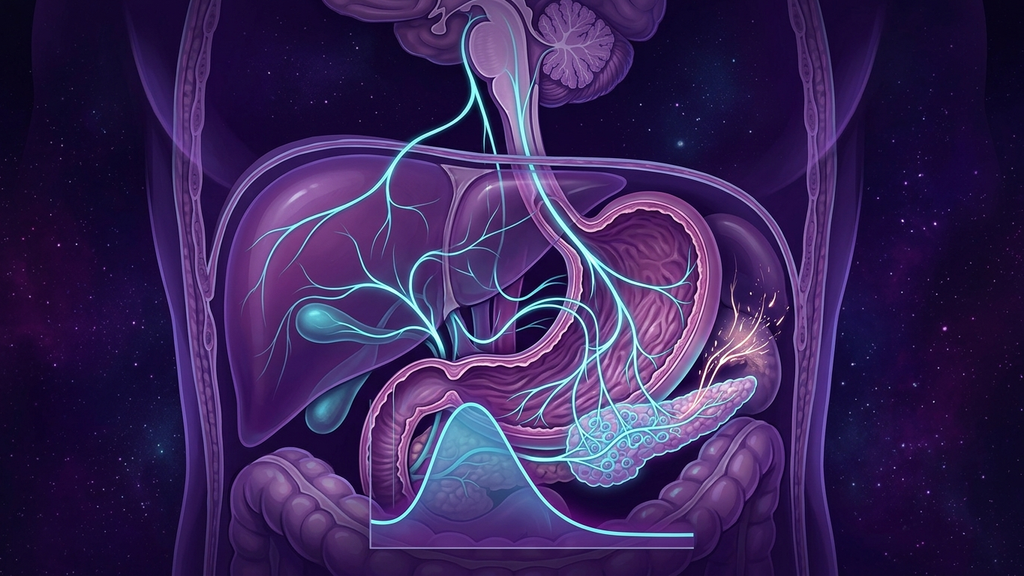
A patient comes in convinced she is hypoglycemic. Ninety minutes after lunch she goes shaky, her heart pounds, she sweats, she gets a wave of doom that feels exactly like a panic attack, and a handful of crackers fixes it. Her fasting glucose is 88. Her HbA1c is 5.2. Every lab is boringly normal, so she is told it is anxiety and offered an SSRI. But the longer I work with these patients, the clearer it becomes: this is rarely a pancreas that cannot make insulin. It is a nervous system that has lost control of timing. Blood sugar stability is not just an endocrine achievement. It is an autonomic one — and the vagus nerve is the conductor.
The Cephalic Phase: You Secrete Insulin Before Food Arrives
Most people, including many clinicians, picture insulin release as a purely chemical event: glucose enters the blood, the pancreas detects it, insulin follows. That is only the second half of the story. The first half is neural. The moment you see, smell, taste, or even seriously anticipate food, the brain fires a pre-emptive command down the vagus nerve to the pancreatic beta cells. This is the cephalic phase of insulin release, and it is mediated by vagal-muscarinic signaling — acetylcholine released onto the islet, acting on M3 receptors, priming the beta cell to secrete before a single molecule of glucose has been absorbed.
The cephalic phase is small in absolute terms but large in consequence. It is the pancreas's head start. It pre-positions insulin so that when the glucose wave from the meal actually hits, the response is fast, proportional, and smooth. When vagal tone is strong, insulin arrives on time and the post-meal curve is a gentle hill. When vagal tone is blunted — and it is often blunted in chronic stress, dysautonomia, POTS, long COVID, ME/CFS, and after years of poor sleep — the cephalic phase weakens. The pancreas loses its head start. Now insulin has to be summoned reactively by rising glucose, which means it tends to arrive late and then overshoot. That single timing failure explains a large fraction of "blood sugar" symptoms in people whose fasting numbers are perfect.
The Vagus Sets the Steepness of the Curve
Insulin timing is only one of the vagal levers. The vagus also controls the rate at which the stomach hands food off to the small intestine, and gastric emptying rate is arguably the single biggest determinant of how steep your post-meal glucose spike is.
The vagus provides the parasympathetic drive that coordinates receptive relaxation, antral grinding, and the controlled opening of the pylorus. In a well-regulated system, the stomach meters carbohydrate into the duodenum at a steady trickle, and glucose enters the blood as a manageable stream. When vagal control of the stomach is erratic — common in autonomic dysfunction — emptying becomes unpredictable. Sometimes it is too fast: a bolus of carbohydrate dumps into the small intestine, glucose spikes sharply, and the beta cells respond with a large, delayed insulin surge. Sometimes it is too slow: food sits, emptying is unpredictable, and glucose and insulin fall out of sync in the other direction. The vagus, in other words, is not a bystander to the glucose curve. It draws it.
Two more vagal functions complete the picture. The vagus helps restrain hepatic glucose output — the liver's release of stored sugar between meals — and it modulates the secretion of the incretin and counter-regulatory hormones that fine-tune the whole system. When vagal signaling degrades, the liver's glucose release becomes less well-timed to actual need, and the buffering that normally smooths the troughs between meals is lost.
The Crash Is Adrenaline, and That Is Why It Feels Like Panic
Here is the mechanistic heart of the matter, the part that reframes everything for both coach and patient. When the post-meal insulin overshoot drives glucose down faster or lower than the brain will tolerate, the body does not wait patiently for balance. It triggers counter-regulation. The dominant counter-regulatory response to a fast glucose drop is a surge of adrenaline (epinephrine) and its sympathetic cousin noradrenaline.
Adrenaline mobilizes glucose from the liver — that is its job here — but adrenaline does not act only on the liver. It acts on the heart, the sweat glands, the vasculature, the smooth muscle of the airways, and the brain's threat circuitry. So the symptoms of a reactive glucose dip are, molecule for molecule, the symptoms of a panic attack, because they are produced by the same chemistry:
- Pounding or racing heart, palpitations, a skipped-beat sensation.
- Tremor, inner shakiness, weak legs.
- Sweating, flushing, a sudden feeling of overheating.
- A wave of anxiety or impending doom that arrives with no psychological trigger.
- Brain fog, difficulty finding words, derealization.
- Intense hunger — the "hangry" state — driven by the counter-regulatory alarm, not by true depletion.
This is why telling these patients their symptoms are "just anxiety" is both technically half-true and clinically unhelpful. Yes, adrenaline is driving the feeling. No, it is not primary anxiety. It is a physiological alarm triggered by a glucose curve the autonomic nervous system failed to shape. Address the vagal-metabolic timing and the "anxiety" often settles on its own.
The Dumping-to-Gastroparesis Spectrum
Autonomic patients frequently live somewhere on a spectrum bracketed by two gastric extremes, and both disrupt glucose stability in mirror-image ways.
At the fast end is dumping physiology: rapid gastric emptying delivers a carbohydrate bolus to the small intestine, producing an early, steep glucose spike followed by a brisk insulin surge and then a late reactive dip one to three hours later — the classic "late dumping" hypoglycemia. At the slow end is gastroparesis: delayed, erratic emptying means glucose absorption is unpredictable and poorly matched to insulin, producing highs and lows that seem to have no relationship to what or when the person ate. Many dysautonomia patients oscillate between the two, which is exactly why their glucose symptoms feel so chaotic and why a single dietary rule never quite works. The common denominator underneath both extremes is a vagus nerve that is no longer metering the stomach reliably.
Why the Labs Are Normal
The final piece of the puzzle for the frustrated patient: standard testing is built to catch endocrine disease, not autonomic mistiming. Fasting glucose and HbA1c describe the average and the baseline. They say nothing about the shape and velocity of the post-meal curve, which is where this entire problem lives. A person can have a flawless fasting glucose and a normal A1c while experiencing sharp post-meal spikes and reactive adrenaline crashes several times a day. Continuous glucose monitoring often reveals the pattern the snapshot labs miss — steep peaks, fast down-slopes, and symptomatic troughs — even when every value technically stays inside the "normal" band. The rate of change, not just the number, is what the nervous system reacts to.
Where Neuromodulation and Ultrasound Fit
Because this is fundamentally a vagal-timing problem, the most useful interventions are the ones that raise vagal tone and slow the glucose curve — and most of them are free.
Breathe before you eat
The cephalic phase depends on parasympathetic dominance at the moment of eating. Eating in a sympathetic ("fight or flight") state suppresses it. Two to three minutes of slow nasal breathing at roughly six breaths per minute with extended exhales, done before the first bite, shifts the autonomic balance toward the vagus precisely when the cephalic insulin signal needs to fire. This is one of the most underused metabolic levers I know of.
Walk after you eat
A ten-to-fifteen minute walk after meals is a double lever. Contracting muscle pulls glucose out of the blood through insulin-independent (GLUT4) transport, blunting the spike at the source, and gentle rhythmic movement supports vagal tone rather than adding the sympathetic load of sitting still while the curve climbs. This one habit flattens the post-meal peak more reliably than most supplements.
Sequence the plate
Eating protein, fat, and fiber before concentrated carbohydrate slows gastric emptying and lowers the steepness of the curve — working with the vagus's metering function instead of overwhelming it. It is a mechanical fix for a neural timing problem.
Hum, gargle, and immerse
The classic vagal maneuvers — humming, gargling, singing, and cold-water face immersion to trigger the dive reflex — all raise parasympathetic tone and, used consistently, help restore the baseline vagal drive this entire system depends on.
Measure with HRV
Heart rate variability is the most accessible proxy for vagal tone. Coaches can use it to track whether the nervous-system work is actually shifting the baseline over weeks, and patients can use it to see that the crashes track their autonomic state rather than their character.
The emerging tech
Transcutaneous auricular vagus nerve stimulation (taVNS) is being studied for metabolic effects, including glucose tolerance and insulin sensitivity, on the rationale that stimulating the vagal pathway directly may restore some of the timing this article describes. The early data is preliminary and the effect sizes are still being characterized, but the mechanism is coherent and the research is active. Low-intensity focused ultrasound aimed at peripheral autonomic and hepatic nerve targets is an even newer frontier — early work suggests ultrasound neuromodulation may influence glucose regulation non-invasively. Both should be framed honestly as emerging: promising mechanism, early human data, and effects we expect to see clarified over the coming years. For now, they complement — they do not replace — the breath, the walk, and the plate.
When to Get Evaluated
Reframing these symptoms as autonomic does not mean ignoring them. Get a proper clinical workup if any of the following are present: documented blood glucose below roughly 55 mg/dL during symptoms; fainting or true loss of consciousness; hypoglycemic symptoms while fasting or overnight (rather than only after meals); rapid unexplained weight loss; symptoms that persist or progress despite the measures above; or any personal or family history of diabetes. Whipple's triad — symptoms plus a low measured glucose plus relief on correction — is what genuinely distinguishes a hypoglycemic disorder from autonomic mistiming, and it deserves a physician's evaluation. And no reader should change or stop any prescribed medication, including diabetes medication, except in partnership with their own clinician.
Clinical takeaway: When a patient has textbook "blood sugar" symptoms — shaky, panicky, sweaty, foggy post-meal crashes — but normal fasting glucose and A1c, stop looking only at the pancreas and start looking at the vagus. The problem is usually the timing of insulin, gastric emptying, and hepatic glucose release, and the adrenaline surge that cleans up a mistimed curve is what your patient experiences as anxiety. Address vagal tone and curve steepness first — breath before meals, a walk after, protein-and-fiber-first sequencing, HRV tracking — and you often find the endocrine numbers were never the point.
References
- Ahrén B. "Autonomic regulation of islet hormone secretion — implications for health and disease." Diabetologia, 2000;43(4):393-410.
- Teff KL. "Visceral nerves: vagal and sympathetic innervation of the pancreas and cephalic phase insulin release." Journal of Neuroendocrinology, 2008;20(6):845-852.
- Power ML, Schulkin J. "Anticipatory physiological regulation in feeding biology: cephalic phase responses." Appetite, 2008;50(2-3):194-206.
- Rayner CK, Samsom M, Jones KL, Horowitz M. "Relationships of upper gastrointestinal motor and sensory function with glycemic control." Diabetes Care, 2001;24(2):371-381.
- Cryer PE. "Mechanisms of hypoglycemia-associated autonomic failure in diabetes." New England Journal of Medicine, 2013;369(4):362-372.
- Browning KN, Travagli RA. "Central nervous system control of gastrointestinal motility and secretion and modulation of gastrointestinal functions." Comprehensive Physiology, 2014;4(4):1339-1368.
- Pavlov VA, Tracey KJ. "The vagus nerve and the inflammatory reflex — linking immunity and metabolism." Nature Reviews Endocrinology, 2012;8(12):743-754.