Chronic Cough, Throat Clearing, and the Lump in the Throat: When the Larynx's Vagal Sensor Won't Reset
A cough that will not quit eight weeks after a cold. A throat that demands clearing every few minutes. A lump sitting just below the Adam's apple that a barium swallow, a laryngoscopy, and a chest CT all insist is not there. The conventional pathway sends these patients on a circuit — ENT, gastroenterology, pulmonology — and each specialist, finding no tumor, no asthma, no erosive esophagitis, discharges them with a shrug and a trial of acid suppression that rarely helps. The failure is not in the tests. It is in the frame. These are not diseases of the tissue. They are disorders of a sensory nerve that has forgotten how to calibrate, and that nerve is the vagus.
The Larynx Is Vagal Territory
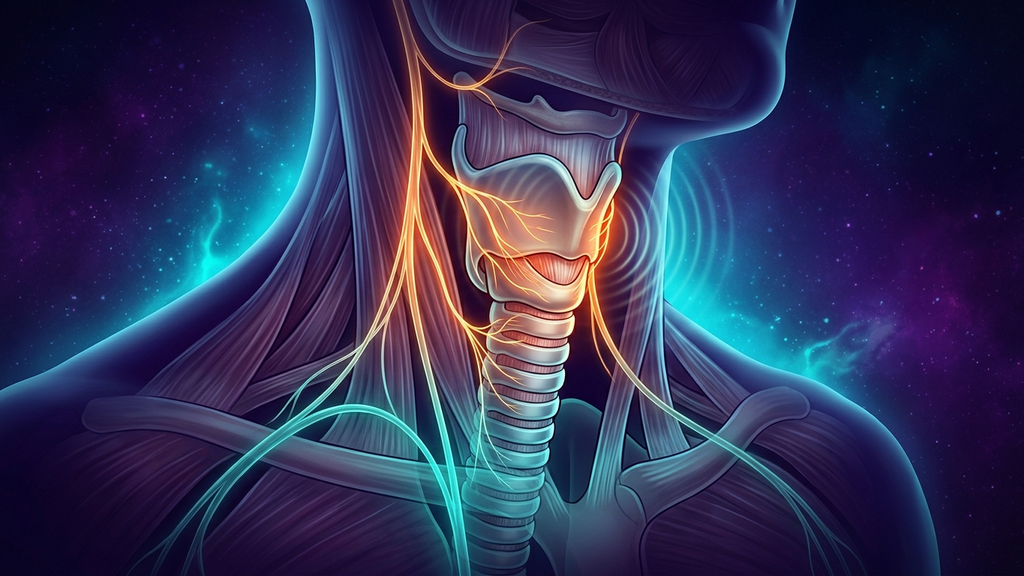
The larynx and the upper airway are among the most densely innervated sensory surfaces in the body, and almost all of that innervation is vagal. The superior laryngeal nerve, a branch of the vagus, carries sensation from the mucosa above the vocal folds and the epiglottis. The recurrent laryngeal nerve, also vagal, supplies sensation below the folds and motor control to nearly every intrinsic laryngeal muscle. This is not incidental anatomy. It means that the airway's tickle, the swallow reflex, the cough reflex, the protective closure of the glottis, and the tone of the voice-box muscles all ride on the same cranial nerve.
When you understand that the larynx is essentially a vagal sensory organ, the cluster of symptoms stops looking like four separate problems and starts looking like one: a single afferent system running too hot. The medical term now gaining traction for the cough version of this is cough hypersensitivity syndrome — the reframing of chronic refractory cough not as a symptom of an underlying lung or reflux disease, but as a disorder of the cough reflex itself, driven by hypersensitive vagal airway afferents.
Central Sensitization, but in the Airway
Chronic pain medicine crossed this bridge two decades ago. It abandoned the idea that persistent pain always means ongoing tissue damage and accepted that the nervous system can become sensitized — that the volume knob on a sensory pathway can be turned up and left there, so that innocuous input produces an outsized response. Fibromyalgia, irritable bowel, and chronic pelvic pain are all now understood partly through this lens of central sensitization.
Chronic cough and its cousins are the laryngeal-airway expression of the same phenomenon. The vagal sensory neurons that report from the airway — and their second-order neurons in the brainstem nucleus tractus solitarius — become hyperexcitable. Two things go wrong at once. There is peripheral sensitization: the airway afferents fire at thresholds that should be sub-threshold, so a whiff of cold air, an aerosol, perfume, laughing, or talking on the phone becomes a trigger. And there is central sensitization: the brainstem and its cortical projections amplify and sustain the signal, which is why these patients describe an almost irresistible urge-to-cough or urge-to-clear that feels like an itch they cannot reach. The parallel to allodynia in pain — where light touch hurts — is close, and clinicians have begun describing the throat version as laryngeal paresthesia or laryngeal hypersensitivity.
Post-Viral Vagal Neuropathy: How It Starts
Ask these patients when it began and a large fraction will tell you: after a bad cold, a flu, a bout of COVID, or a respiratory infection that seemed to resolve except that the cough or the throat sensation never fully left. This is post-viral vagal neuropathy, and it is the cleanest illustration of the mechanism. Many respiratory viruses have an affinity for nerve tissue and can inflame or injure the sensory branches of the vagus supplying the larynx and airway. The acute infection clears, but the afferent nerve stays sensitized — a neuropathy of the sensory vagus rather than an ongoing infection.
The result is a nervous system stuck in a protective posture it no longer needs. Talking triggers a cough. A change in air temperature triggers throat clearing. A tiny amount of laryngopharyngeal reflux — well within the range a normal larynx would ignore — triggers spasm. In its more dramatic form, the same sensitized reflex arc produces laryngospasm: a sudden, brief closure of the vocal folds that leaves the person unable to breathe in for several seconds. It is frightening and, in this context, almost always self-limited, but it convinces patients they are dying, which feeds the anxiety amplifier we will come to.
The Reflux-Cough-Vagus Triangle
Here is where conventional care most often goes wrong. A patient with chronic cough or globus is presumed to have reflux, prescribed a proton pump inhibitor, and — when it fails — told to double the dose. But in the sensitized phenotype, the problem is rarely the volume of acid. It is that the esophagus and the airway share a vagal reflex arc, and that arc has become hypersensitive.
The mechanism is the esophago-bronchial and esophago-laryngeal reflex: vagal afferents in the distal esophagus, when stimulated, drive vagal efferents to the airway, producing cough or laryngeal constriction. In a calibrated system, it takes a meaningful reflux event to trip this. In a sensitized system, a physiologic amount of reflux — or even esophageal distension from a swallow of air — is enough. This is why so many "reflux cough" patients have normal or near-normal acid exposure on pH testing and why acid suppression so often disappoints: you can neutralize the acid, but you have not touched the hypersensitive nerve carrying the signal. The reflux is real, but in this phenotype it is often the trigger, not the disease — and the disease is vagal. Whether to continue, adjust, or taper acid suppression is a decision to make with the prescribing clinician, not something to change on your own; it can still have a legitimate role for genuine tissue irritation, but it should not be expected, by itself, to reset a sensitized nerve.
Globus and the Upper Esophageal Sphincter
Globus — the persistent sensation of a lump or fullness in the throat with nothing physically there — is the same story told through muscle. The upper esophageal sphincter (the cricopharyngeus) is a vagally innervated ring of muscle at the top of the esophagus. Under sympathetic arousal and vagal dysregulation it tends to hold excess tone, and a sensitized laryngopharynx over-reports that tension as a foreign body. Globus classically improves with eating (the sphincter relaxes to swallow) and worsens with stress and with dry swallowing on an empty throat — a pattern that makes no sense for a tumor and perfect sense for a tension-plus-hypersensitivity loop. Reassurance that the scope is clear is necessary but insufficient; it does nothing to down-regulate the afferent.
The Anxiety and Laryngeal-Tension Amplifier
None of this is "in the head," but the head is genuinely part of the circuit. The urge to cough and the sense of a lump are consciously perceived, and the brainstem's cough pathway is heavily modulated by cortical and limbic input. Anxiety raises sympathetic tone, tightens the extrinsic laryngeal muscles, dries the mucosa, and lowers the threshold of the very afferents that are already sensitized. Each cough or throat-clear irritates the mucosa a little more and reinforces the reflex — a self-perpetuating loop where the behavior meant to relieve the sensation is what sustains it. Recognizing this lets a coach validate the patient's experience as real and physiological while pointing to a genuinely modifiable target: the autonomic state feeding the amplifier.
Recognizing the Phenotype
- Cough or throat symptoms that began after a viral illness and never fully cleared.
- Triggers that are sensory, not infectious: talking, laughing, cold air, aerosols, perfume, a change of position.
- Normal chest imaging, normal or non-erosive endoscopy, normal or near-normal pH testing — and no response to acid suppression.
- A dry, non-productive, "tickly" quality and an urge-to-cough or urge-to-clear that feels compulsive.
- Globus that improves with meals and worsens with stress.
- Frequently, other markers of autonomic dysregulation: low HRV, POTS, long COVID, anxiety.
Red Flags: When This Is Not the Diagnosis
Vagal hypersensitivity is a diagnosis reached after dangerous disease has been excluded, not instead of excluding it. Any of the following warrants prompt medical evaluation before assuming a sensitized reflex: coughing up blood (hemoptysis), unexplained weight loss, a current or former smoker with a new or changed cough, stridor or noisy breathing, difficulty or pain on swallowing with food sticking, a neck mass, hoarseness persisting beyond three to four weeks, or any cough lasting more than eight weeks that has not been properly assessed. Laryngospasm that does not self-resolve in seconds, or is accompanied by true sustained breathing difficulty, is an emergency. The reframe in this article applies only once these have been ruled out by a clinician.
Where Neuromodulation and Ultrasound Fit
If the lesion is a sensitized sensory vagus, the logical treatment is to re-regulate that nerve rather than chase phantom acid or infection. Several approaches, from free to emerging, converge on that target.
Breathing and laryngeal-control retraining
Structured breathing and laryngeal-control therapy — the speech-pathology intervention with the best evidence base for refractory chronic cough — teaches patients to interrupt the cough reflex, reduce laryngeal muscle tension, and re-establish nasal, diaphragmatic breathing. Slow breathing at roughly six breaths per minute with extended exhales raises vagal parasympathetic tone and lowers the sympathetic arousal feeding the amplifier. This is the cornerstone, and it is something a coach can teach directly.
Humming, gentle voicing, and the dive reflex
Humming, gentle sustained vowels, and controlled gargling engage the laryngeal musculature under low, deliberate load, helping down-regulate the guarding tension behind globus while gently exercising vagal motor output. Cold-water face immersion recruits the diving reflex — a parasympathetic response mediated partly through the trigeminal and vagal pathways — and can serve as a rapid reset for an over-aroused system between episodes.
Direct vagal neuromodulation and ultrasound
The emerging frontier targets the vagus directly. Transcutaneous auricular vagus nerve stimulation (taVNS), applied at the auricular branch of the vagus in the ear, is being studied as a non-invasive way to modulate central afferent processing and is a rational candidate for cough hypersensitivity, though the trial data here is still early. Further out, low-intensity focused ultrasound aimed at the cervical vagus is being explored as a way to non-invasively and reversibly modulate vagal excitability. In this population the goal would be to calm an over-sensitized afferent pathway rather than to drive it — an approach still in early investigation, but mechanistically aligned with the problem. We expect the evidence here to mature over the coming years. For now, breathing retraining and autonomic down-regulation are what a coach applies today; the technology is the direction of travel.
Clinical takeaway: Chronic cough, relentless throat clearing, globus, and laryngospasm are best understood as vagal sensory hypersensitivity syndromes — cousins of central sensitization expressed through the airway's vagal afferents, often ignited by a virus. Once red flags are excluded, stop treating them as acid, infection, or lung disease and start treating the nerve: down-regulate the sensitized vagal reflex arc with breathing retraining, laryngeal-control work, and autonomic calming, with taVNS and focused ultrasound as the emerging tools on the same target.
References
- Morice AH, Millqvist E, Bieksiene K, et al. "ERS guidelines on the diagnosis and treatment of chronic cough in adults and children." European Respiratory Journal, 2020;55(1):1901136.
- Chung KF, McGarvey L, Mazzone SB. "Chronic cough as a neuropathic disorder." The Lancet Respiratory Medicine, 2013;1(5):414-422.
- Mazzone SB, Undem BJ. "Vagal afferent innervation of the airways in health and disease." Physiological Reviews, 2016;96(3):975-1024.
- Rees CJ, Henderson AH, Belafsky PC. "Postviral vagal neuropathy." Annals of Otology, Rhinology & Laryngology, 2009;118(4):247-252.
- Vertigan AE, Theodoros DG, Gibson PG, Winkworth AL. "Efficacy of speech pathology management for chronic cough: a randomised placebo controlled trial of treatment efficacy." Thorax, 2006;61(12):1065-1069.
- Lee B, Woo P. "Chronic cough as a sign of laryngeal sensory neuropathy: diagnosis and treatment." Annals of Otology, Rhinology & Laryngology, 2005;114(4):253-257.
- Yuan H, Silberstein SD. "Vagus nerve and vagus nerve stimulation, a comprehensive review: Part I." Headache, 2016;56(1):71-78.