Swallowing Difficulty and the Vagus: When the Throat Reports Autonomic Trouble
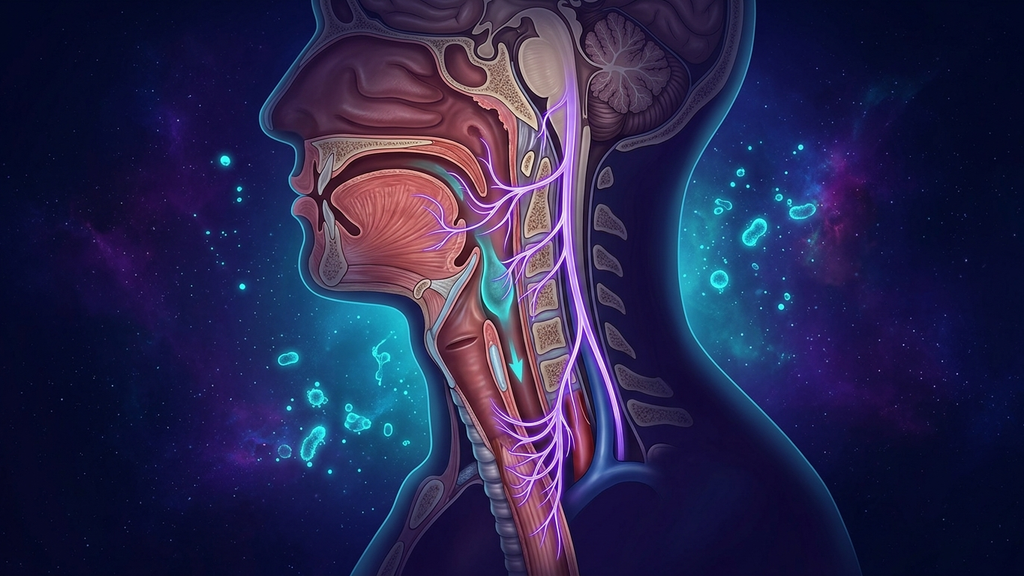
"Swallowing problems." "Discomfort swallowing." "A lump that won't clear." These show up in intake more often than most practitioners expect, frequently alongside anxiety and reflux. When structural and neurological workups come back clean — no stricture, no mass, no motor neuron disease — clients are often told the problem is "just anxiety." That dismissal misses the mechanism. The vagus nerve is the master controller of swallowing, and dysregulated vagal function produces very real swallowing dysfunction.
The Vagus Runs the Swallow
Swallowing is a remarkably complex reflex, coordinating dozens of muscles in precise sequence, and the vagus nerve is central to it. Its pharyngeal and laryngeal branches supply the muscles of the pharynx and upper esophagus, and it carries the sensory information that triggers and shapes the swallow. The upper esophageal sphincter, which must relax at exactly the right moment, is under vagal control. When vagal signaling is disrupted, the timing and coordination of the swallow degrade — even when every structure is anatomically normal.
Globus: The Lump That Isn't There
The classic presentation is globus sensation — the persistent feeling of a lump or tightness in the throat with nothing physically present. It is real perception, not imagination. Two mechanisms combine: heightened sensory afferent signaling from the throat (an over-sensitive vagal report), and increased tension in the upper esophageal sphincter and pharyngeal muscles driven by sympathetic arousal. A client in a chronic guarded state literally holds tension in the throat, and the vagus reports that tension as an obstruction.
The Reflux and Anxiety Overlap
Swallowing difficulty rarely travels alone. It clusters with reflux — because the same vagal control governs esophageal motility and the lower sphincter — and with anxiety, because the throat is exquisitely sensitive to autonomic state. This triad points back to a shared root: dysregulated vagal function. Treating each symptom separately, as most clients have already tried, misses the common driver.
An Autonomic Approach to the Throat
- Rule out structure first. Genuine mechanical and neurological causes must be excluded — this framing applies to functional dysphagia and globus, not to red-flag presentations (progressive dysphagia, weight loss, aspiration), which need urgent workup.
- Down-regulate before the swallow. Slow exhale-biased breathing before meals shifts autonomic state and reduces pharyngeal guarding.
- Use the vagus directly. Humming, gargling, and gentle vocal work stimulate the pharyngeal branches and can retrain coordinated function. For persistent cases, non-invasive vagus nerve stimulation and focused ultrasound neuromodulation target the pathway more directly.
- Address the cluster together. Because reflux, globus, and anxiety share the vagal root, treating autonomic regulation as the central intervention tends to move all three.
Clinical takeaway: Functional swallowing difficulty and globus are vagal, not imaginary. Once red flags are excluded, treat the throat as an autonomic organ — down-regulate arousal, stimulate the vagal pathway directly, and address the reflux-anxiety cluster as one problem with a shared root.
References
- Jones B et al. "Neurophysiology of swallowing." Dysphagia, 2018;33(1):1-10.
- Lee BE, Kim GH. "Globus pharyngeus: a review of its etiology, diagnosis and treatment." World Journal of Gastroenterology, 2012;18(20):2462-2471.
- Ludlow CL. "Central nervous system control of voice and swallowing." Journal of Clinical Neurophysiology, 2015;32(4):294-303.
- Kahrilas PJ et al. "Esophageal motility disorders in terms of pressure topography." Journal of Clinical Gastroenterology, 2008;42(5):627-635.