Neuroinflammation and the Vagal Off-Switch: What Microglia Have to Do With Brain Fog
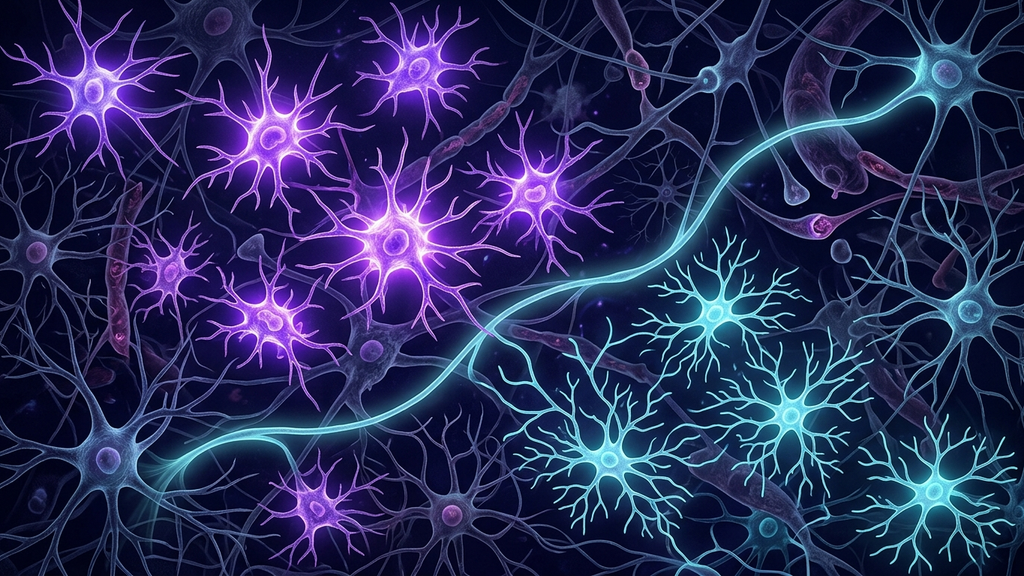
When a client describes brain fog, unrefreshing sleep, low mood, and a body that feels "sick without being sick," the most useful frame is often neuroinflammation. It is one of the largest content gaps in patient-facing education despite being central to nearly every chronic condition in the intake data — long COVID, ME/CFS, chronic pain, depression, autoimmune disease. And it connects directly to the vagus nerve, which is why it belongs in a practitioner's toolkit.
The Brain's Resident Immune Cells
Microglia are the immune cells of the central nervous system. In their resting state they surveil, prune synapses, and support neurons. When they detect a threat — infection, injury, systemic inflammation, chronic stress — they shift to an activated state, releasing inflammatory cytokines. This is protective in the short term. The problem is when they fail to stand down and settle into chronic low-grade activation.
Chronically activated microglia degrade the very tissue they are meant to protect: they impair synaptic function, disrupt neurotransmitter metabolism (notably shunting tryptophan away from serotonin toward the kynurenine pathway), reduce neuroplasticity, and raise the metabolic cost of normal neural activity. The felt result is exactly the symptom cluster clients report — fog, fatigue, anhedonia, and hypersensitivity.
How Body Inflammation Reaches the Brain
Peripheral inflammation communicates with the brain through several routes, and the vagus is a key one. Vagal afferents act as an inflammation sensor: they detect cytokines in the periphery and relay that signal to the brainstem, which can then generate "sickness behavior" — the withdrawal, fatigue, and cognitive slowing that normally accompany fighting an infection. When peripheral inflammation is chronic, this sickness signal never turns off.
The Cholinergic Anti-Inflammatory Pathway
Here is why the vagus is not just a sensor but a treatment target. The efferent vagus drives the cholinergic anti-inflammatory pathway: acetylcholine released onto immune cells suppresses pro-inflammatory cytokine production. A well-toned vagus actively dampens inflammation; a poorly toned one lets it run. This is the mechanistic basis for vagus nerve stimulation as an anti-inflammatory intervention, and it applies centrally as well as peripherally.
Practical Levers for Quieting Neuroinflammation
- Vagal tone restoration — breath work, and for stubborn cases non-invasive or focused-ultrasound vagal stimulation, to engage the cholinergic anti-inflammatory pathway.
- Sleep — the glymphatic system clears inflammatory metabolites during deep sleep; without it, microglia stay activated.
- Metabolic support — omega-3 fatty acids (resolvins actively terminate inflammation), and glycemic stability to avoid feeding the fire.
- Address the source — chronic infection, gut permeability, and unresolved autoimmune activity keep the peripheral signal alive; quieting microglia downstream while ignoring the upstream source is a losing battle.
- Photobiomodulation — transcranial near-infrared light has preliminary evidence for shifting microglia toward a resting phenotype and supporting mitochondrial function in neurons.
Clinical takeaway: Brain fog with fatigue and mood change is often neuroinflammation, not a psychological state. The vagus nerve is both the sensor that reports peripheral inflammation and, via the cholinergic anti-inflammatory pathway, one of the few switches that can turn it down. Treat the source, restore vagal tone, protect sleep.
References
- Tracey KJ. "The inflammatory reflex." Nature, 2002;420(6917):853-859.
- Pavlov VA, Tracey KJ. "The vagus nerve and the inflammatory reflex—linking immunity and metabolism." Nature Reviews Endocrinology, 2012;8(12):743-754.
- Dantzer R et al. "From inflammation to sickness and depression: when the immune system subjugates the brain." Nature Reviews Neuroscience, 2008;9(1):46-56.
- Salter MW, Stevens B. "Microglia emerge as central players in brain disease." Nature Medicine, 2017;23(9):1018-1027.