The Pelvic Floor Is an Autonomic Organ: Rethinking Pelvic Dysfunction
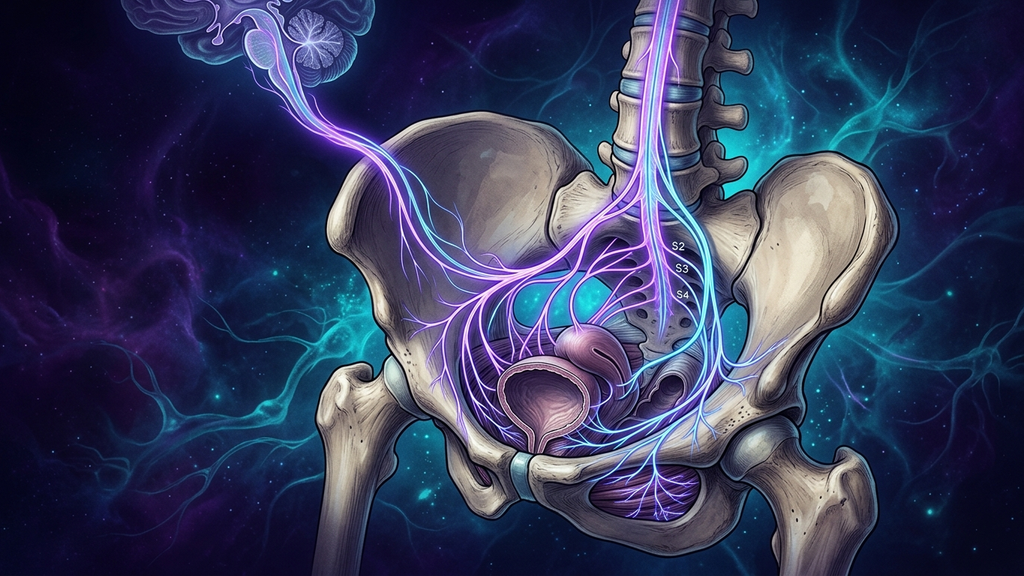
Pelvic floor dysfunction, pelvic pain, and the overlap with IBS and anxiety appear repeatedly in intake — often in clients who have already tried pelvic floor physical therapy with only partial relief. The reason is that the pelvic floor is not merely a muscular hammock. It is deeply autonomic tissue, and a pelvic floor that will not release is frequently reporting the state of a nervous system that will not stand down.
Why the Pelvic Floor Mirrors Autonomic State
The pelvic floor is unusual: it is under both voluntary and autonomic control, and it participates in the body's defensive posture. When the sympathetic nervous system is chronically activated — the "guarded" state so many clients live in — the pelvic floor guards with it, holding tension the client cannot consciously find or release. This is why cueing someone to "relax" the pelvic floor so often fails: the muscle is obeying a threat signal that operates below voluntary access.
The Sacral and Vagal Connections
Two neural systems matter here. The sacral parasympathetic outflow supplies the bladder, bowel, and sexual organs and governs their "rest and eliminate" functions. The vagus, while it does not directly innervate the pelvic floor muscles, sets the global parasympathetic tone that permits those sacral functions to operate normally. When overall autonomic tone is dominated by sympathetic drive, both the sacral system and the pelvic musculature are pushed out of their normal rhythm — producing the constellation of urgency, incomplete emptying, pain, and dysfunction.
The Bladder Clue
Overactive bladder, urinary urgency, and interstitial-type symptoms frequently travel with pelvic floor dysfunction, and they share the same autonomic root. A bladder that signals urgency when it is not full is a bladder receiving an amplified sympathetic threat signal. Treating the bladder in isolation misses the shared driver.
Why Purely Local Treatment Plateaus
Manual therapy, biofeedback, and down-training are valuable and often necessary — but they address the local expression while the systemic driver keeps re-arming the muscle. The clients who plateau are usually the ones whose autonomic state was never addressed. The pelvic floor cannot maintain a released state inside a body that is maintaining a defensive one.
An Integrated Approach
- Down-regulate the whole system first. Diaphragmatic, exhale-biased breathing links directly to pelvic floor tone — the diaphragm and pelvic floor move as a coordinated unit, and slowing the breath releases both while raising vagal tone.
- Restore vagal set-point. Breath practice, and for resistant cases non-invasive vagus nerve stimulation or focused ultrasound neuromodulation, to move the client out of chronic guard.
- Then do the local work. Manual release and biofeedback land far better once the systemic threat signal is lowered.
- Screen for the overlap conditions. IBS, anxiety, and trauma history are common companions and often share the autonomic driver — treating them in parallel accelerates the pelvic result.
Clinical takeaway: A pelvic floor that won't release is often reporting an autonomic state, not a local muscular fault. Down-regulate the whole nervous system — starting with the diaphragm-pelvic floor breathing unit — before or alongside local therapy, and the plateaus tend to break.
References
- Bharucha AE. "Pelvic floor: anatomy and function." Neurogastroenterology & Motility, 2006;18(7):507-519.
- Bo K et al. "An International Urogynecological Association / International Continence Society joint report on the terminology for the conservative management of pelvic floor dysfunction." Neurourology and Urodynamics, 2017;36(2):221-244.
- Hodges PW et al. "Postural and respiratory functions of the pelvic floor muscles." Neurourology and Urodynamics, 2007;26(3):362-371.
- Cyr MP et al. "Autonomic nervous system regulation in women with provoked vestibulodynia." Journal of Sexual Medicine, 2021;18(6):1097-1108.