Perimenopause as an Autonomic Event: Why Estrogen Withdrawal Reads as Vagal Withdrawal
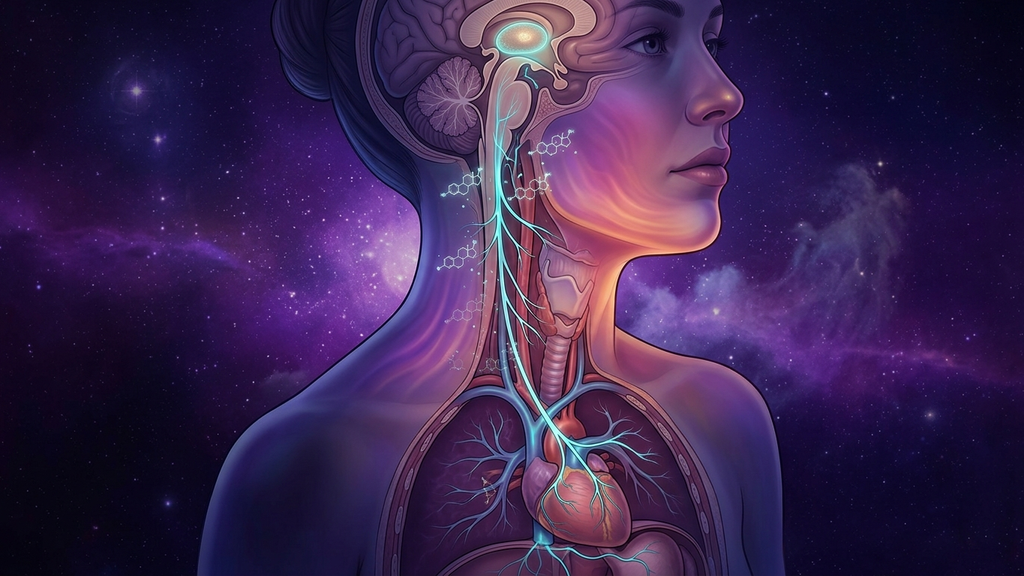
A woman in her late forties develops palpitations, air hunger, 3am waking drenched in sweat, a racing pulse when she stands, new bloating, and a wave of anxiety she has never felt before — all in the same eighteen months. She is told it is "just hormones," or "just anxiety," and offered an SSRI. Both answers are half-right and therefore misleading. The conventional frame treats perimenopause as an endocrine event: estrogen falls, symptoms follow, replace or wait it out. But that frame cannot explain why so many of these symptoms are autonomic — cardiovascular, thermoregulatory, respiratory, gastrointestinal. The missing frame is that estrogen was silently supporting vagal tone. Its withdrawal is a nervous-system transition as much as a hormonal one.
Estrogen Was Propping Up the Vagus
We rarely teach estradiol as a neuromodulator, but that is one of its central jobs. Estrogen receptors are expressed in the very structures that govern parasympathetic outflow: the nucleus tractus solitarius and dorsal motor nucleus of the vagus in the brainstem, the nucleus ambiguus (source of the cardioinhibitory vagal fibers), the hypothalamus, and the central arms of the baroreflex. Through these receptors, estradiol does several things at once. It supports cardiac vagal control, biasing the heart toward parasympathetic braking. It improves baroreflex sensitivity, the moment-to-moment reflex that adjusts heart rate to defend blood pressure when you stand. And it stabilizes central neurotransmission, favoring serotonergic and GABAergic tone while moderating noradrenergic drive.
Read that list again through an autonomic lens. Vagal braking of the heart, baroreflex defense of standing blood pressure, and inhibitory neurotransmitter tone are exactly the systems that keep a person feeling calm, grounded, and physically steady. Estrogen was subsidizing all three. When the subsidy is withdrawn — and, crucially, when it is withdrawn erratically during the perimenopausal transition rather than smoothly — the vagus loses a chronic supporter, and relative sympathetic dominance emerges by default. This is why the cluster of symptoms is not random. It is the predictable signature of vagal withdrawal.
Why the Transition Is Worse Than the Destination
Patients and clinicians often assume the hard part is low estrogen. In practice, the perimenopausal fluctuation is frequently more symptomatic than the stable low-estrogen state of late menopause. Estradiol in perimenopause does not glide downward; it swings — sometimes higher than premenopausal peaks, sometimes crashing within days. The autonomic nervous system is a control system tuned to a set point, and it tolerates a new stable set point far better than it tolerates volatility. Each estradiol swing is a perturbation the brainstem must re-accommodate. The result is an autonomic system that never settles: vagal tone that is present one week and diminished the next, a baroreflex whose gain keeps changing, a thermoregulatory center that cannot find its threshold.
This explains a clinical observation that puzzles many women: their symptoms are not a smooth decline but a chaotic, unpredictable ride, and they can feel almost normal for stretches and then destabilized without an obvious trigger. They are not imagining the inconsistency. They are living inside a control system being repeatedly knocked off its set point.
The Hot Flash Is an Autonomic Discharge, Not a Temperature
The vasomotor symptom — the hot flash — is the clearest window into the autonomic mechanism, and it is almost always taught wrong. A hot flash is not the body being "too hot." It is a narrowed thermoneutral zone at the level of the hypothalamus, coupled to a sympathetic thermoregulatory surge. Normally the brain tolerates a comfortable band of core temperature before it triggers cooling or shivering. In the estrogen-withdrawn brain, that band narrows dramatically — driven substantially by hyperactivity of KNDy neurons in the hypothalamus, which lose estrogen's restraining influence and appear to reset the thermoregulatory threshold. A small rise in core temperature that would previously be ignored now crosses the sweating threshold, and the hypothalamus fires a full autonomic cooling response: cutaneous vasodilation, sweating, and a sympathetically mediated surge in heart rate.
That heart-rate surge is why so many women describe a hot flash as a panic or a palpitation as much as a heat sensation. It is a sympathetic discharge with a vagal-withdrawal component, and the emotional coloring is generated by the same autonomic event, not layered on top of it. When it happens at night, the surge fragments sleep architecture and produces the classic 3am waking drenched in sweat — a nocturnal autonomic event, not simple insomnia.
Recognizing the Autonomic-Perimenopausal Phenotype
This phenotype has a recognizable clinical signature that a coach or clinician can learn to spot:
- New palpitations and a sense of a pounding or racing heart, often at rest or on standing, in a woman with a structurally normal heart.
- Orthostatic, "POTS-like" symptoms — lightheadedness, a racing pulse on standing, exercise intolerance — sometimes appearing for the first time in the mid-forties.
- Air hunger: the feeling of not getting a satisfying breath, which is a respiratory manifestation of sympathetic drive and a lowered tolerance for normal CO2.
- Hot flashes and night sweats tightly coupled to a racing pulse and a wave of dread.
- New-onset anxiety that feels physiologic and bottom-up rather than psychological, plus brain fog and word-finding lapses.
- New GI complaints — bloating, altered motility, reflux — reflecting the vagus's role in gut motility and gut-brain signaling.
- A measurable drop in heart rate variability (HRV) across the transition, which is perhaps the single most objective marker.
That last point deserves emphasis because it converts a "psychological" story into a measurable one. HRV, particularly its high-frequency (vagally mediated) component, tends to decline across the menopausal transition in longitudinal data. When a woman is told her symptoms are "just anxiety," her falling HRV is quietly documenting the vagal withdrawal that anxiety is often a consequence of, not the cause. Validating this is not soft reassurance; it is accurate physiology.
When to Get Evaluated: Red Flags First
Reframing symptoms as autonomic does not mean assuming everything is benign, and this must be said plainly. New palpitations warrant at least a baseline evaluation — an ECG and, where indicated, ambulatory monitoring and thyroid testing — to exclude arrhythmia and thyroid disease, both of which are common in midlife women and can masquerade as "perimenopause." Specifically, seek evaluation for: chest pain or pressure, especially with exertion; syncope or near-fainting, as opposed to lightheadedness; palpitations that are sustained, very fast, or associated with breathlessness; and any abnormal uterine bleeding — bleeding that is very heavy, prolonged, between periods, or after apparent menopause — which requires gynecologic assessment and is never to be dismissed as "just perimenopause." And if an SSRI or any other medication has been prescribed, the decision to start, continue, or change it belongs with the prescribing clinician; nothing here is a reason to alter a prescription on your own. The autonomic frame is an addition to good clinical evaluation, not a replacement for it.
Where Neuromodulation and Ultrasound Fit
If the mechanism is vagal withdrawal and sympathetic dominance, then the therapeutic leverage is anything that restores vagal drive — and here the news is genuinely encouraging, because the vagus is accessible from the outside. This is the level at which a coach can work.
Paced breathing
Slow breathing at roughly six breaths per minute, with exhales longer than inhales, is the most reliable non-invasive way to raise vagal activity acutely. It is not merely calming; paced respiration has been studied specifically for hot flashes, and while the early trials were promising, later controlled studies have been mixed — so it is fair to call it a plausible, low-risk tool rather than a proven cure for vasomotor symptoms. What is well established is its effect on raising HRV and shifting the autonomic balance toward the parasympathetic. For the perimenopausal phenotype this is close to a first-line practice: it directly opposes the sympathetic surge that drives both the palpitation and the flash.
HRV biofeedback
Structured HRV biofeedback — breathing at one's personal resonance frequency while watching the heart-rate oscillation grow — trains baroreflex gain, the exact reflex estrogen was supporting. Over weeks it can raise resting vagal tone and improve orthostatic tolerance, addressing the "POTS-like" complaints closer to their mechanism.
The dive reflex and cooling tools
Cold water on the face, particularly the forehead and the cheeks around the eyes, triggers the mammalian dive reflex — a hardwired vagal response that slows the heart within seconds. During an acute palpitation or a rising flash, this is a genuinely useful rescue tool, and it doubles as thermoregulatory cooling for the narrowed thermoneutral zone.
Humming, gargling, singing
The vagus innervates the larynx and pharynx; vocal-cord and soft-palate vibration engages these vagally innervated structures. Humming, chanting, or gargling for a few minutes is a low-effort daily practice that can nudge tone upward and gives an anxious nervous system something concrete to do.
Emerging tech: taVNS and low-intensity focused ultrasound
Two device-based approaches are worth watching, with honest framing. Transcutaneous auricular vagus nerve stimulation (taVNS) delivers mild electrical stimulation to the vagal branch in the outer ear (the cymba conchae) and is being studied for HRV improvement, mood, and autonomic regulation; the early data are promising, and the perimenopausal population is a logical future target, though it has not been specifically established there. Low-intensity focused ultrasound directed at the cervical or auricular vagus is the newer frontier — a non-invasive way to modulate the nerve without electrodes on the skin. The evidence base here is early: this is being studied, not established, and we expect the picture to clarify over the coming years. What both technologies share with breath and cold is a single logic — reach the vagus, restore parasympathetic tone, and let the autonomic system re-find its set point.
A Note on Hormone Therapy
None of this is an argument against hormone replacement therapy. For many women, addressing estradiol directly is a logical intervention precisely because estrogen was the upstream autonomic supporter, and the decision to use HRT — including timing, formulation, and personal risk — is an important conversation to have with a knowledgeable clinician. The autonomic tools described here are best understood as complementary: they work whether or not a woman uses HRT, they help during the erratic transition when hormones are hardest to stabilize, and they give her direct, daily agency over a nervous system that has felt out of her control. Framing it as either/or does women a disservice.
Clinical takeaway: Treat the midlife symptom cluster — palpitations, hot flashes, air hunger, insomnia, anxiety, brain fog — as an autonomic transition first, and a purely hormonal one second. Estrogen was supporting vagal tone and baroreflex sensitivity; its erratic withdrawal produces measurable vagal withdrawal and relative sympathetic dominance. Validate it with HRV, rule out the red flags, and coach the vagus back up with paced breathing, biofeedback, and the dive reflex — with HRT as a parallel clinician conversation, not a competitor.
References
- Thurston RC, Joffe H. "Vasomotor symptoms and menopause: findings from the Study of Women's Health Across the Nation." Obstetrics and Gynecology Clinics of North America, 2011;38(3):489-501.
- Freedman RR. "Menopausal hot flashes: mechanisms, endocrinology, treatment." Journal of Steroid Biochemistry and Molecular Biology, 2014;142:115-120.
- Rance NE, Dacks PA, Mittelman-Smith MA, Romanovsky AA, Krajewski-Hall SJ. "Modulation of body temperature and LH secretion by hypothalamic KNDy neurons: a novel hypothesis on the mechanism of hot flushes." Frontiers in Neuroendocrinology, 2013;34(3):211-227.
- Mercuro G, Zoncu S, Saiu F, Sarais C, Rosano GMC. "Menopause induced by oophorectomy reveals a role of ovarian estrogen on the maintenance of pressure homeostasis." Maturitas, 2004;47(2):131-138.
- Freedman RR, Woodward S. "Behavioral treatment of menopausal hot flushes: evaluation by ambulatory monitoring." American Journal of Obstetrics and Gynecology, 1992;167(2):436-439.
- Lehrer PM, Gevirtz R. "Heart rate variability biofeedback: how and why does it work?" Frontiers in Psychology, 2014;5:756.
- Yuan H, Silberstein SD. "Vagus nerve and vagus nerve stimulation, a comprehensive review: part I." Headache: The Journal of Head and Face Pain, 2016;56(1):71-78.