Sympathetic Lock: Why the Nervous System Gets Stuck in Fight-or-Flight
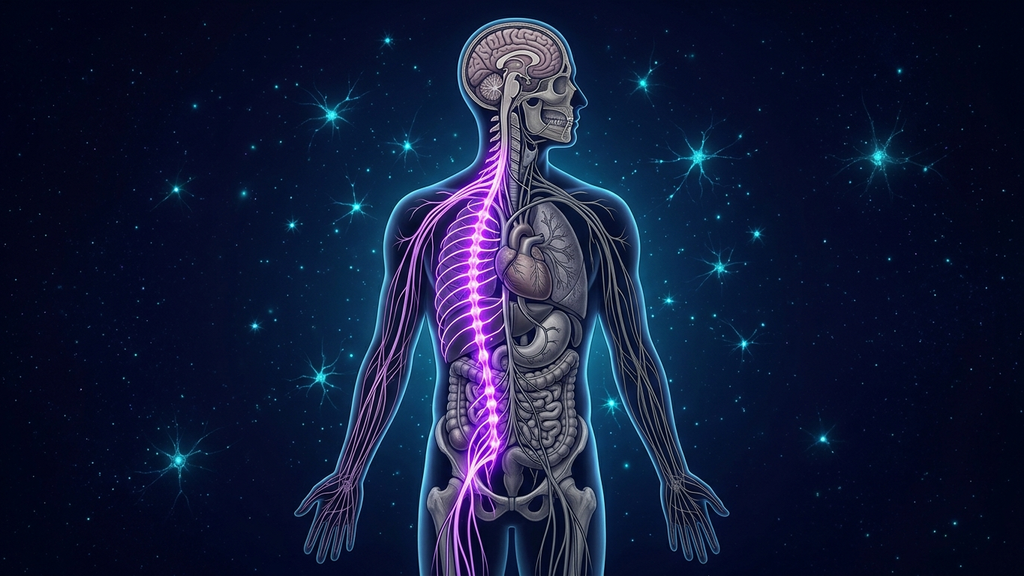
If you work with dysregulated patients, you already know the phrase before they say it: "I feel stuck in fight or flight." In our intake data it is the most frequent way people describe their own physiology — "sympathetic lock," "always on," "wired," "can't come down." For the practitioner, the useful move is to stop hearing this as an emotional complaint and start treating it as what it is: a failure of autonomic state-switching.
What "Stuck" Actually Means Physiologically
A healthy autonomic nervous system oscillates. It ramps sympathetic tone up to meet a demand, then hands control back to the parasympathetic branch — largely via the vagus nerve — once the demand passes. The clinical problem is not sympathetic activation itself. It is the failure to disengage it. The system loses the ability to return to baseline, and the patient lives in a chronically mobilized state.
This shows up in objective markers your clients can track: a resting heart rate that sits higher than it should, low heart rate variability (particularly a collapsed high-frequency band, which reflects vagal output), shallow high-thoracic breathing, cold hands and feet from peripheral vasoconstriction, and a startle response that fires too easily.
Why the Switch Fails
Three mechanisms tend to converge, and it helps to name which one dominates in a given client:
1. Reduced vagal brake
The vagus supplies the parasympathetic "brake" that decelerates the system. When vagal tone is low — from chronic stress, illness, inflammation, or trauma — the brake is weak even when the accelerator eases off. The patient cannot downshift because the downshifting hardware is underpowered.
2. Interoceptive miscalibration
The brain predicts danger based partly on signals from the body. When those afferent signals are noisy or misread — common in trauma and in conditions like POTS or MCAS — the brain keeps issuing a threat forecast, and sympathetic output follows the forecast, not the reality.
3. Bioenergetic cost of standing down
Returning to and maintaining a calm parasympathetic state is not free. It requires cellular energy. In a patient whose mitochondria are already depleted, "rest and digest" is metabolically expensive, and the system defaults to the cheaper, more primitive mobilized state.
A Practitioner's Sequence for Unlocking It
Order matters. Trying to teach a deeply sympathetic-dominant client to "relax" before restoring the machinery of relaxation is why so many interventions stall.
- Restore the afferent safety signal first. Slow exhale-biased breathing (inhale 4, exhale 8), humming, and cold-water face immersion all stimulate vagal afferents directly. These are not relaxation exercises — they are inputs to the brainstem.
- Add mechanical vagal input. Non-invasive cervical or auricular vagus nerve stimulation, and increasingly low-intensity focused ultrasound neuromodulation, can shift measured HRV within a single session. For clients who "can't meditate their way out," this gives the brake external assistance.
- Rebuild the energy budget. Sleep, protein, magnesium, and gentle mitochondrial support so that maintaining a calm state stops being metabolically unaffordable.
- Then, and only then, train the pattern. Once the hardware responds, repetition builds the new default. This is where breath work, graded exposure, and interoceptive training earn their keep.
What to Tell the Client
The reframe is therapeutic in itself. A client who believes they are anxious by character is fighting their identity. A client who understands they have a physiological switch that is temporarily jammed — and that the switch can be serviced — has a problem, not a flaw. That shift alone lowers sympathetic drive.
Clinical takeaway: "Stuck in fight or flight" is a vagal-brake and bioenergetic problem masquerading as a personality trait. Don't start with relaxation training. Start by restoring the afferent safety signal and the energy to hold a calm state, then train the pattern.
References
- Porges SW. "The polyvagal theory: neurophysiological foundations of emotions, attachment, communication, and self-regulation." W.W. Norton, 2011.
- Thayer JF, Lane RD. "Claude Bernard and the heart-brain connection: further elaboration of a model of neurovisceral integration." Neuroscience & Biobehavioral Reviews, 2009;33(2):81-88.
- Shaffer F, Ginsberg JP. "An Overview of Heart Rate Variability Metrics and Norms." Frontiers in Public Health, 2017;5:258.
- Badran BW et al. "Neurophysiologic effects of transcutaneous auricular vagus nerve stimulation." Brain Stimulation, 2018;11(3):492-500.