Tau Protein as the Quantum Bridge Between Microtubules and Consciousness
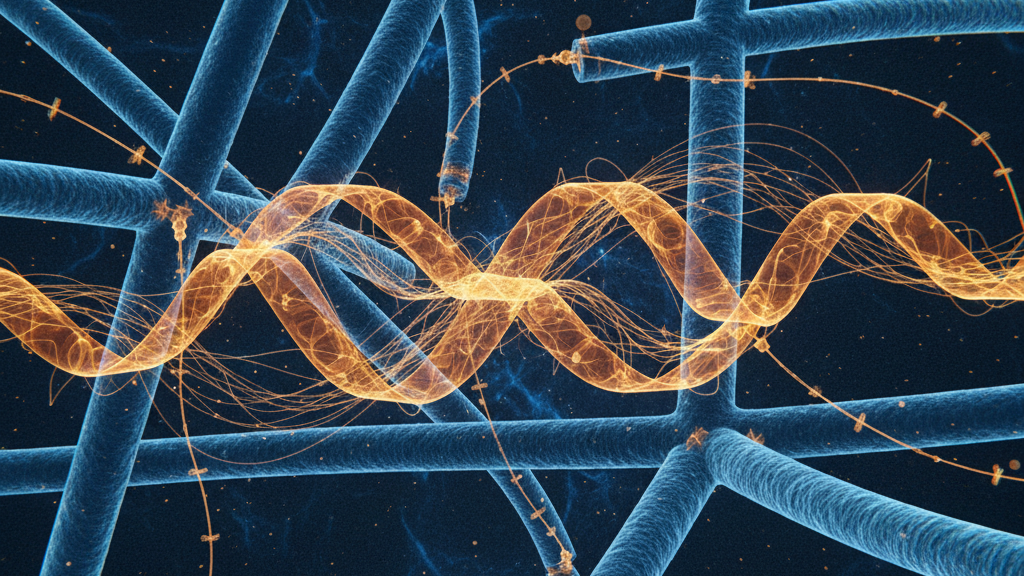
Tau is one of the most studied — and most misunderstood — proteins in neuroscience. Its public face is pathological: the hyperphosphorylated tangles that scar the Alzheimer's brain. Its day job, however, is quietly indispensable. Tau binds along the outside of axonal microtubules, stabilizing them, regulating their assembly, and orchestrating axonal transport. If you take Orch-OR seriously and treat microtubules as the cellular substrate of consciousness, tau becomes the molecule that decides when, where, and how that substrate functions.
Tau in Health
Tau is a microtubule-associated protein (MAP) — one of several proteins that bind to microtubules and modulate their behavior. It is most abundant in axons, where microtubules are unusually stable and unusually long. Tau:
- Stabilizes microtubules by binding to the outside of the tubulin lattice
- Spaces microtubules apart so that motor proteins can carry cargo between them
- Regulates the rate of polymerization and depolymerization at microtubule ends
- Contains long intrinsically disordered regions (IDRs) that are flexible, dynamic, and unusually electrically active
That last property is where tau becomes interesting beyond its structural role. IDRs do not have a fixed shape; they sample a broad range of conformations on millisecond timescales. They can act as antennae, as connectors, and — possibly — as quantum interfaces between adjacent microtubule segments.
Phosphorylation as the Master Switch
Tau's behavior is governed by phosphorylation. Healthy tau carries 2–3 phosphate groups; in Alzheimer's, this rises to 7–10 or more. Phosphorylation:
- Changes tau's affinity for microtubules — heavily phosphorylated tau detaches
- Promotes tau's self-aggregation into fibrils
- Releases microtubules to disassemble, collapsing axonal transport
- Shifts the conformational distribution of tau's IDRs in ways that may matter for any quantum signaling role they play
The Quantum-Bridge Hypothesis
If microtubules can sustain quantum-coherent states across short distances, the obvious next question is: how are those states coordinated between microtubules? Tau is the most natural candidate. Its IDRs span the gap between adjacent microtubules. Its conformational landscape is large enough to encode information. Its phosphorylation state is dynamically regulated by signals the neuron actually cares about.
On this view, tau is not just structural glue — it is a tunable bridge that gates which microtubule arrays are coherently coupled at any given moment. The phosphorylation state sets the bridge's "resistance," and normal neural signaling adjusts that resistance in real time as part of ordinary cognition.
"Tau is far more than a microtubule stabilizer. Its intrinsically disordered domains, its rapid post-translational regulation, and its location at the structural interface between adjacent microtubules make it uniquely positioned to act as a regulated communication element of the cytoskeleton." — Wang & Mandelkow, Nature Reviews Neuroscience, 2016
What This Reframes About Alzheimer's
If the quantum-bridge hypothesis is even partially right, Alzheimer's disease is not only a structural collapse — it is a decoherence disorder. Hyperphosphorylated tau is not merely failing to stabilize microtubules; it is also tearing down the regulated quantum coupling between them. Each tangle removes a chunk of the brain's coherent processing fabric. The cognitive decline becomes the surface signature of progressive loss of orchestrated coherence.
This reframing has practical implications. Most current Alzheimer's therapeutics target removal: clear amyloid, clear tangles, restore the structural picture. The decoherence framing suggests an additional approach: restore coherence in the microtubules that remain. That is a very different therapeutic target.
Therapeutic Permutations Worth Exploring
- Ultrasound-driven coherence restoration. If LIFU at the right frequency stabilizes microtubule quantum states, it could partially compensate for impaired tau function, even without removing existing tangles. Early Alzheimer's mouse-model work with focused ultrasound is suggestive on exactly this point.
- Tau-state biomarkers. A blood biomarker that reports tau's phosphorylation distribution — not just total tau — would let us distinguish "structural collapse" from "regulatory dysfunction" early.
- Lifestyle interventions that target tau dynamics. Sleep, exercise, and ketogenic states all influence tau phosphorylation. The decoherence framing predicts these should matter not only for clearance but for ongoing cognitive resilience.
- Combined therapy. Removing existing tangles while simultaneously restoring coherence in surviving tissue is a more honest description of what a successful Alzheimer's therapy probably needs to do.
An Honest Caveat
The "tau as quantum bridge" picture is a hypothesis, not a settled finding. Tau's structural and regulatory roles are well established; its possible quantum-coherence role is not. But the hypothesis is concrete enough to test, and it changes how we think about both consciousness and neurodegeneration. That alone makes it worth holding seriously.
Further Reading
Wang Y. & Mandelkow E. (2016). Tau in physiology and pathology. Nature Reviews Neuroscience, 17, 5–21. doi:10.1038/nrn.2015.1