Overheating, Night Sweats, and Ice-Cold Hands: When the Autonomic Thermostat Fails
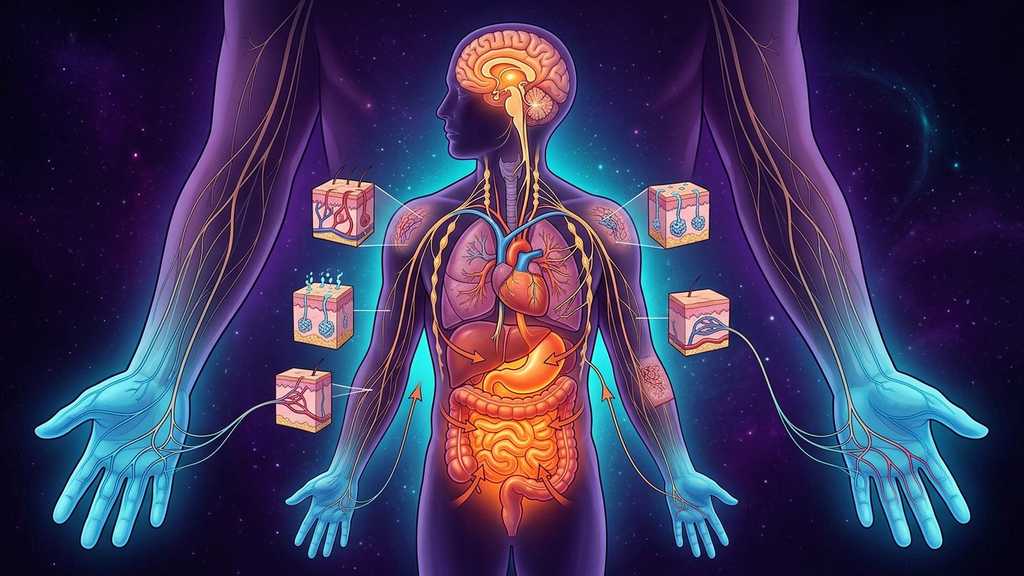
Almost every patient who tells me they "run hot" has already been worked up for the obvious things. Thyroid panel, normal. Perimenopause, maybe, but the timing doesn't fit. Infection, ruled out. They overheat in a mild room, sweat through the sheets at night, flush without warning — and yet their hands and feet are so cold their partner won't let them touch bare skin. Conventional medicine treats each of these as a separate complaint. It isn't. A hot core with cold extremities, heat intolerance, and abnormal sweating are one syndrome with one address: the autonomic thermostat. And the thermostat's balancing input — the brake that keeps the sympathetic effectors from running wild — is the vagus nerve.
Your Thermostat Is Autonomic, Not Metabolic
People assume body temperature is set by metabolism — how much heat you generate. Generation matters, but the tighter, faster control system is heat distribution and dissipation, and that is run almost entirely by the autonomic nervous system. The preoptic area of the hypothalamus holds the set-point, comparing skin and core temperature against an internal reference. When core temperature drifts, the hypothalamus doesn't change your metabolism first. It changes where your blood goes and whether you sweat.
Both of those are effector functions of the sympathetic nervous system. Skin blood flow is governed by sympathetic vasoconstrictor fibers (noradrenergic) and, in humans, a separate active vasodilator system. Sweating is sudomotor — sympathetic fibers that are unusual in being cholinergic rather than adrenergic; they release acetylcholine onto eccrine glands. So the entire output arm of temperature control is sympathetic. The question is what keeps that sympathetic output proportional to the actual thermal load. That is where autonomic balance, and the vagus, enter.
The Vagus Is the Balancing Input
The vagus nerve is the great parasympathetic brake. It doesn't directly dilate skin vessels or trigger sweat, but it sets the tonic background against which the sympathetic thermoregulatory effectors operate. High vagal tone means a calm, well-damped autonomic system: sympathetic outflow rises smoothly when you need to shed heat and falls back when you don't. Low vagal tone means a system that overshoots and undershoots — the thermostat with a sticky relay.
Roughly eighty percent of vagal fibers are afferent, carrying information from the body to the brainstem, including thermal and cardiovascular signals that feed the hypothalamic and insular circuits building your sense of how hot you are. This is why vagal collapse produces both an effector problem (poor heat dumping, erratic sweating) and a perceptual problem (feeling scorching when your skin is cool). Heart rate variability, the beat-to-beat variation driven largely by vagal modulation of the sinoatrial node, is our best non-invasive readout of this brake. In dysautonomia, HRV is often low — and thermoregulation is one of the first systems to show it.
The Narrowed Thermoneutral Zone
A healthy autonomic system maintains a wide thermoneutral zone — a range of ambient temperatures across which you stay comfortable with only minor vasomotor adjustments and no sweating or shivering. In dysautonomia, that zone collapses. The band between "too cold" and "too hot" narrows to a few degrees. A room that feels fine to everyone else pushes the patient straight into maximal vasodilation and sweating, or straight into vasoconstriction and cold, clammy extremities, because there is no smooth middle gear left. This is the core mechanism behind heat intolerance in POTS, long COVID, and ME/CFS: not that the body generates too much heat, but that it has lost the graded control that keeps small thermal challenges from becoming full-blown autonomic events.
The Paradox: Hot Core, Cold Hands
The complaint that most confuses patients — and most clinicians — is boiling in the chest and face while the hands and feet are ice-cold. It sounds contradictory. Mechanistically it is the same event viewed at two ends of the body.
The hands, feet, nose, and ears are dominated by arteriovenous anastomoses — direct shunts between arteries and veins that are exquisitely sensitive to sympathetic vasoconstrictor tone. When sympathetic drive is high (chronic stress, standing intolerance, the hyperadrenergic state common in POTS), these shunts clamp down and peripheral blood flow falls, leaving extremities cold and often mottled. That same blood is redirected centrally. The core stays warm — sometimes uncomfortably so — and the face, richly supplied and prone to active vasodilation, flushes. So the patient experiences a hot, flushed center and freezing periphery simultaneously, driven by one thing: a sympathetically over-constricted skin circulation with the vagal brake too weak to modulate it. It is not poor circulation in the plumbing sense. It is a control-system problem.
Abnormal Sweating: Too Much and Too Little
Sudomotor dysfunction cuts both ways, and patients often have both. Some sweat torrentially — drenching night sweats, sweat that pours with minimal exertion — because sympathetic-cholinergic outflow to the sweat glands is disinhibited. Others sweat too little (hypohidrosis or patchy anhidrosis), which is common in autonomic neuropathies and a well-documented finding in some long-COVID and small-fiber-neuropathy patients. Reduced sweating is dangerous precisely because sweating is the body's main tool for dumping heat by evaporation; lose it and heat intolerance worsens sharply. Many patients have a mosaic — anhidrotic in some regions, hyperhidrotic in others — which is a signature of patchy small-fiber and autonomic-fiber involvement. Night sweats in this population are frequently autonomic: a nocturnal shift in the balance of vagal and sympathetic activity mistimed against the natural drop in core temperature during sleep.
When the Brain Feels Heat That Isn't There
Not all overheating is in the effectors. Because the insular cortex constructs the felt sense of body temperature from interoceptive afferents — many carried by the vagus and spinothalamic pathways — a miscalibrated interoceptive system can make a patient feel intensely hot when skin and core temperatures are objectively normal. This interoceptive misreporting is real suffering, not imagination, and it explains why some patients feel they are burning up while a thermometer and an infrared skin reading say otherwise. It also explains why interventions that retrain interoception and raise vagal tone — slow breathing, cold-water face exposure — can reduce the sensation of overheating even before the effector arm fully recovers.
How to Recognize the Autonomic-Thermostat Phenotype
- Heat intolerance out of proportion to fitness or environment; a small, narrow comfortable temperature band.
- Cold hands and feet — often blue, white, or mottled — coexisting with a hot, flushed core or face.
- Night sweats without an infectious source or a positive malignancy workup, and without measured fever.
- Sweating that is excessive, patchy, or conspicuously absent in some regions.
- Dizziness or palpitations on standing, worse in the heat or after hot showers.
- Low resting HRV, and symptoms that flare with stress and standing, not just ambient heat.
When to Get Evaluated: Red Flags
Autonomic thermoregulatory dysfunction is common and generally benign to work up, but several conditions can mimic it and must be excluded. Drenching night sweats with unintentional weight loss, persistent fever, or new lymph node swelling require prompt evaluation for infection, lymphoma, and other malignancy. A measured fever is not autonomic dysregulation and needs its own workup. New heat intolerance with weight loss, tremor, and a racing heart warrants thyroid testing. And anyone in this phenotype should take genuine heat-exposure risk seriously: because heat dissipation is impaired, these patients are at elevated risk of heat exhaustion and heat stroke — confusion, fainting, a very high core temperature, or cessation of sweating in the heat is a medical emergency. None of the self-directed strategies below replace evaluation when these signs are present, and none of them involve starting, stopping, or changing a prescribed medication — that is a decision to make with your clinician.
Where Neuromodulation and Ultrasound Fit
Because the problem is autonomic balance, the leverage points are the ones that raise vagal tone and retrain vasomotor control — and none of them require touching a prescribed medication, which should only be adjusted with the patient's clinician.
1. Slow breathing to shift the balance
Breathing at approximately six breaths per minute with extended exhales is the most reliable, lowest-cost way to increase vagal modulation of the heart. It won't instantly recalibrate the thermostat, but done daily it raises the tonic parasympathetic background so sympathetic thermoregulatory output becomes less erratic. It also directly damps the interoceptive "I'm burning up" signal within minutes.
2. Measured cold exposure to retrain vasomotor tone
Cold-water face immersion — or simply pressing a cold, damp cloth over the forehead, cheeks, and eyes — triggers the diving reflex, a vagally mediated response that lowers heart rate and shifts balance toward parasympathetic dominance. Beyond the acute effect, brief, controlled cold exposure trains the vasomotor system to constrict and dilate on demand, which is exactly the graded control these patients have lost. The emphasis is on measured: in a heat-intolerant, orthostatically fragile patient, cold should be applied to the face and hands, not as whole-body plunges that can provoke a dangerous cardiovascular swing.
3. Humming, gargling, and singing
These recruit the vagally innervated muscles of the pharynx and larynx and are a gentle, accessible way to engage vagal pathways for patients too deconditioned for anything more demanding.
4. HRV biofeedback
Pairing slow breathing with real-time HRV feedback lets a patient — and their coach — see the vagal brake strengthen over weeks. Rising HRV in this population tends to track with a widening thermoneutral zone and fewer thermoregulatory crashes.
5. Emerging tech: taVNS and focused ultrasound
Transcutaneous auricular vagus nerve stimulation (taVNS), which delivers mild electrical stimulation to the vagal-innervated skin of the outer ear, is being studied for autonomic and inflammatory conditions, with early data suggesting it can raise vagal indices. Low-intensity focused ultrasound applied non-invasively to the cervical vagus is a newer approach under active investigation as a way to modulate autonomic tone with spatial precision. Both are early — being studied, not established for thermoregulation specifically — but the mechanistic rationale is sound, and we expect the evidence base to mature over the coming years. For now they are adjuncts to the breathing, cold, and biofeedback work, not replacements for it.
Clinical takeaway: Treat overheating, night sweats, flushing, and ice-cold extremities as one autonomic-thermostat problem — a narrowed thermoneutral zone with sympathetic effectors running unchecked because the vagal brake has weakened — not four unrelated symptoms. Rule out fever, weight loss, and thyroid disease first, respect the real heat-stroke risk, then coach the vagus back with slow breathing, measured facial cold exposure, HRV biofeedback, and, as the data matures, taVNS and focused ultrasound.
References
- Charkoudian N. "Skin blood flow in adult human thermoregulation: how it works, when it does not, and why." Mayo Clinic Proceedings, 2003;78(5):603-612.
- Morrison SF, Nakamura K. "Central mechanisms for thermoregulation." Annual Review of Physiology, 2019;81:285-308.
- Benarroch EE. "Thermoregulation: recent concepts and remaining questions." Neurology, 2007;69(12):1293-1297.
- Low PA, Tomalia VA, Park KJ. "Autonomic function tests: some clinical applications." Journal of Clinical Neurology, 2013;9(1):1-8.
- Shaffer F, Ginsberg JP. "An overview of heart rate variability metrics and norms." Frontiers in Public Health, 2017;5:258.
- Yuan H, Silberstein SD. "Vagus nerve and vagus nerve stimulation, a comprehensive review: Part I." Headache, 2016;56(1):71-78.
- Fudim M, Qadri YJ, Waldron NH, et al. "Autonomic dysfunction and post-acute sequelae of SARS-CoV-2." Circulation Research, 2022;131(1):e29-e33.